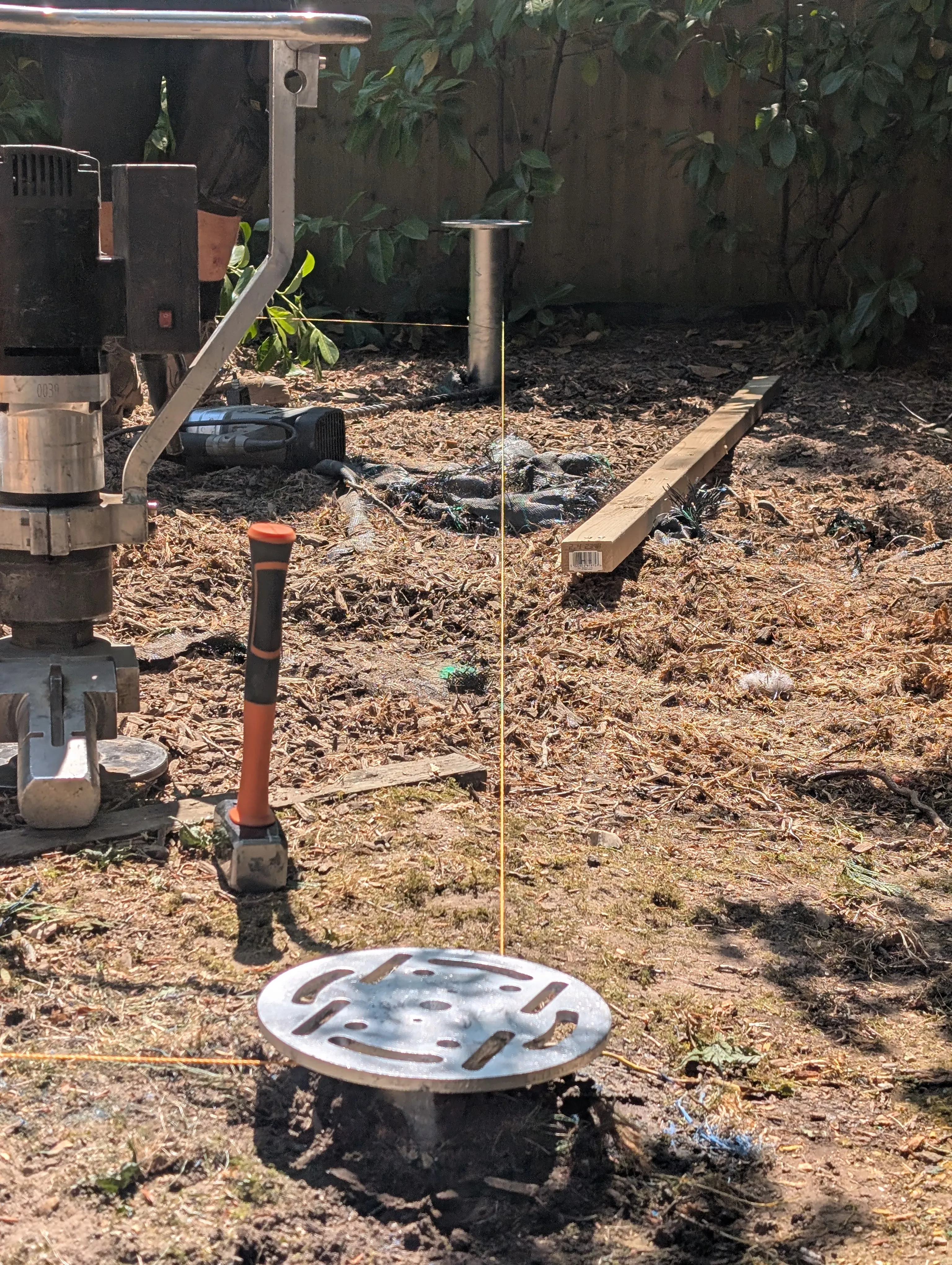
Ground screw testing in Castle Cary
Ask JustBases about standalone ground screw testing in Castle Cary and Ansford. We consider suitable trial screws, existing foundations and screws fitted by other installers, with the test chosen for the evidence your project needs.
Ground screw tests we offer
A physical test applies load to a screw and records its response. Upward, downward and sideways loading answer different questions, so the method needs to match the project's requirement. If you have been asked for a test without further detail, we can discuss the request before agreeing the scope.
Installation torque monitoring and specialist torsional testing are separate services. Monitoring records resistance while the screw is inserted; a torsional test applies an agreed twisting load. Both are price on application and neither is automatically part of a physical test booking.
Pull-out testing
A pull test applies tensile load upwards and records the support's response. It provides evidence for a requirement concerned with uplift, at the tested position and under the agreed loading arrangement.
Learn more: Pull-out testingCompression testing
A direct compression test pushes down on the screw and measures its movement under the applied load. Where applicable calculated compression evidence is proposed instead, its product, method and assumptions need to be identified; it is recorded as calculated evidence, not a direct downward measurement.
Learn more: Compression testingLateral testing
Lateral testing examines movement under a sideways load. The direction, loading point and connection arrangement form part of the agreed test, allowing the result to be considered against the relevant horizontal-load requirement.
Learn more: Lateral testingGround screw testing prices in Castle Cary
The guide rates identify the three physical test services separately. The written quotation establishes what will be tested, the number of positions, the setup and access arrangements, and the results or calculations commissioned for the project.
Please mention any required attendance, reporting deadline or test instructions when discussing the scope. Installation torque monitoring and specialist torsional testing each remain price on application, with their purpose and arrangements agreed individually.
Local guide prices start with our Ringwood prices, adding 0.1% for each one-way road mile to the town, then rounding up to a whole pound. Your written quotation confirms the price for your site and agreed work.
- Pull test (tensile or uplift test)
- From £502
- Load test (compression test)
- From £1,004
- Lateral test (sideways load)
- From £492
- Installation torque monitoring
- Price on application
- Specialist torsional load test
- Price on application
Each additional test
Each extra charge applies to an additional test of the same type, at the same location on the same day. The first test of each type is priced separately.
- Pull test (tensile or uplift test)
- £160 extra
- Load test (compression test)
- £320 extra
- Lateral test (sideways load)
- £155 extra
No VAT is added to the guide prices shown. Guide prices are subject to site conditions, access and the written quotation.
Ask about a ground screw test
A postcode and a short account of what you need to establish are enough to start. You can add photos, screw information or an existing test request if available; we can discuss the next steps without a complete brief.
Use the form, call 01202 039753 or message Craig on WhatsApp. Let us know if the enquiry concerns trial screws or an installed foundation, so we can begin with the relevant testing arrangements.
Request your free quote
Explain what you need to find out about the foundation. We can talk through the test you need.
Your enquiry
Ground screw testing in Castle Cary
Agreeing and carrying out your test
The useful starting point is the decision that the test will inform. We then establish the loading and practical setup required to obtain the evidence, and what will be supplied afterwards. Those details should be clear before the visit.
Define the evidence needed
The responsible designer or project requirement establishes the loading directions, test loads and acceptance criteria. Test positions and the proposed method are agreed with those needs in mind, including whether the enquiry is for direct measurements or any applicable calculated evidence.
Make the position safely available
The screw head, connections and surrounding space need to permit the agreed force to be applied safely. We assess the proposed access and setup, particularly where a structure is already supported. Keep structural connections in place while the enquiry is assessed.
Record the response and agreed results
The physical test records the response to its agreed loading. Written results and any project load calculations are supplied within the commissioned scope, with the basis of calculated values distinguished from measurements. The responsible designer considers that evidence against the project's requirements.
Trial screws and foundations already in use
Trial testing is useful when the foundation proposal needs evidence before the remaining supports are commissioned. Discuss the test requirement while the trial work is being planned, so the proposed screw, its position and the test arrangement can be considered together. Any supply or installation of trial screws needs to be agreed as part of the work.
For an existing foundation, we need to understand how the screw is connected and what it is carrying. A test may require working space at its head and a safe way to apply the specified load. Photos and available installation information help assess that possibility, including screws fitted by others. Do not disconnect a floor or remove a structural component to make it available for a quotation.
Reading the test results
Your results should make clear what evidence was obtained for the requirement agreed. A recorded movement under an applied load is a measurement; an applicable compression calculation relies on an identified method and assumptions. That distinction matters when the responsible designer decides whether the evidence satisfies the intended foundation requirement. The report and agreed calculations do not automatically approve every screw, connection or part of the building.
Arranging a test near Castle Cary
Send the full site postcode and describe where the screws are on the property. We can discuss the visit once the required test and practical setup are understood, with the written quotation identifying the work and the results to be provided.
For new supports, see ground screw installation in Castle Cary; for other foundation choices use the Castle Cary base services. The Somerset service areas page also lists nearby town routes.
Testing enquiries around Castle Cary and Ansford
We welcome base and testing enquiries from Castle Cary and Ansford, including the centre and Market Place, Ansford Hill, Ansford Park, Churchfield Drive, Cumnock Road and Cumnock Terrace, Station Road, Torbay Road, Blackworthy Road, Millbrook Gardens, Cockhill, Dimmer and Clanville.
Nearby communities include Alford, Lovington, Hornblotton, North Barrow, South Barrow, Babcary, Foddington, Steart, Lydford-on-Fosse, East Lydford, West Lydford, Lydford Fairplace, Keinton Mandeville, Kingweston and Barton St David. We also welcome enquiries from Galhampton, North Cadbury, Woolston, Yarlington, Sparkford, South Cadbury, Sutton Montis, Weston Bampfylde, Queen Camel and West Camel.
Around Bruton and Wincanton, the enquiry area includes Hadspen, Cole, Pitcombe, Shepton Montague, Higher Shepton, Lower Shepton, Stoney Stoke, Bruton, Wyke Champflower, Redlynch, Wincanton, Holton, Maperton and North Cheriton. It also includes Ditcheat, Alhampton, Wraxall, Sutton, Pylle, Evercreech, Evercreech Junction, Stoney Stratton, Chesterblade, Lamyatt, Milton Clevedon and Shepton Mallet.
Useful postcode examples are BA7 around Castle Cary and Ansford, BA22 around North Barrow and some southern villages, BA4 around Ditcheat and Shepton Mallet, BA10 Bruton, BA9 Wincanton and TA11 around the Lydfords. Send the full postcode so we can confirm arrangements for the address and work required. The Somerset service areas page gives the wider town links.
Feedback on Craig’s earlier work
Feedback on Craig’s earlier groundwork and customer service.
"Craig and the team are absolutely fantastic. From courtesy, to standard of work, to tidiness — everything exceeded expectations. The job was arranged, booked and done extremely quickly and we are very happy with the results. Nothing was too much trouble, and communication was easy."
"Craig and his crew were excellent from the first communication, quote, timing of work and quality of work. Highly recommended."
Ground screw testing questions
Can I book testing independently of an installation?
Yes. You can ask us for a testing quotation even if you are not ordering a foundation. We agree the test work and written results as a separate service, after assessing the proposed screws and practical test arrangement.
Can you consider screws fitted by another installer?
Yes, suitable other-installer screws can be considered. Any product identification, installation records and drawings already held are useful, but an initial conversation can start without them. We need to assess whether the required test can be carried out safely and what the resulting evidence will establish for that particular foundation.
How do I choose between pull, compression and lateral testing?
Start with the force the project needs evidence about: upward tension, downward compression or sideways loading. A responsible designer may already have specified the direction and required loading. Those requirements establish which test is relevant to the foundation assessment.
What does an upward pull test measure?
The screw is subjected to the agreed upward loading and its response is recorded. This provides evidence about resistance to uplift under that test arrangement. Its usefulness to the design depends on the specified loading and criteria, which are settled for the project before testing.
What is physically measured during a compression test?
A direct compression test applies downward load and measures the resulting movement. The loading and measurement arrangement need to suit the screw and the evidence required. The compression testing guide explains that service; discuss the project's load requirements when arranging it so the results answer the intended question.
When might compression evidence be calculated rather than measured directly?
A calculation may be applicable where there is a suitable identified product and method for deriving the required evidence, with its assumptions stated. Whether that basis is appropriate needs agreement for the project. A calculated compression value is not the same record as a direct downward test, and should be clearly identified as such in the agreed report or calculations.
What direction does a lateral test cover?
It applies a sideways force in the direction agreed for the test. The loading point and connection arrangement affect what is being examined, so they are considered alongside the direction and required criteria. The recorded movement is then evidence for that setup; your designer considers how it relates to the foundation's horizontal-load requirement.
Can trial testing help before the full foundation is commissioned?
It can provide evidence to inform the proposed foundation before the remaining installation is agreed. Discuss the intended decision and testing requirement early so suitable trial supports and the loading arrangement can be planned. The quotation needs to identify any trial-screw supply or installation as well as the tests and written results required.
Can a screw be tested while a building is already supported on it?
That requires assessment of the structural connection, current loading and the space needed for a safe test arrangement. Existing support must remain safe throughout the work. Send available photographs and information for an initial discussion, and leave connections undisturbed; any necessary preparation or temporary support needs to be considered and agreed by those responsible for the structure.
Who defines the test loads and acceptance criteria?
They should follow the responsible designer's specification or the agreed project requirement. The test service then needs an appropriate method and safe setup for applying that loading and obtaining the requested evidence. If no criteria have yet been provided, say so when enquiring; we can identify what needs clarifying before the test is commissioned.
What written results and project calculations can be agreed?
Explain who will use the evidence and what they have requested. We agree the written report, test results and any project load calculations in the quotation, including a required format if there is one. Calculated values are identified by their basis; the responsible designer then uses the reported evidence for the specified foundation assessment.
Is installation torque monitoring the same as a physical load test?
No. It records turning resistance as the screw is installed and is a separately agreed, price-on-application service. A pull, compression or lateral test applies load in its specified direction to investigate the response. An installation torque reading cannot be converted to load capacity through a universal formula, so tell us which evidence your project has requested.
How is specialist torsional testing different, and how is it priced?
A specialist torsional test applies an agreed twisting load to examine the screw's response. It is distinct from logging resistance during insertion and from the three physical load directions described above. The required loading, connections and practical arrangements must be scoped for the project, and the price is on application rather than automatically included in another test fee.
What can I send if I have not been given a testing brief?
Explain why testing has been suggested and provide the postcode. If you have a message from a supplier or designer, you can share it along with any convenient photos, but these are optional for first contact. We can discuss the enquiry and identify the test purpose, requirements and arrangements that need agreement before booking.
What does each additional ground screw test cost?
At the same location on the same day, each additional compression test costs £320 extra, each additional pull, tensile or uplift test costs £160 extra, and each additional lateral test costs £155 extra. These fixed charges are for further tests of the same type. The first test of each type is priced separately, using the starting price for your location. The extra-test charges stay the same in every location.
Tell us what you need the test to establish
Contact us with the purpose and postcode. We can clarify the testing enquiry, agree the practical scope and written price, then arrange the test and the required written results.