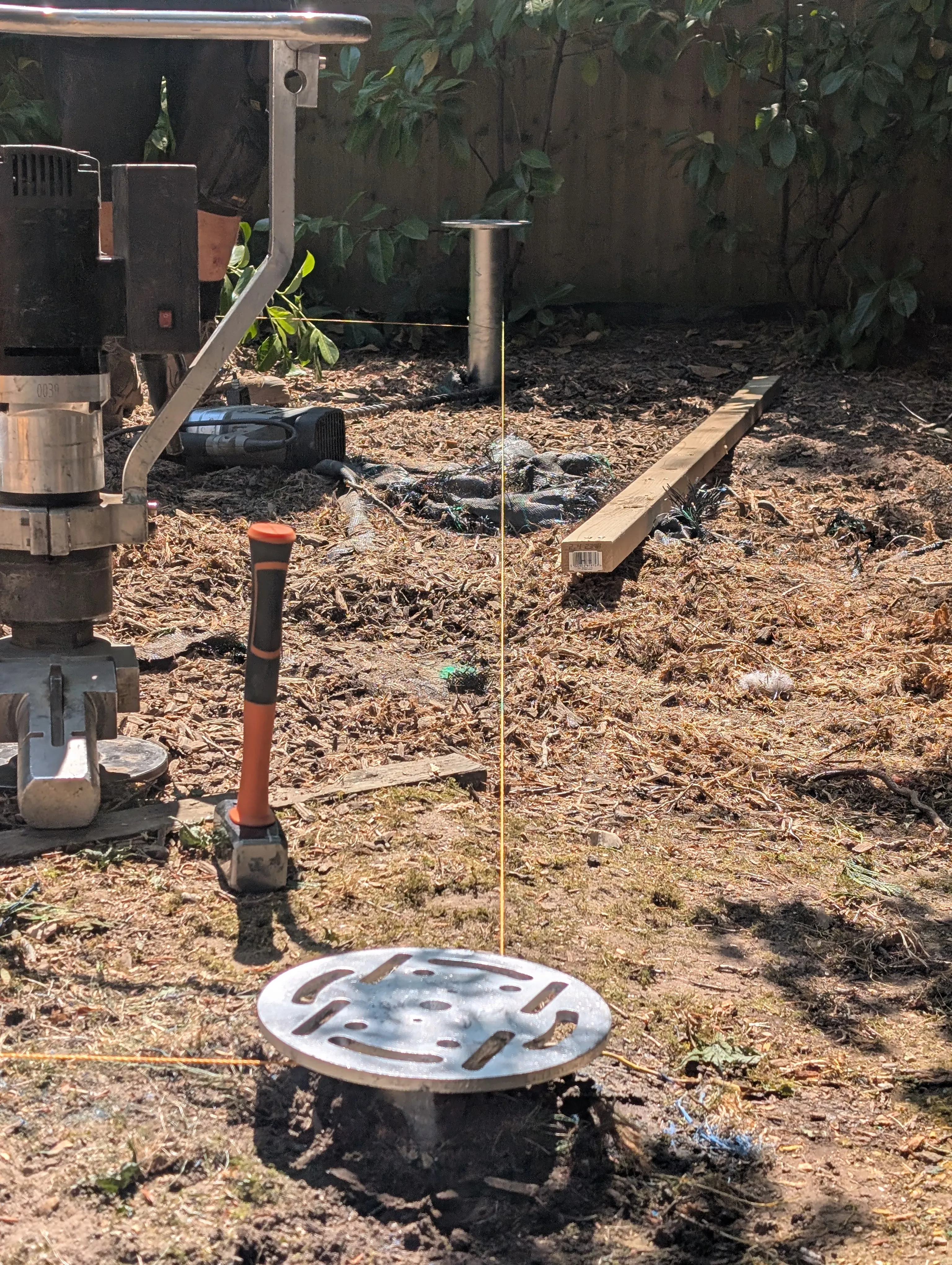
Ground screw testing in Crawley
Book ground screw testing in Crawley as a standalone service for suitable trial screws or existing foundations, including installations by others. We offer pull-out, compression and lateral testing, with recorded results, a written report and project-specific load calculations as agreed in the quotation.
Pull-out, compression and lateral testing
Start with the evidence the project needs: resistance to uplift, support under downward load, or response to a sideways force. These are different test directions. We agree the appropriate method and loading requirements so the work addresses the actual question.
Pull-out testing
An upward load is applied to the screw and its response is recorded. This provides evidence about uplift behaviour at the tested point under the agreed method and conditions.
Learn more: Pull-out testingCompression testing
Direct compression testing applies a downward load and measures the response. Where compression evidence is calculated from pull results using an applicable agreed method, its basis is identified: that is different from directly measuring a downward test.
Learn more: Compression testingLateral testing
A load is applied sideways and the resulting movement or response is recorded. The project requirements determine the relevant direction, load and interpretation.
Learn more: Lateral testingGround screw testing prices
The guide below is a starting point for the listed testing services. Your quotation defines the tests and points required, the loading brief and the work needed to set up safely at the site. Tell us the purpose before choosing a package so the scope is useful to the project.
Insertion-torque monitoring during installation and specialist torsional testing are two separate services, each priced on application. Neither is automatically included in a pull-out, compression or lateral test, or in the installation price.
Local guide prices start with our Ringwood prices, adding 0.1% for each one-way road mile to the town, then rounding up to a whole pound. Your written quotation confirms the price for your site and agreed work.
- Pull test (tensile or uplift test)
- From £527
- Load test (compression test)
- From £1,054
- Lateral test (sideways load)
- From £516
- Installation torque monitoring
- Price on application
- Specialist torsional load test
- Price on application
Each additional test
Each extra charge applies to an additional test of the same type, at the same location on the same day. The first test of each type is priced separately.
- Pull test (tensile or uplift test)
- £160 extra
- Load test (compression test)
- £320 extra
- Lateral test (sideways load)
- £155 extra
No VAT is added to the guide prices shown. Guide prices are subject to site conditions, access and the written quotation.
Tell us why you need a ground screw test
A postcode and the reason for the test are enough to begin. For example, tell us whether you need evidence for a proposed foundation or for screws already in place. Send the original request, brief or photos if available; we can establish what further information is needed during discussion.
Request your free quote
Give us your contact details and a short description of the testing you need. You can ask before the technical requirements are complete.
Your enquiry
Ground screw testing in Crawley
How we carry out the agreed test
A useful test begins with a clear purpose and a loading method suited to it. The test scope is agreed before the visit, including the requirements supplied by the responsible designer or other project decision-maker.
Establish the question and test requirement
We discuss what the evidence will be used for, the proposed test points and the required direction. The responsible project party's loads, method and acceptance criteria are agreed before testing.
Prepare a safe test arrangement
The available connection, surrounding space and condition of the installation are assessed for the proposed loading. Any preparation or access work needed for a suitable setup is identified before arrangements are confirmed.
Apply and record the agreed loading
Testing follows the commissioned method and loading sequence, recording the response at the identified point. The agreed procedure governs when loading stops; the programme and practical arrangements must allow that work to be carried out safely.
Issue the agreed results and calculations
The commissioned deliverables include recorded results, the written report and project-specific load calculations within the quoted scope. They give the responsible designer the evidence agreed for the project requirement.
Trial screws and existing foundations
For screws already supporting a building, the connection and loading situation are important parts of assessing whether the proposed test is practicable. Share what you know about the installation and any available records. We can discuss the next checks without asking you to loosen a connection or remove part of the structure yourself.
A trial screw can be installed and tested at an agreed location to help investigate the foundation proposal. Agreeing that purpose first makes the trial useful: it establishes what is being tested and how the evidence will inform the next decision. Additional points or different test directions are included only when commissioned.
Results, report and agreed load calculations
The written report brings together the results of the commissioned tests and the project-specific load calculations agreed in your quotation. It explains the evidence obtained for the stated testing requirement, so the responsible designer can assess it against the project's criteria. Let us know about any particular report requirement when agreeing the work. The report covers that testing commission; it is not automatic approval of the complete building or a replacement for the wider foundation design.
Installation torque monitoring and torsional testing
Torque means a turning action. During installation, monitoring records resistance as the screw is driven into the ground. That reading describes the installation process; it is not a direct upward, downward or sideways load test.
Specialist torsional testing applies a separate twisting load as a test. If you need that service, say so when enquiring so its purpose and practical method can be agreed. Both specialist torsional testing and insertion-torque monitoring are separately priced on application. Neither has a universal conversion into an allowable foundation load.
Arranging a test in Crawley
Tell us where the screws are and why the evidence is needed. If the request came from a designer, supplier or another contractor, you can forward their wording. We can then clarify which parts of the requirement can be met by the proposed tests and what needs agreement before scheduling.
You do not need to buy an installation to arrange testing. For new foundation work, ground screw installation in Crawley explains the separate packages. Our Crawley overview and West Sussex service area show the other services and listed towns.
Testing enquiries around Crawley
Send the postcode of the screws and the reason testing is needed. We discuss standalone testing at suitable sites in Crawley and the surrounding places below, confirming the test arrangement and scope for the address.
Postcode examples are RH10 and RH11 around Crawley, RH6 around Horley, Smallfield and Charlwood, RH12 around Faygate and Rusper, RH17 around Handcross and Balcombe, and RH19 around Felbridge and Furnace Wood. The individual location and testing work are confirmed during the enquiry.
The West Sussex service area shows the other listed towns. You can return to Crawley's base and testing services for the wider local offer.
Crawley neighbourhoods
Town centre, Bewbush, Broadfield, Forge Wood, Furnace Green, Gossops Green, Ifield, Langley Green, Maidenbower, Northgate, Pound Hill, Southgate, Three Bridges, Tilgate and West Green.
Worth and the Ifield surroundings
Worth, Crabbet Park, Ifield Green, Ifield West, Ifield Wood, Tinsley Green, Lowfield Heath and Manor Royal.
Colgate and Rusper surroundings
Colgate, Faygate, Kilnwood Vale, Rusper and Lambs Green.
Copthorne and Crawley Down surroundings
Copthorne, Crawley Down, Rowfant, Turners Hill, Furnace Wood, Domewood and Felbridge.
Pease Pottage and Handcross surroundings
Pease Pottage, Woodgate, Handcross, Slaugham, Warninglid, Balcombe and Staplefield.
Charlwood and Hookwood surroundings
Charlwood, Hookwood, Norwood Hill, Russ Hill and the Povey Cross area.
Horley and Smallfield surroundings
Horley, Meath Green, Langshott, Court Lodge, Westvale Park, The Acres, Burstow, Smallfield, Shipley Bridge and Keeper's Corner.
Feedback on Craig’s earlier work
Feedback on Craig’s earlier groundwork and customer service.
"Craig and the team are absolutely fantastic. From courtesy, to standard of work, to tidiness — everything exceeded expectations. The job was arranged, booked and done extremely quickly and we are very happy with the results. Nothing was too much trouble, and communication was easy."
"Craig and his crew were excellent from the first communication, quote, timing of work and quality of work. Highly recommended."
Ground screw testing questions
These answers explain what to request, the evidence each test provides and how the work is agreed.
Can I book a test on screws installed by another contractor?
Yes. We consider standalone testing on suitable third-party installations as well as trial screws and our own installation work. Explain the purpose and location first. Any product or installation information you hold can help establish a suitable method, but it is not necessary to buy a new foundation from us. Practical suitability and the quoted test scope are agreed before the work is arranged.
What does a pull-out test measure?
It records how the screw responds when an upward load is applied under the agreed test method. That evidence is relevant to uplift requirements at the tested point. The load, sequence and criteria should relate to the project question, so the result is considered in that context. It is not the same action as compression or a sideways lateral test.
What is measured in a direct compression test?
A direct compression test applies a downward load and records the screw's response to that loading. It therefore gives measured downward evidence. A calculation based on pull-test results is a different route and can only provide applicable compression evidence where the agreed method and its assumptions support it. The quotation and report should make clear which type of evidence is being commissioned.
When is sideways lateral testing the relevant test?
It is relevant when the project needs evidence of a screw's response to a sideways force. The responsible designer or project brief establishes the direction and loading requirement to investigate. The method records the response to that agreed loading rather than answering an uplift or downward-support question. Our lateral testing guide explains the separate service.
Can a trial screw help before the rest of the foundation is installed?
A trial can provide evidence for an agreed foundation proposal before the full installation proceeds. Its location, screw and loading requirements need to be selected for the purpose of the investigation. The result then informs the relevant project decision. The scope may call for more than one point or direction; a trial should not be taken as automatic confirmation of every later support.
Can you test an existing foundation without removing the building?
That depends on the accessible connection, the loading already on the foundation and whether a suitable safe test arrangement can be established. Start by telling us what is installed and why a test has been requested. Photos can help assess the next step. Leave structural connections intact for the enquiry; any preparation affecting the building needs to be agreed with the responsible people rather than attempted just to expose a screw.
Who decides the test load and the result needed for the building?
The project's responsible designer or other appointed party sets the required loading and acceptance criteria for the intended use. We agree the commissioned test method and practical scope against that requirement before testing. If the request is incomplete, we identify what still needs to be established.
What if I have been asked for testing but have no engineer's brief?
You can still enquire. Send the reason you were given, the postcode and any message or photograph available. We can discuss what the test is intended to establish and what additional requirement needs to be agreed before loading takes place. You do not need to turn a general request into your own technical specification before contacting us.
Is turning resistance during installation a load test?
Insertion-torque monitoring records resistance to rotation while the screw is driven. A physical pull-out, compression or lateral test applies a load in its specified direction and records the response. They provide different information and are separately commissioned. Monitoring is priced on application and is not automatically included with installation or a physical test; the project requirements determine whether it is useful.
How does specialist torsional testing differ from monitoring installation?
Specialist torsional testing uses a separately applied twisting load as a test, whereas insertion monitoring records turning resistance during the installation operation. Tell us which evidence is required so the correct scope and method can be discussed. Torsional testing is priced on application, separately from monitoring. Any use of torque evidence in a capacity assessment needs an applicable method and justified basis.
What will the written report and calculations cover?
They cover the commissioned tests and project-specific load calculations agreed in the quotation, together with the recorded results. If the requester needs a particular output, share that requirement when discussing the scope. The report is the agreed testing deliverable, not an automatic appointment to design the whole foundation. Its findings are considered by the responsible project party for the purpose for which the tests were commissioned.
Can a pull test be used to provide compression evidence?
It may be possible where an applicable agreed method supports calculating compression evidence from pull results for the product and project. The calculation and its assumptions need to be identified and accepted by the responsible designer. That is derived evidence, not a direct downward test. If direct compression measurement is required, the commissioned work needs to provide that instead.
Does a test report approve the entire building or carry an installation guarantee?
No. The report provides the agreed testing evidence; the building and foundation design still need the appropriate interpretation and approvals. JustBases' installation guarantee concerns the quoted workmanship and supplied screws or foundation materials, not a warranty that a test result approves the whole structure. Keep the testing commission and any installation package distinct when discussing the project.
How is a testing quotation arranged for a Crawley-area address?
Start with the postcode and the reason for testing. The test directions, number of points, loading requirement and practical setup determine the written scope, using the guide prices and separate price-on-application services as relevant. We confirm the address and arrangements during that discussion. An original request, photos or records help when available, but a complete technical pack is not required for first contact.
What does each additional ground screw test cost?
At the same location on the same day, each additional compression test costs £320 extra, each additional pull, tensile or uplift test costs £160 extra, and each additional lateral test costs £155 extra. These fixed charges are for further tests of the same type. The first test of each type is priced separately, using the starting price for your location. The extra-test charges stay the same in every location.
Discuss the testing you need
Send the postcode and purpose, whether the screws are proposed, trial installations or already supporting a structure. We can discuss suitability and the required evidence, then agree the written testing scope, price and arrangements.
Start a testing enquiry, call 01202 039753 or WhatsApp Craig. Available documents help the discussion, but you can make contact before a complete brief is ready.