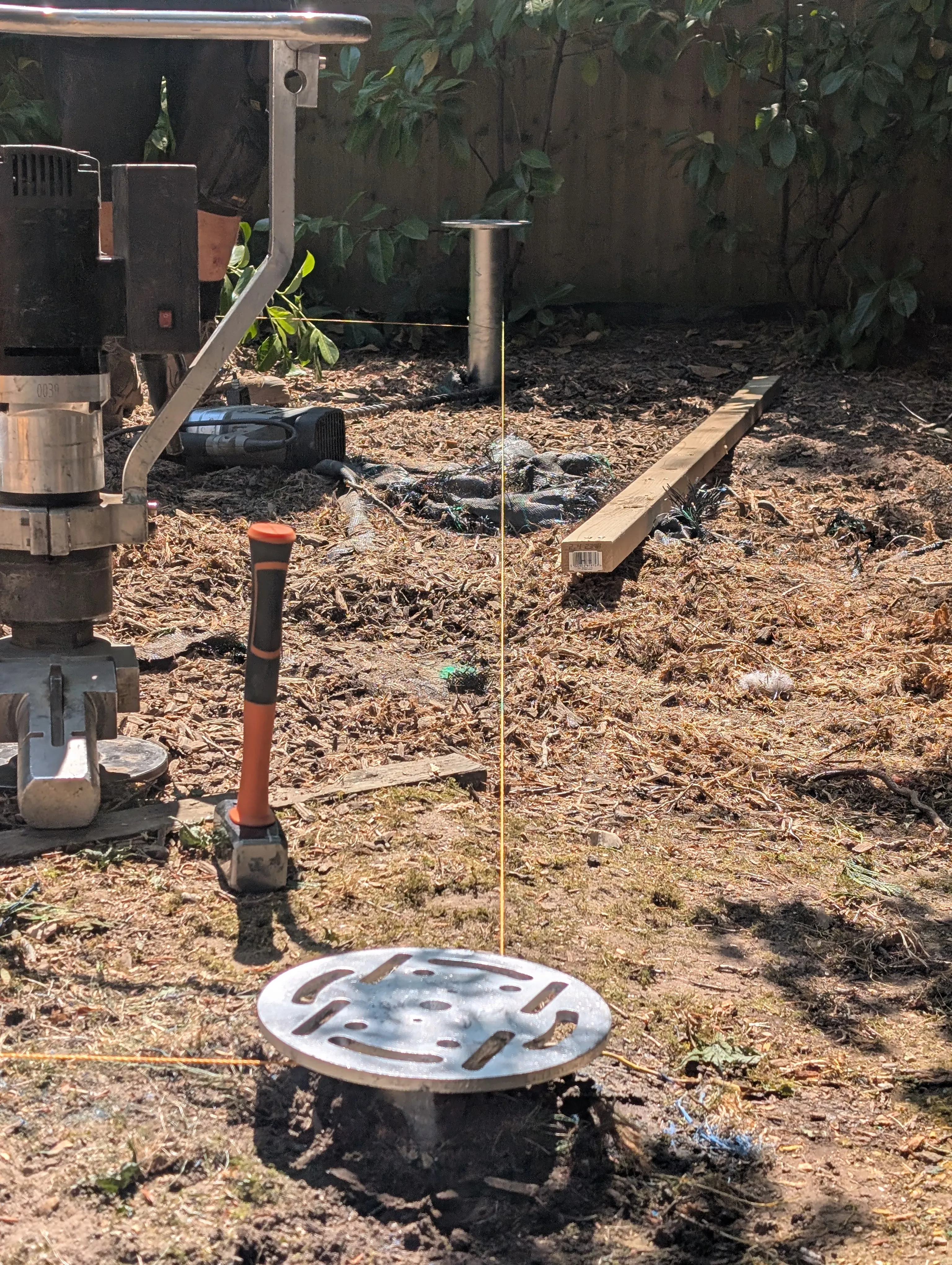
Ground screw testing in Eastleigh
Arrange a ground screw test in Eastleigh to obtain measured information for a foundation assessment. JustBases provides pull, compression and lateral testing for suitable trial screws and existing installations, including work by other installers. Testing can be commissioned on its own, with the loading programme and written findings agreed for your project.
Pull, compression and lateral testing
The test should demonstrate the response that matters to the foundation decision. An agreed force is applied and the resulting movement recorded, giving the assessor measured evidence for the specified loading rather than just a product description.
The three main directions are explained below. A responsible designer or appointed assessor establishes which are needed and the required loads and acceptance criteria. We agree the selected positions, safe arrangement and reporting around that requirement.
Pull testing
An uplift test loads the screw upwards. Its response is recorded to examine the lifting force specified in the assessment. The load, movement and relevant arrangement need to be understood together when the result is reviewed.
Learn more: Pull testingCompression testing
Direct compression loading acts down into the screw and measures its response. If a project instead uses a compression value derived from another test, the applicable calculation and its basis are agreed and reported distinctly.
Learn more: Compression testingLateral testing
A lateral test examines sideways loading. The connection and the height and direction of the applied force are part of the specified check. This supplies lateral evidence where that response is required in the design.
Learn more: Lateral testingEastleigh ground screw testing prices
The guide prices help you budget for the main methods. We confirm the work in a quotation that identifies the programme, test quantity, site arrangements and written evidence to be provided. Include any requirement for calculations or additional records in the discussion.
Installation torque monitoring and specialist torsional testing are both priced on application. The first measures resistance to turning while a screw is driven; the second applies a separate twisting action as a test. Each is an individually agreed service, not an automatic addition to a pull, compression or lateral visit.
Local guide prices start with our Ringwood prices, adding 0.1% for each one-way road mile to the town, then rounding up to a whole pound. Your written quotation confirms the price for your site and agreed work.
- Pull test (tensile or uplift test)
- From £492
- Load test (compression test)
- From £983
- Lateral test (sideways load)
- From £481
- Installation torque monitoring
- Price on application
- Specialist torsional load test
- Price on application
Each additional test
Each extra charge applies to an additional test of the same type, at the same location on the same day. The first test of each type is priced separately.
- Pull test (tensile or uplift test)
- £160 extra
- Load test (compression test)
- £320 extra
- Lateral test (sideways load)
- £155 extra
No VAT is added to the guide prices shown. Guide prices are subject to site conditions, access and the written quotation.
Tell us what the test needs to establish
If you have only been told that a foundation needs testing, explain the request in your own words and give the postcode. We can discuss how to develop it into an agreed brief. You can share the designer's note, screw details or photographs if available, but an initial enquiry does not depend on them.
Speak to Craig through the form or WhatsApp, or call 01202 039753. Testing is available on its own for suitable existing screws.
Request your free quote
Give us your contact details and a short description of the testing you need. You can ask before the technical requirements are complete.
Your enquiry
Ground screw testing in Eastleigh
Agreeing and carrying out the test
We agree what needs to be measured and how the work can be performed before attendance is confirmed. A defined programme gives the site team a preparation plan and the assessor a clear record to expect.
Establish the evidence required
Identify the foundation question and current project information. Settle the test methods and locations with the responsible assessor, including the loads, sequence, measurements and acceptance or stopping criteria.
Confirm a safe loading arrangement
Assess access to the screw and the intended test connection. Establish how the force will be applied and resisted, and agree any preparation or competent support work around a connected structure.
Record the response and issue the results
Carry out the agreed testing and record the applied loading and corresponding response. Provide the written results and included calculations for review by the designer or other appointed assessor.
Testing at the right stage of the foundation
Tell us which decision needs the evidence: selecting a proposed foundation, checking selected supports after installation or assessing an existing arrangement. That helps establish the useful stage for testing and who needs to review the results. Testing is available as a separate service in each suitable case.
For installed screws, the information needed depends on what is being examined. A layout, product identification or installation record may explain the positions and connections. Share what you have first. We identify whether further information is necessary to plan the test or make its findings useful to the assessment.
The loading must be safe for any frame or building already supported. Show the visible arrangement without disturbing loaded fixings, and explain whether the structure remains in use. The competent people responsible agree any unloading, temporary support or exposure needed; those tasks and their completion are settled before the visit.
A trial is planned to investigate the proposed support, with its screw specification and location chosen for that purpose. Coordinate the people supplying and installing it with the testing programme. The findings should be available while the foundation decisions they inform can still be made.
Understanding the measured evidence
Begin with the information the assessor needs to make a decision. If the request calls for a measured downward response, a report of upward loading alone does not supply it. An agreed, applicable calculation may use pull-test data to derive compression evidence, but the report must identify that calculation and its assumptions as distinct from direct compression measurements.
The written record lets the assessor relate the findings to the work commissioned: which supports were examined, how they were loaded and what response was recorded. Agree any project load calculations and particular document requirements with the quotation, so the delivered evidence answers the request.
Receiving the report is followed by the project's assessment and any required approval. The responsible person uses the evidence against the foundation criteria; the test itself does not certify the complete building. Allow for that review before committing work that depends on the findings.
Planning an Eastleigh test visit
Agree when the evidence is needed and allow for the review that follows testing. A test date and a date on which another contractor can proceed are separate programme decisions. Tell us who will coordinate the next work and any preparation that must be completed beforehand.
For practical arrangements, describe the actual test area as well as the entrance. Available photographs can help explain the connection and surrounding space. We establish the preparation and safe setup for the method being commissioned, including the roles of anyone working on the existing structure.
See Eastleigh ground screw installation if new supports are also required. You can compare other methods through the Eastleigh base services or check Hampshire service locations. The testing work retains its own brief and quotation.
Eastleigh-area testing locations
We consider testing requests from Eastleigh, the Itchen Valley and the adjoining communities listed below. Give the postcode and purpose so we can agree the appropriate work and practical attendance for your address.
Local district references include SO50 and SO53, with nearby SO30, SO31, SO21, SO32, SO52, SO51, SO16, SO17 and SO18 locations also welcome for discussion. Test scope, access and travel are confirmed before booking; you can ask about another nearby site.
- Eastleigh town and local areas: town centre, Barton and Barton Park, Blenheim, Brookwood, Cable, Chestnut, Nightingale, Newtown, North Stoneham, Lakeside, the Southampton Airport area and Boyatt Wood.
- Chandler's Ford and adjoining communities: Chandler's Ford, Hiltingbury, Velmore, Valley Park, Allbrook, North Boyatt, North Baddesley, Ampfield, Chilworth, Nursling, Rownhams and Romsey.
- Bishopstoke, Fair Oak and nearby villages: Bishopstoke, Stoke Common, Underwood, Whalesmead, Fair Oak, Crowdhill, Horton Heath, Durley, Upham and Lower Upham.
- Itchen Valley and Winchester-side places: Otterbourne, Hursley, Compton, Shawford, Twyford, Colden Common, Brambridge, Highbridge, Hensting, Fishers Pond, Nob's Crook and Winchester.
- Hedge End, Botley and West End: Hedge End, Botley, Boorley Green, Boorley Park, Curdridge, Curbridge, West End, Allington, Chartwell Green, Hatch Grange, Kanes Hill, Moorgreen and Telegraph Woods.
- Bursledon, Hamble and Hound: Bursledon, Lowford, Hamble-le-Rice, Hound, Netley Abbey, Old Netley and Butlocks Heath.
- Adjoining Southampton areas: Mansbridge, Swaythling, Bassett, Townhill Park, Harefield and Bitterne Park, with other Southampton addresses welcome for discussion.
Feedback on Craig’s earlier work
Feedback on Craig’s earlier groundwork and customer service.
"Craig and the team are absolutely fantastic. From courtesy, to standard of work, to tidiness — everything exceeded expectations. The job was arranged, booked and done extremely quickly and we are very happy with the results. Nothing was too much trouble, and communication was easy."
"Craig and his crew were excellent from the first communication, quote, timing of work and quality of work. Highly recommended."
Ground screw testing questions
These answers help explain the testing decision before a programme is agreed. Initial enquiries can be made with incomplete project information.
Can you test screws supplied by a different company?
Yes, suitable third-party screws can be considered for a standalone test. We establish what can be identified about the product and how the required load can be applied safely. Explain the assessment you need, the site's postcode and what the screws currently support.
Can you help if I have not been told which test to request?
We can explain the available methods and what the loading directions mean. Tell us what is proposed or pass on the question you have received. The responsible designer or other appointed assessor defines the detailed evidence and criteria before testing, but that can follow the initial conversation.
Why might the brief require more than one loading direction?
A foundation may have to resist upward, downward and sideways forces. The evidence for one case does not automatically establish the others. The assessment therefore identifies which responses need measuring and whether any applicable calculation forms part of the evidence, with each method clearly defined in the programme.
Who decides the load and permitted movement?
The person responsible for the foundation assessment establishes the loading requirements and the criteria for judging the response. We agree the test arrangements against that brief. Defining those requirements before attendance means the measurements have a clear purpose when the results are reviewed.
How is the selection of test positions made?
The assessor chooses the locations and quantity needed for the evidence being sought. They consider the foundation arrangement and relevant available information when deciding what should be examined. We confirm a safe way to test the selected supports and quote the resulting programme.
What access is needed at the screw itself?
There must be a suitable connection and space for the agreed loading arrangement, not simply a route into the garden. The required working area depends on the method and surroundings. Describe what is accessible and let us assess any preparation rather than altering a supporting connection yourself.
Will a missing installation document prevent a first enquiry?
No. Share whatever is known about the foundation and explain why testing is needed. We can identify which records or product details matter to the requested work. If more information is needed for a meaningful assessment, that requirement is discussed before the test is confirmed.
What should be coordinated for a proposed trial?
Agree the test purpose and the trial screw with the responsible assessor, then establish who supplies and installs it. The testing and review need to fit the foundation design programme. Tell us about those arrangements so the work can be quoted and attended at a useful stage.
What does installation torque monitoring measure?
It measures the turning resistance encountered during insertion of the screw. That record can contribute installation information when specified. It is different from measuring movement under a physical test load, and any capacity relationship used with it needs an applicable justified assessment rather than a universal conversion.
Is a specialist torsional test included with monitoring?
They are distinct services. A torsional test applies a twisting load to investigate the screw's response, while monitoring records resistance during installation. Each is separately scoped and priced on application. Specify the service actually required so neither the visit nor the report relies on an ambiguous torque request.
How should calculated compression evidence be described?
The result should be identified as derived, with its method, assumptions and supporting evidence clear. The calculation must be applicable to the project and agreed for the assessment. If the brief needs measured downward behaviour, commission a direct compression test rather than relying on a different evidential basis.
What written information is supplied after testing?
The agreed service provides recorded results and a written test report, with project load calculations where commissioned. The record identifies the testing performed and its response so it can be reviewed by the appointed assessor. Particular information or document requirements should be established when the quotation is prepared.
What if the response does not meet the project's requirements?
The findings need to go back to the responsible assessor before dependent work continues. They decide what the result means for the proposed foundation and what change or further evidence is appropriate. Any additional test or revised scope is discussed and agreed separately, rather than presumed to follow automatically.
What is enough to start the testing discussion?
Send the postcode and explain what prompted the test request. Craig can discuss that with you and identify the next useful details, whether the project is at proposal stage or the foundation is already built. You can add records as the discussion develops; the visit is booked after the programme and price are agreed.
What does each additional ground screw test cost?
At the same location on the same day, each additional compression test costs £320 extra, each additional pull, tensile or uplift test costs £160 extra, and each additional lateral test costs £155 extra. These fixed charges are for further tests of the same type. The first test of each type is priced separately, using the starting price for your location. The extra-test charges stay the same in every location.
Ask for your testing quotation
Tell Craig about the required Eastleigh test, or explain the question you need answered. We can discuss a suitable scope and the further details needed, then quote the agreed visit and reporting.