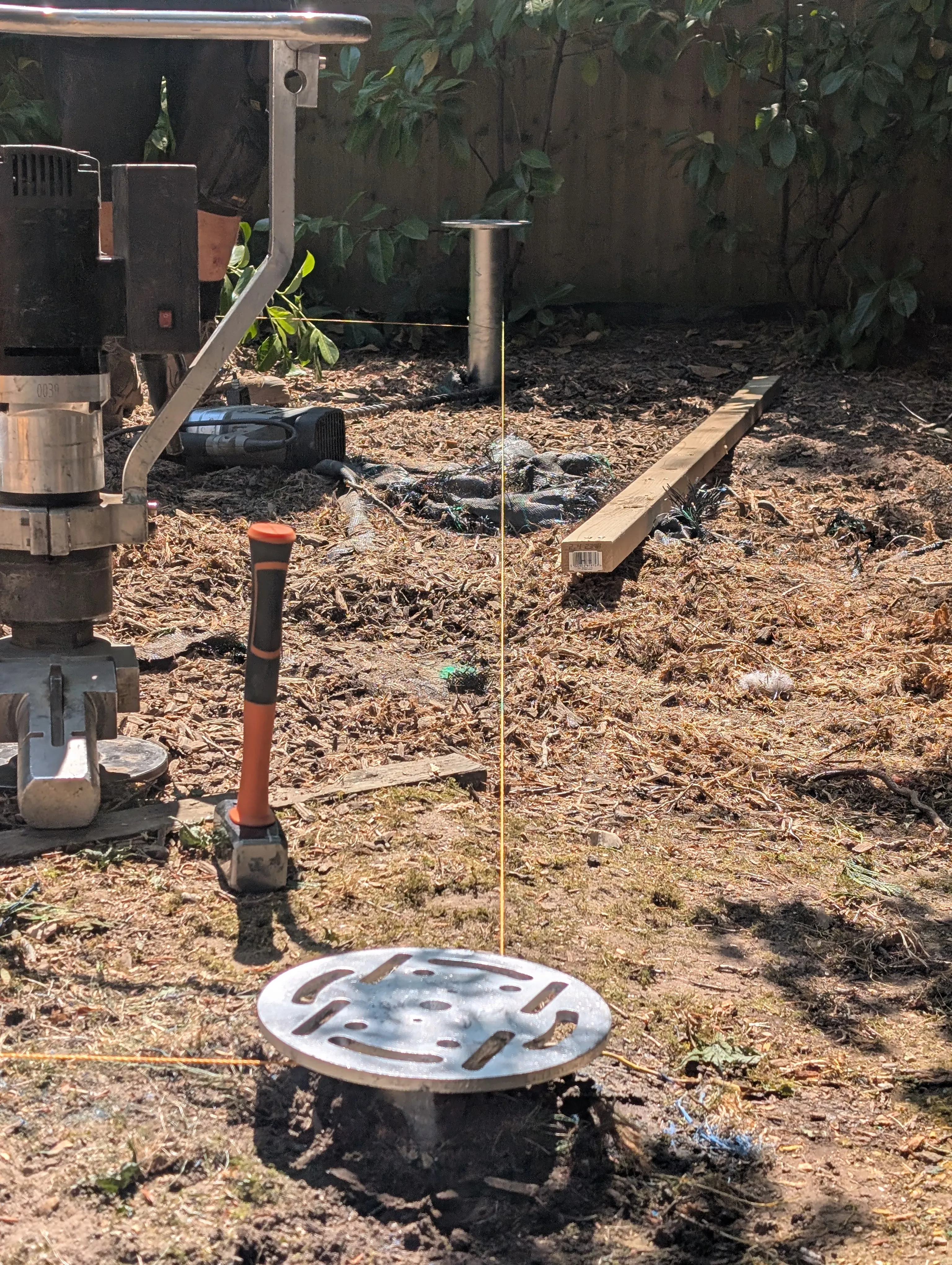
Ground screw testing in Farnham
We carry out standalone ground screw testing in Farnham and nearby villages, with an agreed loading programme and written results. Pull-out, compression and lateral tests are available for trial screws and suitable existing installations, including work by other installers. Tell JustBases what you need to establish and we will discuss the test arrangements.
Ground screw tests we offer
A physical test applies a defined load and records how the tested screw responds. It can provide evidence during foundation design or from a suitable installation already in place. We establish the required direction, loading stages and measurements so the results address the project team's question.
Torque services answer different questions. Monitoring during installation records the resistance to turning as a screw is driven. Specialist torsional testing applies a twisting load under an agreed test programme. Both are price on application and are separate from the direct upward, downward and sideways tests.
Pull-out testing
The screw is loaded upwards to measure its response to uplift. The test follows the specified load stages and records the observations required at that identified screw and position.
Learn more: Pull-out testingCompression testing
A direct compression test pushes downwards and measures the screw's response. Compression assessed by a calculation from other evidence is reported separately, using an applicable agreed method and stated assumptions.
Learn more: Compression testingLateral testing
A sideways load checks the response in a specified lateral direction. Its connection arrangement, load application and movement measurements are agreed to suit the evidence needed.
Learn more: Lateral testingGround screw testing prices in Farnham
Use the testing guide below for initial budgeting, then ask for a quote against the required programme. The method, test positions, load stages, connection arrangements and report all contribute to the scope. Access and the working space around each position also need to be established.
A trial installation or preparation of an existing connection is identified where it forms part of the commission. We make clear who handles any associated support, release or reinstatement work. Installation torque monitoring and specialist torsional testing are separately scoped, both price on application.
Local guide prices start with our Ringwood prices, adding 0.1% for each one-way road mile to the town, then rounding up to a whole pound. Your written quotation confirms the price for your site and agreed work.
- Pull test (tensile or uplift test)
- From £507
- Load test (compression test)
- From £1,013
- Lateral test (sideways load)
- From £496
- Installation torque monitoring
- Price on application
- Specialist torsional load test
- Price on application
Each additional test
Each extra charge applies to an additional test of the same type, at the same location on the same day. The first test of each type is priced separately.
- Pull test (tensile or uplift test)
- £160 extra
- Load test (compression test)
- £320 extra
- Lateral test (sideways load)
- £155 extra
No VAT is added to the guide prices shown. Guide prices are subject to site conditions, access and the written quotation.
Ask about a ground screw test
Tell us the postcode, whether the screws are planned or already fitted, and why the evidence is needed. A short description is enough to begin. If a designer, building supplier or contractor has asked for a test, let us know who will use the report.
You can send an available brief, drawing, screw record or site photo later. We discuss the missing details and the programme required before agreeing the work and written price. Enquire through the form, call 01202 039753 or message Craig on WhatsApp.
Request your free quote
Give us your contact details and a short description of the testing you need. You can ask before the technical requirements are complete.
Your enquiry
Ground screw testing in Farnham
How ground screw testing works
Useful testing begins with an agreed purpose. We coordinate the loading and reporting requirement with safe access to the screws, then carry out the defined work and provide the evidence for review.
Define the evidence needed
The responsible designer or specifier supplies or agrees the loading requirements and acceptance criteria. We identify the test direction, screw positions, stages and any required hold periods or movement observations, together with the report recipient.
Plan safe access and loading
We assess the screw heads, attachments and room for the test arrangement. For an existing structure, any temporary support or connection changes need an agreed safe method. Preparation and reinstatement are assigned before the visit.
Test and provide the report
Loads are applied and the required response recorded under the agreed programme. The written report identifies what was tested, where and how, giving the project team the measurements and any separately agreed calculations needed for its assessment.
Testing existing screws and trial installations
A trial provides evidence before committing to the complete foundation arrangement. The proposed product, position and loading programme are selected around the design question. Agree who installs the trial and what happens to it afterwards, along with the testing itself, so the work fits the foundation programme.
For existing screws, send any product details, installation records and information about the frame. We consider the connection available at the head, the current load on the screw and the space needed to apply the specified test. Another installer's foundation can be assessed on that basis without ordering a replacement installation.
If a frame, deck or building is attached, its safe support and connection sequence require particular attention. Share what you have for assessment and keep structural connections intact. Any planned release, temporary works and reinstatement are coordinated with the responsible parties before testing proceeds.
What your test report tells you
The report records the agreed work and its results, identifying the tested screws and positions, loading direction and method, applied loads and measured response. Relevant site and test observations are included so the reader understands the conditions in which that evidence was obtained. Tell us about any required report format or position-identification system when scoping the work.
Calculations are kept distinct from direct measurements. A compression calculation based on other evidence must use an applicable agreed method, with its assumptions and inputs stated. It is a calculated assessment, not a direct downward load test. Installation torque monitoring likewise provides its own installation record rather than a substitute result in another test direction.
Your designer or specifier interprets the evidence against the project's requirements. The report concerns the tested elements and conditions; it does not certify the complete structure, its frame or connections, or automatically establish regulatory acceptance. Making the report's intended use clear before testing helps align the work with the decision it needs to support.
Arranging testing in Farnham
We agree the site contact, access arrangements and the stage when the chosen screws will be available. Explain the unloading route, working restrictions and known services. If another contractor is fitting a frame, coordinate the test stage before the relevant heads or working space are covered.
For a completed installation, the proposed access and connection method are assessed first. A plan or photo can help explain what is attached and where the test positions are. The quotation identifies the agreed testing and report, along with any preparation and separate responsibilities needed to make the visit possible.
If your project also needs new supports, see ground screw installation in Farnham. Our Farnham overview explains the other base methods, and the Surrey service hub lists the wider town area. You can commission testing independently of those installation services.
Areas we cover around Farnham
Testing enquiries are welcome from Farnham and the surrounding neighbourhoods and villages below. Include the full postcode and the evidence you are seeking so we can confirm the site assessment, visit arrangements and reporting scope.
- Farnham town areas: town centre, Castle area, The Chantrys, Folly Hill, Dippenhall, Great Austins, Firgrove, Shortheath, Weydon, Moor Park and Compton in Farnham.
- Hale and Weybourne area: Hale, Upper Hale, Sandy Hill, Heath End, Weybourne and Badshot Lea.
- Bourne and Rowledge area: The Bourne, Upper Bourne, Middle Bourne, Lower Bourne, Boundstone, Wrecclesham and Rowledge.
- Runfold and Seale area: Runfold, The Sands, Seale and Tongham.
- Frensham and Tilford area: Tilford, Charleshill, Frensham, Millbridge, Shortfield Common, Spreakley, Rushmoor, Churt, Dockenfield and Batt's Corner.
- Elstead and Thursley area: Elstead, Thursley, Pitch Place, Bowlhead Green and Warren Park.
- Ash and Normandy area: Ash, Ash Green, Ash Vale, Puttenham, Wanborough, Normandy, Christmas Pie, Flexford, Wyke, Willey Green and Pinewood.
- Hampshire-side nearby villages: Crondall, Ewshot, Dora's Green, Bentley, Isington, Binsted, Blacknest, Bucks Horn Oak, Holt Pound, Frith End, Malms, Hawbridge, South Hay, Wheatley, Wyck, Upper Froyle and Lower Froyle.
- Postcode enquiries: GU9 and GU10, with nearby village addresses in GU8, GU12, GU3 and GU34. We confirm the arrangements for the full site postcode in your quotation.
Feedback on Craig’s earlier work
Feedback on Craig’s earlier groundwork and customer service.
"Craig and the team are absolutely fantastic. From courtesy, to standard of work, to tidiness — everything exceeded expectations. The job was arranged, booked and done extremely quickly and we are very happy with the results. Nothing was too much trouble, and communication was easy."
"Craig and his crew were excellent from the first communication, quote, timing of work and quality of work. Highly recommended."
Frequently asked questions
These answers explain what can be tested, how the programme is defined and how the report is used.
Is testing available for another installer's foundation?
Yes, we can assess suitable screws installed by others for standalone testing. Tell us what they support and why the evidence is needed. We review available product and installation information, access and connections, then agree whether and how the required programme can be carried out safely.
What is the difference between the three direct load tests?
A pull-out test loads upwards, a compression test loads downwards and a lateral test loads sideways in a specified direction. Each records response to that loading. The project's designer or specifier identifies the evidence required, which may involve one direction or an agreed combination.
What can testing a trial screw help establish?
A defined trial gives the designer evidence from a selected product and position before the wider foundation is installed. Its purpose, loads and observations should be agreed around the design decision being made. Trial supply, installation and treatment afterwards are separate details to include in the scope where required.
What if the screw head is beneath a fitted frame?
We first assess how the head is connected and whether a safe test arrangement is practical. Access or temporary support may need to be coordinated with the responsible designer and contractor. Provide photos or drawings when available and leave structural connections assembled until the method and responsibilities are agreed.
Do you need the screw product and installation records?
Available records help identify what is being tested and how it was installed. Send what you have, including product details, positions and frame information. If something is missing, we discuss what must be established for the proposed programme; you can make the initial enquiry with just the purpose and postcode.
How are loading stages and acceptance requirements agreed?
The responsible designer or specifier supplies or agrees the required loads and criteria. We coordinate the test stages, hold periods, movement measurements and stopping requirements with that brief. The resulting programme defines what will be done and how the report can be reviewed for the project.
How are the test positions identified and selected?
The foundation's evidence requirement guides the number and location of tests, with positions agreed by the responsible designer or specifier. A plan, reference labels or another clear identification method links the report to the tested screws. Agree that system before the visit so the results can be matched to the intended supports.
Can a test affect whether the screw is used afterwards?
It can, depending on the programme and observed response. Testing to a specified proof load and investigating a limiting response have different purposes. The loading, stopping criteria and treatment of the tested screw must therefore be agreed in advance, including the decision about any subsequent foundation use.
What does torque monitoring during installation measure?
It measures the turning resistance while a screw is driven and produces the agreed installation record. It is not a direct upward, downward or sideways loading test. Using it in a capacity assessment requires an applicable agreed method, not a universal conversion. Monitoring is separately commissioned and price on application.
What is a specialist torsional test used for?
It examines the response to an applied twisting load under a specified programme. That is different from recording turning resistance during installation and from the three direct load directions. Tell us the designer's evidence requirement so the specialist scope, connection arrangement and report can be discussed; the service is price on application.
What information is included in the test report?
The written report identifies the agreed tests, screw positions, applied loads and measured response, with relevant test conditions and observations. Any commissioned calculations are identified as calculations. If the project team needs a particular reporting format or supporting records, agree those requirements when the work is scoped.
Can compression be calculated from other test evidence?
Where an applicable method has been agreed for the screw and site, a compression assessment can be commissioned using other evidence. Its inputs, assumptions and calculation must be stated. This remains distinct from a direct compression test, which physically applies downward load and measures the resulting response.
Does the report certify the building or all its foundations?
No. The evidence relates to the elements, positions and conditions tested under the agreed programme. The responsible designer or specifier considers it within the full foundation and building assessment, including the frame and connections. Regulatory acceptance and whole-structure compliance are separate from issuing the test report.
What needs to be ready for the booked visit?
The agreed test positions and working area must be safely accessible, with the site contact and attendance arrangements confirmed. Share known services and site restrictions. Any temporary support, connection changes and reinstatement follow the agreed method and assigned responsibilities; we clarify these with the test scope and written quote before booking.
What does each additional ground screw test cost?
At the same location on the same day, each additional compression test costs £320 extra, each additional pull, tensile or uplift test costs £160 extra, and each additional lateral test costs £155 extra. These fixed charges are for further tests of the same type. The first test of each type is priced separately, using the starting price for your location. The extra-test charges stay the same in every location.
What happens next
Start a Farnham testing enquiry, call 01202 039753 or message Craig on WhatsApp. We will clarify the purpose, review the installation and access information, then agree the test programme and written price before arranging the visit.