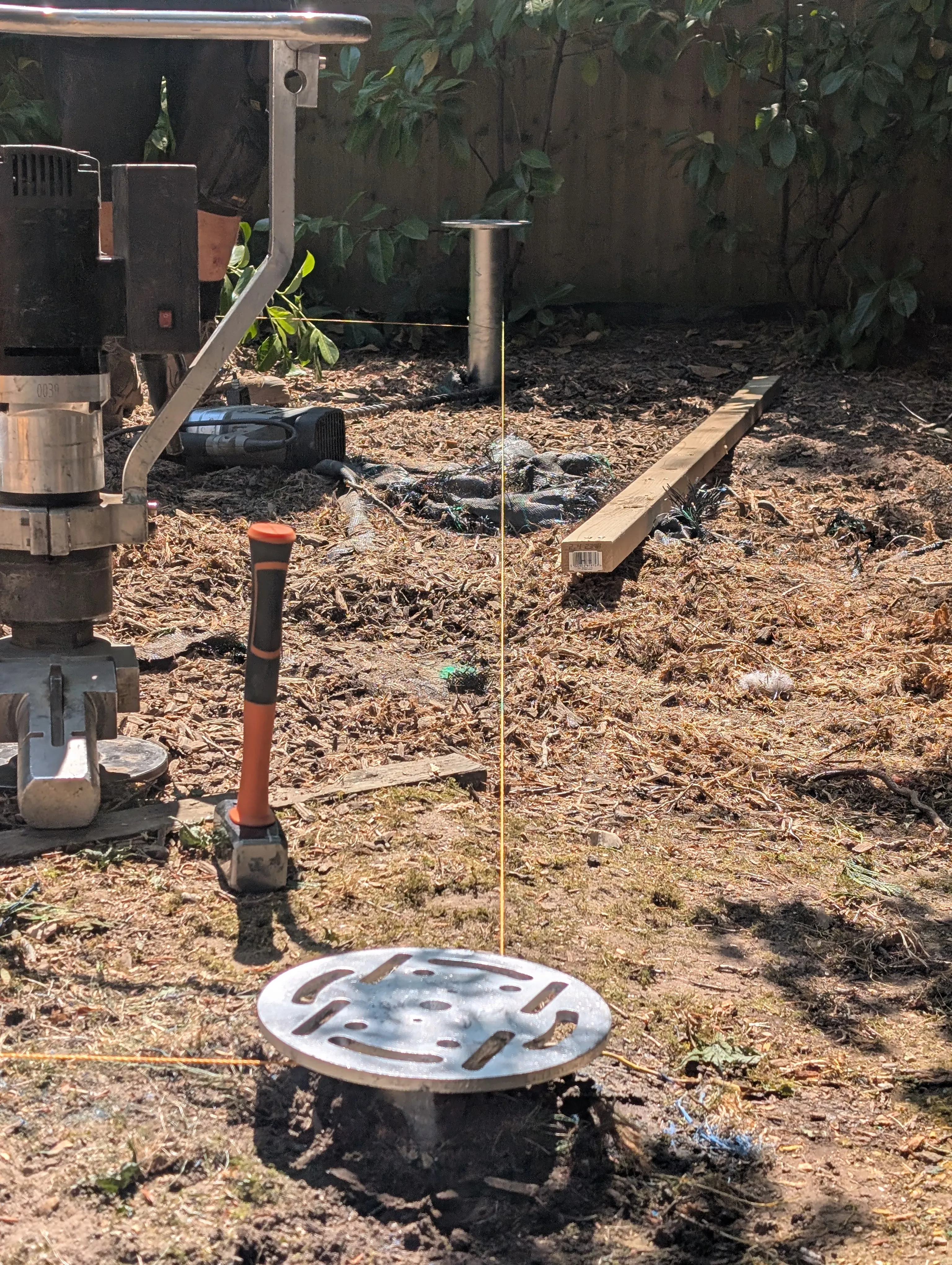
Ground screw testing in Havant
JustBases provides ground screw testing in Havant: upward pull, direct downward compression and sideways lateral loading, with recorded results, a written report and agreed load calculations. Testing can be booked separately for suitable trial or existing screws, including foundations installed by another company.
Tests for upward, downward and sideways loads
The useful starting point is the decision the test will inform. Your designer may need evidence for a proposed support, a change to a building or an existing installation. We establish the required direction of force and the response to record before agreeing the work.
The three physical methods below are separate services. More than one can be relevant to a foundation, and the selected tests need to address the project’s requirements.
Pull testing
An upward load acts on the selected screw and its response is recorded. This provides evidence for the agreed uplift or pull-out question at that position, using the screw and setup identified for the test.
Learn more: Pull testingDirect compression testing
A downward load is physically applied to the screw and the resulting movement is measured. It investigates downward response under the test conditions. A compression value calculated from other data is a separate form of evidence.
Learn more: Direct compression testingLateral testing
A sideways load and the associated movement are recorded in the agreed direction. The direction and connection arrangement matter when the result is used to assess horizontal resistance.
Learn more: Lateral testingGround screw testing prices
The guides give the starting point for the three physical test services. Your quote defines the number and location of tests, the site arrangements, visits, reporting and calculations required. Tell us why the evidence is needed so the quoted work addresses that purpose.
Installation torque monitoring and specialist torsional load testing are both POA and separately commissioned. Monitoring records turning resistance during driving; a torsional test applies a distinct twisting action to investigate rotational behaviour. They are not included automatically with pull, compression, lateral testing or installation.
Where an applicable method is agreed, compression can be calculated using pull-test evidence and the necessary project information. Such a result is labelled as a calculation, not a physical downward measurement. The calculation scope is agreed before it is commissioned.
Local guide prices start with our Ringwood prices, adding 0.1% for each one-way road mile to the town, then rounding up to a whole pound. Your written quotation confirms the price for your site and agreed work.
- Pull test (tensile or uplift test)
- From £501
- Load test (compression test)
- From £1,002
- Lateral test (sideways load)
- From £491
- Installation torque monitoring
- Price on application
- Specialist torsional load test
- Price on application
Each additional test
Each extra charge applies to an additional test of the same type, at the same location on the same day. The first test of each type is priced separately.
- Pull test (tensile or uplift test)
- £160 extra
- Load test (compression test)
- £320 extra
- Lateral test (sideways load)
- £155 extra
No VAT is added to the guide prices shown. Guide prices are subject to site conditions, access and the written quotation.
Tell us why you need testing
You may be asking on your own behalf or arranging evidence for a supplier, installer or designer. Describe the decision you need to make and give the postcode. Craig can help establish the next step even if the technical request is not complete.
If someone has already asked for testing, send their request when convenient. Knowing who will use the evidence helps us settle the relevant test scope and any information they need from the visit.
Request your free quote
Give us your contact details and a short description of the testing you need. You can ask before the technical requirements are complete.
Your enquiry
Ground screw testing in Havant
Agreeing and carrying out the test
The test programme is settled before attendance. That allows the site team and the person assessing the results to work to the same purpose.
Explain the decision
Tell us about the proposed or fitted foundation and why evidence is needed. We establish who is specifying the test and what information is already available.
Define the work
The relevant points, load directions and criteria are agreed with the responsible project team. We confirm a practical, safe setup and record the tests, calculations and reporting in the quotation.
Measure the response
At the selected points, the agreed loading is applied and the response recorded. The work follows the agreed method and its limits, with any restriction or change affecting the evidence identified.
Deliver the agreed results
The records, written report and commissioned calculations are supplied for the project’s assessment. The responsible designer uses the findings with the rest of the foundation information to decide the next step.
Testing an existing foundation
You can ask us to test another company’s installed screws without ordering replacement foundations. Explain what the foundation currently supports and the question you want the assessment to resolve. Drawings, product references or earlier test records can help the responsible assessor understand what is there; send whatever you already hold, and we can discuss what else is needed for the proposed work.
Keep a supporting screw and its attached structure intact while the work is being assessed. If a test needs an opening, removal of a connection, unloading or temporary support, competent people must plan and carry out that preparation. We agree the safe test arrangement before anyone alters the foundation.
Understanding what the results can establish
A result is most useful when the project team has stated what it is looking for. The requested load and acceptable response give the assessment a basis; a number without that context does not settle whether the foundation meets the design requirement. We agree the required records so the designer can make that comparison.
The report distinguishes measurements from calculations. If compression has been derived from pull data, the calculation method, relevant assumptions and applicability need to be clear to the person using it. A direct compression test instead records the response to an actual downward load; the two should not be presented as the same observation.
Your assessor also considers what the selected tests represent. Changes to the screw product, location, installation or proposed building may call for a review of the evidence. A test report supports that assessment; it is not certification of the whole building and does not itself grant planning or Building Control approval.
Getting ready for a testing visit
Once the test scope is understood, agree who is providing access to the points and completing any preparation. The tester needs to assess the working area for the chosen method, including safe attachment and a way for the setup to resist the applied force. A photograph can help plan a visit, but the arrangement must be confirmed before testing.
For work involving another contractor, put the relevant people in contact early enough to settle responsibilities and timing. Confirm when the evidence is required and what construction can proceed before it is available. That helps avoid covering a point that still needs testing or committing to later work before the assessment is complete.
If you also need new supports, see Havant ground screw installation. You can compare all Havant base services or check our Hampshire coverage. Installation and testing can be discussed together while remaining clearly defined pieces of work.
Testing enquiries around Havant
Give the actual site postcode for a testing enquiry in the places below. Local districts include PO9, PO10 and PO11; adjoining enquiries can involve PO7 and PO8 towards Waterlooville and the northern villages, PO6 towards Portsmouth and PO18 on the Chichester side. We agree the visit, access and travel for the particular address and test programme.
Havant and its neighbourhoods
Havant town centre, Bedhampton, Brockhampton, Warblington, Denvilles, Broadmarsh and Langstone; Leigh Park, West Leigh and Warren Park.
Waterlooville and nearby areas
Waterlooville, Purbrook, Crookhorn, Widley, Stakes, Cowplain and Wecock Farm.
Hayling Island
Northney, Stoke, West Town, Mengham, Selsmore and Eastoke, as well as other Hayling Island addresses.
Rowlands Castle and the surrounding villages
Rowlands Castle, Finchdean and Old and New Idsworth; Horndean, Blendworth, Catherington, Lovedean and Clanfield. These include addresses in East Hampshire, outside Havant Borough.
Emsworth and the West Sussex border
Emsworth, then neighbouring Southbourne, Hermitage, Lumley, Prinsted and Thornham; Westbourne, Aldsworth and Woodmancote; Nutbourne, Hambrook and Chidham. The West Sussex places are in Chichester District, not Havant Borough.
Towards Portsmouth
Farlington, Drayton and Cosham are nearby Portsmouth areas; send the property postcode to ask about work there.
Feedback on Craig’s earlier work
Feedback on Craig’s earlier groundwork and customer service.
"Craig and the team are absolutely fantastic. From courtesy, to standard of work, to tidiness — everything exceeded expectations. The job was arranged, booked and done extremely quickly and we are very happy with the results. Nothing was too much trouble, and communication was easy."
"Craig and his crew were excellent from the first communication, quote, timing of work and quality of work. Highly recommended."
Ground screw testing questions
You do not need to diagnose the foundation yourself. Explain what has prompted the enquiry and we can discuss the testing work needed to provide useful evidence.
Who should I speak to if I have been told the foundations need testing?
You can contact Craig directly with the postcode and the reason given. Share the request from the designer, supplier or other project professional if you have it. We can then establish which decision they need evidence for and what should be included in the test quotation.
Can testing be commissioned without a new JustBases installation?
Yes. It is available as a standalone service for suitable foundations, including another company’s screws. We review the proposed test and the practical setup before agreeing the work, so the service can be commissioned independently of who supplied or fitted the original supports.
What does a pull test tell the project team?
It records the selected screw’s response under an upward load. The results are considered against the agreed uplift requirement and the details of the tested screw and position. They do not also constitute a direct measurement of downward or sideways response.
How is a sideways test different from a twisting test?
Lateral testing applies force in an agreed sideways direction and measures the response. A torsional test applies a rotational action instead. These are different loading arrangements; the responsible designer identifies which question the project needs to answer, and specialist torsional work is quoted POA.
Who provides the screw for a trial test?
Tell us whether a foundation contractor will fit the trial or you would like that work included in our quotation. We agree who supplies and installs it, and what must be ready for the test. This keeps a testing-only visit separate from an order that also includes the trial foundation.
Will you need to test every screw in the foundation?
The test programme determines the selected points and extent of the work. The responsible designer considers the foundation layout and how the results will be used, while the tester checks the practical arrangements. We quote the agreed programme rather than assuming every support needs the same test.
What information helps if the screws have already been covered by a floor?
Tell us what is built above them and provide any layout, installation records or photographs you already have. We need to understand the access and loading arrangement before confirming feasibility. Do not cut openings or release structural connections simply to prepare for an enquiry.
Can I request a test because I want to change the building above the screws?
Yes, describe the proposed change and involve the person assessing the revised support requirements. They can identify the evidence needed for the new use. Testing may contribute to that review, but the frame, connections and other relevant parts of the altered structure also need consideration.
Can the force to apply be chosen when the tester arrives?
The loading programme and the criteria for assessing the response should be settled before the visit. The practical setup needs to suit that programme. If the brief changes, the tester and responsible designer should review the implications before a different test is undertaken.
Can an installation log replace a physical test?
An installation torque log records resistance to turning as a screw is driven. It can be relevant evidence within an appropriate assessment, but it does not directly measure the response to a separate upward, downward or sideways load. Any relationship used needs justification for the actual screw system and site.
When would a calculated compression figure be appropriate?
Only where an applicable method and the required input information support that calculation and its use is agreed for the project. The written results should identify it as derived evidence, with its basis available for review. If a direct downward measurement is required, that calls for a physical compression test.
What date should I give you when asking about testing?
Tell us when you need the written findings, as well as any proposed test date. For example, the designer may need time to assess the evidence before the building installer proceeds. We discuss both attendance and reporting when agreeing the programme, including time for the project team’s review.
Will the report approve my complete garden building?
No. It documents the agreed test work and findings, with the commissioned calculations. The complete building and foundation still need the relevant design assessment and any statutory approvals. Tell us who needs the report before booking so their evidence requirements can be discussed.
What can I send if I do not know the screw make or test method?
Begin with the site postcode, what is supported and why you are asking for testing. Available photographs, old paperwork or the name of the installer may help later. Craig can explain what information is needed to develop the scope; you do not need to select a method unaided.
What does each additional ground screw test cost?
At the same location on the same day, each additional compression test costs £320 extra, each additional pull, tensile or uplift test costs £160 extra, and each additional lateral test costs £155 extra. These fixed charges are for further tests of the same type. The first test of each type is priced separately, using the starting price for your location. The extra-test charges stay the same in every location.
Arrange the next step with Craig
Call 01202 039753, message Craig on WhatsApp or use the form above. Tell us what you want to find out and where the screws are; the test details can be developed after the first conversation.
For an existing building, keep the supports and connections undisturbed while the enquiry is reviewed. We will discuss any necessary site preparation as part of agreeing the work.