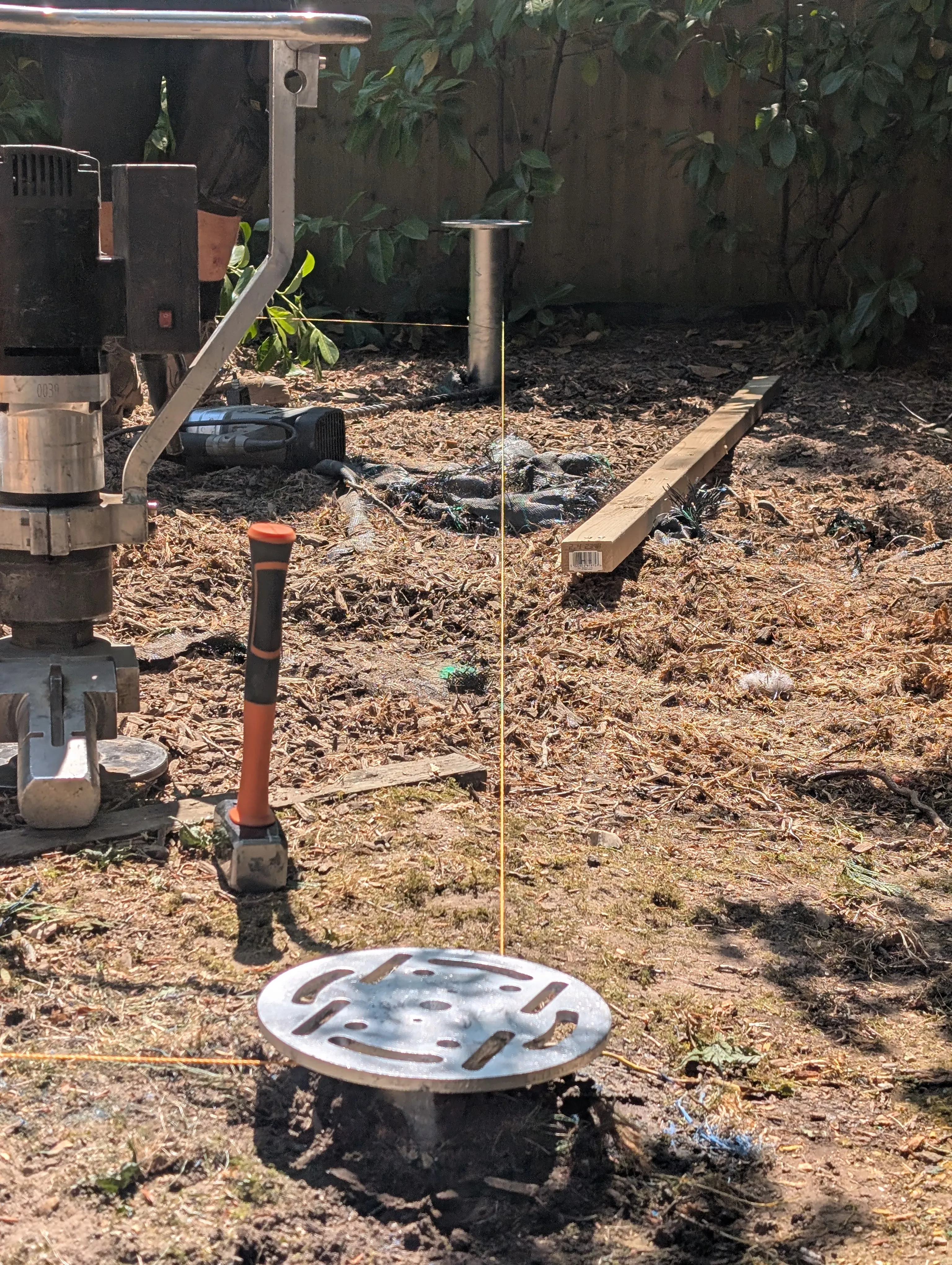
Ground screw testing in Winchester
Measure the response of a ground screw foundation with JustBases testing in Winchester and the surrounding area. Pull, compression and lateral tests can be arranged for suitable trial or existing screws, including another installer's work, with the method, measurements and written reporting agreed for your project.
Measure the screw response in the required direction
Testing provides measured information about the screw's behaviour under the chosen loading. The useful question is how much load is applied and what movement occurs, considered against the requirements set for the foundation.
Different directions examine different parts of that behaviour. The test arrangement, load height and sequence are agreed with the intended assessment in mind, so a result can be related to the design rather than treated as a general rating for the whole structure.
Pull testing
A pull test loads the screw upwards and records its response to uplift. Agree the loading stages and movement criteria needed to examine the lifting forces identified in the foundation design.
Learn more: Pull testingCompression testing
Compression testing applies downward force to examine support under vertical loading. A direct test records the downward load and resulting movement; any separately agreed derived assessment must be described as such.
Learn more: Compression testingLateral testing
A lateral test applies force across the screw to examine sideways movement. Loading direction, height and the connection detail are part of the brief because the design may depend on their relationship.
Learn more: Lateral testingWinchester ground screw testing prices
See the guide for the main testing options, then ask us to price the particular brief. Test quantity, directions, site arrangements and the required record are confirmed together. If the visit depends on a trial installation or enabling work by another contractor, include that in the programme discussion.
Two additional torque services are priced on application. Installation torque monitoring measures turning resistance while a screw is driven; specialist torsional testing investigates response to a separately applied twisting action. Each needs its own agreed scope and is not automatically included in a load-test quotation.
Local guide prices start with our Ringwood prices, adding 0.1% for each one-way road mile to the town, then rounding up to a whole pound. Your written quotation confirms the price for your site and agreed work.
- Pull test (tensile or uplift test)
- From £494
- Load test (compression test)
- From £988
- Lateral test (sideways load)
- From £484
- Installation torque monitoring
- Price on application
- Specialist torsional load test
- Price on application
Each additional test
Each extra charge applies to an additional test of the same type, at the same location on the same day. The first test of each type is priced separately.
- Pull test (tensile or uplift test)
- £160 extra
- Load test (compression test)
- £320 extra
- Lateral test (sideways load)
- £155 extra
No VAT is added to the guide prices shown. Guide prices are subject to site conditions, access and the written quotation.
Tell us what needs checking
You can enquire with the postcode and a simple explanation of the proposed building or existing foundation. Share a test brief or installation records if available, but they are not a condition of first contact. Use the form or WhatsApp here, or call 01202 039753.
Request your free quote
Give us your contact details and a short description of the testing you need. You can ask before the technical requirements are complete.
Your enquiry
Ground screw testing in Winchester
Agreeing, carrying out and recording the test
A defined brief makes the testing visit useful to both the site team and the person assessing the foundation. We agree the work in a sequence that fits the foundation's current stage.
Identify the screws and decision
Confirm the reason for testing, the foundation arrangement and the available screw information. The designer or appointed assessor defines the required evidence, test locations and criteria for judging the result.
Prepare a safe loading position
The access and proposed loading arrangement are reviewed before the visit is confirmed. We establish how the screw can be reached and what preparation or support is needed around an existing connected structure.
Follow the agreed loading sequence
Loads are applied in the specified direction and stages, with the corresponding movement recorded. Conditions or observations that affect interpretation are noted alongside the measurements.
Deliver the test record
The results are set out against the identified test positions and method. The agreed record goes to the relevant project contact for review against the design requirements and any decisions about further work.
Testing before construction or on an existing foundation
Before construction, testing a suitable trial screw can help the designer choose the foundation arrangement and decide what further verification is required. The trial needs a defined relationship to the proposed screw type, installation and ground at the selected position. Sampling decisions belong in the design and test plan.
For installed foundations, we welcome standalone requests whether JustBases or another contractor fitted the screws. Explain the reason for the enquiry and send any available layout, product and installation details. We review those with the physical access to establish an appropriate scope.
A connected frame changes the preparation needed for a test. Its loads and stability must be considered before anything is disconnected or subjected to the test loading. Agree any temporary works with the responsible people; leave the existing building and foundation undisturbed while we assess the initial enquiry.
Reading the evidence alongside the design
The report should let the assessor identify the tested screw, understand the method and follow the measured response. The agreed reporting scope covers the test references, relevant screw information, loading arrangement and load/movement records, with observations or restrictions that affect their use.
Direct compression evidence comes from loading downwards and measuring the response. A compression value derived using another agreed method has a different basis: its assumptions and applicability must be clear to the designer. Confirm the evidence required before booking, particularly where a reviewing body has requested a specific test.
The designer considers the test alongside the proposed building loads, screw layout, connections and supporting frame. That load path runs from the building and floor through the frame and its connections, into the screws and the ground. A measured result for a selected screw does not check every element along that path or certify the complete building.
Criteria agreed before testing provide a basis for assessment. If the recorded behaviour does not meet them, the designer can decide whether the foundation detail, test programme or supporting investigation needs to change. Any further work is a separately agreed next step.
Arranging testing with the right project information
Tell us who needs the results and when they are needed in the construction programme. A designer's note, an existing installation record or a condition relating to the work can help define the required evidence. We can begin the conversation before those documents are assembled.
For the site arrangements, describe the approach to the foundation and any restrictions around the screw heads. Mention known services, other contractors, occupied areas and features that must stay accessible. Once the loading method is agreed, we confirm the area and preparation needed for the visit.
Where you need a new foundation as well as testing, see ground screw installation in Winchester. The installation quote identifies whether screws are supplied for a frame by others or with an agreed timber frame. Testing remains a defined service rather than an assumed part of every installation.
For a project requiring a solid slab, Winchester concrete base installation explains that alternative. Our Winchester foundation page brings the wider base options together.
Winchester-area testing coverage
We consider testing requests across the Winchester neighbourhoods and nearby village groups listed here. Send the full address and the purpose of the test to confirm the visit scope. SO22 and SO23 city addresses, surrounding SO21/SO24 locations and the Brambridge SO50 fringe are enquiry areas, with access and arrangements agreed for the individual site.
- Winchester neighbourhoods: city centre, St Cross, Stanmore, Weeke, Fulflood, Harestock, Badger Farm, Oliver's Battery, Abbotts Barton, Hyde, Highcliffe, Winnall, Bar End, St Giles Hill, Oram's Arbour, Teg Down, Bereweeke, Sleepers Hill, The Soke, Kings Barton and Bushfield.
- Littleton, Hursley and adjoining places: Littleton, Sparsholt, Crawley, Hursley, Otterbourne, Compton, Compton Street, Compton Down, Southdown, Shawford, Colden Common, Fishers Pond and Brambridge.
- The Worthys and Itchen Valley villages: Headbourne Worthy, Kings Worthy, Abbots Worthy, Martyr Worthy, Easton, Avington, Itchen Abbas, Chilland, Itchen Stoke and Ovington.
- Twyford and the Alresford villages: Twyford, Chilcomb, Owslebury, Morestead, New Alresford, Old Alresford, Bishops Sutton, Tichborne, Cheriton, Beauworth, Kilmeston, Hinton Ampner and Bramdean.
- South Wonston and the Dever villages: South Wonston, Wonston, Hunton, Stoke Charity, Sutton Scotney, Norton, Micheldever, Micheldever Station, East Stratton, West Stratton, Weston Colley, Woodmancote and Northington.
Feedback on Craig’s earlier work
Feedback on Craig’s earlier groundwork and customer service.
"Craig and the team are absolutely fantastic. From courtesy, to standard of work, to tidiness — everything exceeded expectations. The job was arranged, booked and done extremely quickly and we are very happy with the results. Nothing was too much trouble, and communication was easy."
"Craig and his crew were excellent from the first communication, quote, timing of work and quality of work. Highly recommended."
Ground screw testing answers
These points help turn an initial testing enquiry into an agreed visit and useful record.
Can I ask about testing while the foundation is still being designed?
Yes. Early discussion helps establish whether a trial and a later verification stage would be useful. Explain the proposed structure and postcode first. The designer can then define the loading directions, locations and criteria needed before a test is booked.
Why would the design call for both pull and compression testing?
Uplift and downward support are different loading requirements. An upward test measures the response to lifting, while a direct compression test measures downward behaviour. Where the design needs both types of evidence, the test plan should identify each rather than assuming one direction proves the other.
What details matter for a lateral test?
The required sideways loading direction, application height and connection arrangement need to be specified with the load and movement criteria. Those details affect how the measured behaviour relates to the design. Your designer can explain which arrangement represents the required foundation check.
Do you accept testing enquiries for another installer's foundation?
We do, as a standalone service where the screws and site can be tested appropriately. The starting point is the reason for the check and the available installation information. We confirm a suitable method and safe access before committing to the visit.
What if I cannot find the original installation records?
Tell us what is known and send any visible product details or photographs that are easy to obtain safely. We can discuss what further information is necessary for the proposed test and assessment. A load result may not establish hidden screw dimensions, product condition or the details of every connection.
How is the number of tests decided?
The responsible assessor sets an appropriate sample for the foundation and the decision being made. The layout, differing positions, available site information and required assurance all contribute. We quote the agreed test programme and identify any additional testing as a change to that scope.
Is it possible to test a foundation with a building already in use?
It requires assessment of the current loads, access and stability as well as the test method. A suitable arrangement may involve planned enabling work or temporary support. Keep the structure unchanged for the first enquiry; any disconnection must be directed by the competent people responsible for the work.
What does insertion-torque monitoring actually record?
It records the turning resistance encountered as a screw is installed. That information can form part of the installation evidence when specified. It does not itself measure the screw's movement under an applied vertical or sideways design load, and any capacity assessment using it needs an applicable method.
Can I request specialist torsional testing?
You can enquire about a separately specified test of the screw's response to twisting. We need the required purpose and method to establish the scope. Specialist torsional testing and monitoring torque during installation are distinct services, each priced on application and not automatically part of the other tests.
How is a derived compression assessment described?
It should be labelled as derived and identify the assessment method, assumptions and evidence used. It is not described as a directly measured downward test when that was not performed. The designer or reviewing body determines whether that basis meets the requirement for the project.
Does the testing service decide the building is safe?
The service provides the agreed measurements and test record for assessment against defined criteria. Building safety also depends on the structure, connections, full foundation arrangement and other design requirements. The responsible designer reviews the evidence; a screw test is not a whole-building certificate or automatic approval.
Could a further test be needed after a design change?
It may be needed if the revised screw, layout, loading or other relevant conditions are not covered by the existing evidence. The designer should review the change and specify what additional information is required. Any return visit or revised programme is then agreed and quoted.
Can the report go to my engineer or building-control contact?
Tell us the intended recipient and any requested reporting format when the scope is agreed. We can arrange the test record for the nominated project contact. Whether the evidence satisfies a design or approval requirement remains for the relevant assessor or authority to determine.
What needs to be settled before the testing date?
Before booking, agree the method, test positions, loading requirements, criteria, safe access and reporting scope. If another contractor must install trial screws or prepare access, coordinate that work too. None of those details prevents you starting with a simple project explanation and postcode.
What does each additional ground screw test cost?
At the same location on the same day, each additional compression test costs £320 extra, each additional pull, tensile or uplift test costs £160 extra, and each additional lateral test costs £155 extra. These fixed charges are for further tests of the same type. The first test of each type is priced separately, using the starting price for your location. The extra-test charges stay the same in every location.
Request a Winchester testing visit
Tell us what you need to establish and where the foundation is. We can discuss the suitable next step and reporting needs. For other local enquiries, see our Hampshire service areas.