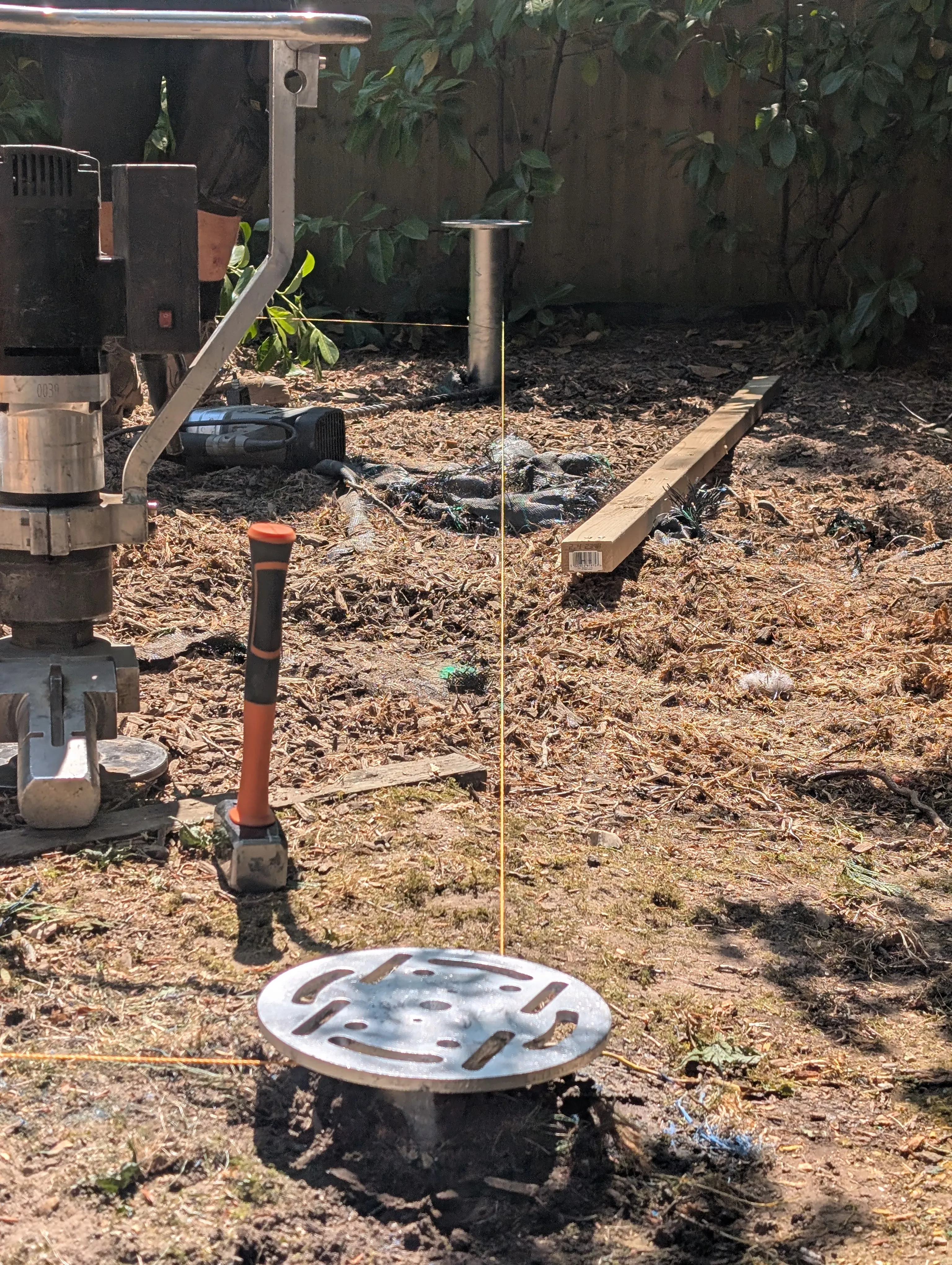
Ground screw testing in Farnborough
JustBases offers standalone ground screw testing in Farnborough for homeowners, installers and project teams. We can discuss suitable screws supplied or fitted by others, as well as trials before a full installation. Choose from pull, compression and lateral testing, with the work and reporting agreed for your project.
Ground screw tests we offer
The test applies a force in a defined direction and records the screw’s response. Agreeing that direction matters: a building may need evidence about downward support, uplift or sideways loading.
Pull-out testing
An upward force examines how the installed screw responds to lifting. The recorded load and movement provide evidence for the agreed uplift or tensile requirement at the tested position.
Learn more: Pull-out testingCompression testing
A direct compression test loads the screw downwards and measures its response. Compression may also be calculated from pull results where a justified method is applicable and agreed; that is reported as a calculation, not as a direct downward test.
Learn more: Compression testingLateral testing
A sideways load examines horizontal response under the agreed test arrangement. The direction and connection matter to the requirement being investigated; lateral testing is separate from applying an upward, downward or twisting load.
Learn more: Lateral testingGround screw testing prices in Farnborough
The guides distinguish the three physical testing methods. Your quotation confirms the required work, test positions and visit arrangements, including travel and the agreed results, written report and any project-specific load calculations. Product information, access and the proposed test setup help establish that scope.
Installation torque monitoring and specialist torsional testing are each price on application. Monitoring records turning resistance while screws are fitted; torsional testing applies an agreed twisting load. These are distinct services, arranged separately rather than automatically added to a physical load test or an installation.
Local guide prices start with our Ringwood prices, adding 0.1% for each one-way road mile to the town, then rounding up to a whole pound. Your written quotation confirms the price for your site and agreed work.
- Pull test (tensile or uplift test)
- From £510
- Load test (compression test)
- From £1,020
- Lateral test (sideways load)
- From £500
- Installation torque monitoring
- Price on application
- Specialist torsional load test
- Price on application
Each additional test
Each extra charge applies to an additional test of the same type, at the same location on the same day. The first test of each type is priced separately.
- Pull test (tensile or uplift test)
- £160 extra
- Load test (compression test)
- £320 extra
- Lateral test (sideways load)
- £155 extra
No VAT is added to the guide prices shown. Guide prices are subject to site conditions, access and the written quotation.
Ask about a ground screw test
Tell us what the foundation supports, or is intended to support, and why a test is being considered. Add the full postcode. Any existing test request, product information or photos are helpful if available, but you can start without them.
Request your free quote
Tell us what you need to find out about the screws. We can discuss the testing from a short outline.
Your enquiry
Ground screw testing in Farnborough
How ground screw testing works
A useful test starts with an agreed purpose and finishes with evidence the project team can interpret. We settle the method, practical arrangements and written scope before attendance.
Agreeing the test
We discuss the question to be answered, the screws concerned and the stage of the project. The responsible designer or project team establishes the required loads, positions and acceptance criteria; the quotation identifies the testing and reporting to be supplied.
Access and safe test arrangements
The tester needs a suitable connection and enough working space for the agreed arrangement. Existing floors and attached structures are considered in that assessment. Leave structural connections in place unless an appropriate safe method has been agreed by the responsible people.
Results and report
The applied loading and response are recorded for the specified test. We provide the results and a written test report, together with project load calculations within the agreed scope. Measured test evidence and calculated figures are identified for what they are.
Testing existing screws and trial installations
A trial can help answer a foundation question before the full layout is installed. Tell us whether screws are already available or whether a trial installation needs arranging, and what decision the results will inform. The product and testing work must be agreed together so the trial produces relevant evidence.
For an existing foundation, start by explaining what is attached to the screws and how the supports can be reached. Photos taken from a safe position can help us assess the next step. Testing may need an agreed arrangement around the structure; do not release a connection, lift a floor or load a support yourself to make it ready.
What your test report tells you
Read the result against the question the test was commissioned to answer. For example, an uplift result describes response to an upward test; a direct compression result records downward loading. The report identifies the tested position and relevant arrangement so the responsible designer can consider the evidence against the project’s requirements.
If compression capacity is calculated using pull-test evidence, the report makes the calculation and its applicable basis clear. It does not describe that figure as a measured compression result. Test results and agreed calculations contribute to the foundation decision; the complete building, connections and design still need the appropriate review and approval.
Arranging testing in Farnborough
When arranging the visit, give us the actual work address and tell us how the test area is reached. We will discuss anything that needs to be ready for safe testing before confirming attendance.
For other work, see Farnborough ground screw installation or poured concrete bases. The town service page explains the available foundation choices, and our Hampshire directory lists other service towns. Testing can be booked on its own.
Areas we cover around Farnborough
We welcome enquiries from Farnborough town centre, Cove, Southwood, North Camp and South Farnborough, West Heath, Cherrywood, Fernhill, Empress, Knellwood and St John’s. Nearby residential areas include the Prospect Estate, Mayfield and Grange, Pinewood Park, Sycamore Park, St Christopher’s estate, the Hawley Estate and Fox Lane area, Farnborough Street, Pinehurst Road, Westmead and the streets around Queen Elizabeth Park.
Around Blackwater we also consider work in Hawley, Hawley Green, Minley, Frogmore, Darby Green and Yateley, and nearby Sandhurst, Little Sandhurst, College Town and Owlsmoor. To the east are Frimley, Frimley Green, Mytchett, Deepcut and Camberley, including Heatherside, Parkside, Old Dean, St Michaels and Watchetts.
The surrounding area includes Fleet, Ancells Farm, Elvetham Heath, Hartland Village, Church Crookham, Crookham Park, Crookham Village, Zebon Copse, Edenbrook, Dogmersfield, Ewshot and Crondall. We also welcome enquiries from Aldershot, Wellesley, Ash Vale, Ash, Ash Green and Tongham.
Send the full site postcode so we can confirm the work and travel in your quotation. Farnborough addresses include GU14; nearby examples fall within GU11, GU12, GU15, GU16, GU17, GU46, GU47, GU51, GU52 and GU10. Availability is confirmed for your address and requested service.
Feedback on Craig’s earlier work
Feedback on Craig’s earlier groundwork and customer service.
"Craig and the team are absolutely fantastic. From courtesy, to standard of work, to tidiness — everything exceeded expectations. The job was arranged, booked and done extremely quickly and we are very happy with the results. Nothing was too much trouble, and communication was easy."
"Craig and his crew were excellent from the first communication, quote, timing of work and quality of work. Highly recommended."
Frequently asked questions
Can you test screws installed by another contractor?
Yes, you can enquire about testing independently of an installation purchase. We need to establish what product is present, what the test should show and whether a suitable arrangement is possible. Share any installation records you have; if information is missing, explain what you know so we can discuss the assessment needed.
Which physical testing methods can I request?
Pull-out, compression and lateral testing are available for the agreed project. They apply upward, downward and sideways forces respectively. If a designer has asked for testing, share their request so the method matches the evidence required. If you are unsure, describe the foundation and the reason for the enquiry first.
What does a pull-out test measure?
It records the response as an upward force is applied to the screw. The load and movement are considered with the agreed test conditions and uplift requirement. This gives the project team evidence about the tested screw at its position.
How is a direct compression test carried out?
The arrangement applies downward load to the screw and records its movement as specified in the test brief. This supplies physical evidence for a compression requirement. Before the visit we agree the loading and safe setup with the relevant project information, so the result can be assessed against the required criteria.
Can compression be calculated from a pull result?
It can be part of the agreed service where the method is justified for the screw and site concerned. The resulting compression figure is calculated from evidence and assumptions appropriate to that method. It is labelled as a calculation in the report and remains distinct from physically pushing down on the screw and measuring the response.
What can a lateral test establish?
It examines how the support responds to a horizontal load in the agreed direction. That can provide evidence where sideways movement or resistance is relevant to the design. The connection and test arrangement are settled for the requirement; a lateral test is not an applied torsional test, which concerns twisting.
Is installation torque monitoring a load test?
Monitoring records the turning resistance encountered while a screw is being installed. It provides installation information, whereas a physical test applies a defined force and measures response. Any use of torque information in assessing capacity needs an applicable justified basis. Monitoring is separately arranged and priced on application, not automatically included.
What is a torsional test?
A specialist torsional test applies a twisting load to investigate the screw’s rotational response. If this is what your designer needs, share the requirement so the arrangement can be considered and quoted. It is a separate price-on-application service from recording torque during installation and from pull, compression or lateral testing.
Can a trial be tested before the full foundation is installed?
Yes, testing can be discussed at the stage when the proposed foundation is being selected. First establish the purpose of the trial and the screw or installation arrangement to investigate. We then agree the test scope and price any trial supply or fitting required.
Can screws underneath an existing structure be tested?
That needs an assessment of the structure, the connections and safe access to the relevant supports. Describe what is in place and send any safely obtainable photographs. Keep the structure supported as it is: testing preparation or alteration to a connection must follow an appropriate agreed method, not improvised work to expose the screw.
Who specifies the test load and acceptance criteria?
The responsible designer or project team needs to define the requirement the foundation must meet. We discuss that requirement when agreeing the test, including relevant positions and loading. You can contact us before those figures are settled; the necessary brief is resolved before testing rather than being a barrier to asking for advice.
What will I receive after the visit?
The service provides recorded results and a written test report, with the project-specific load calculations agreed in the quotation. Any calculated evidence is distinguished from direct measurements. If your project needs a particular submission format or additional professional sign-off, raise it when discussing the scope so the required service can be confirmed.
Does a successful test approve the complete building?
The test supplies evidence for the specified foundation requirement and positions. Your designer considers that evidence with the frame, connections, building loads and wider design, and the relevant approval process remains separate. A test result is not automatic certification of the whole structure.
How can I request a testing price without a technical brief?
Give us the postcode and explain why testing is being considered, such as a request from the building supplier or a check of fitted screws. Tell us the project stage and any product details you know. We can then work through the necessary scope with you; drawings and photographs are optional at first contact. At the same location on the same day, each additional compression test costs £320 extra, each additional pull, tensile or uplift test costs £160 extra, and each additional lateral test costs £155 extra. These fixed charges are for further tests of the same type; the first test of each type is priced separately.
What happens next
Explain the testing purpose and we will discuss a suitable scope and provide a written price. Once the requirement and safe arrangements are agreed, we can arrange the visit and the information to be supplied afterwards.
Request a testing quote, call 01202 039753 or message Craig on WhatsApp.