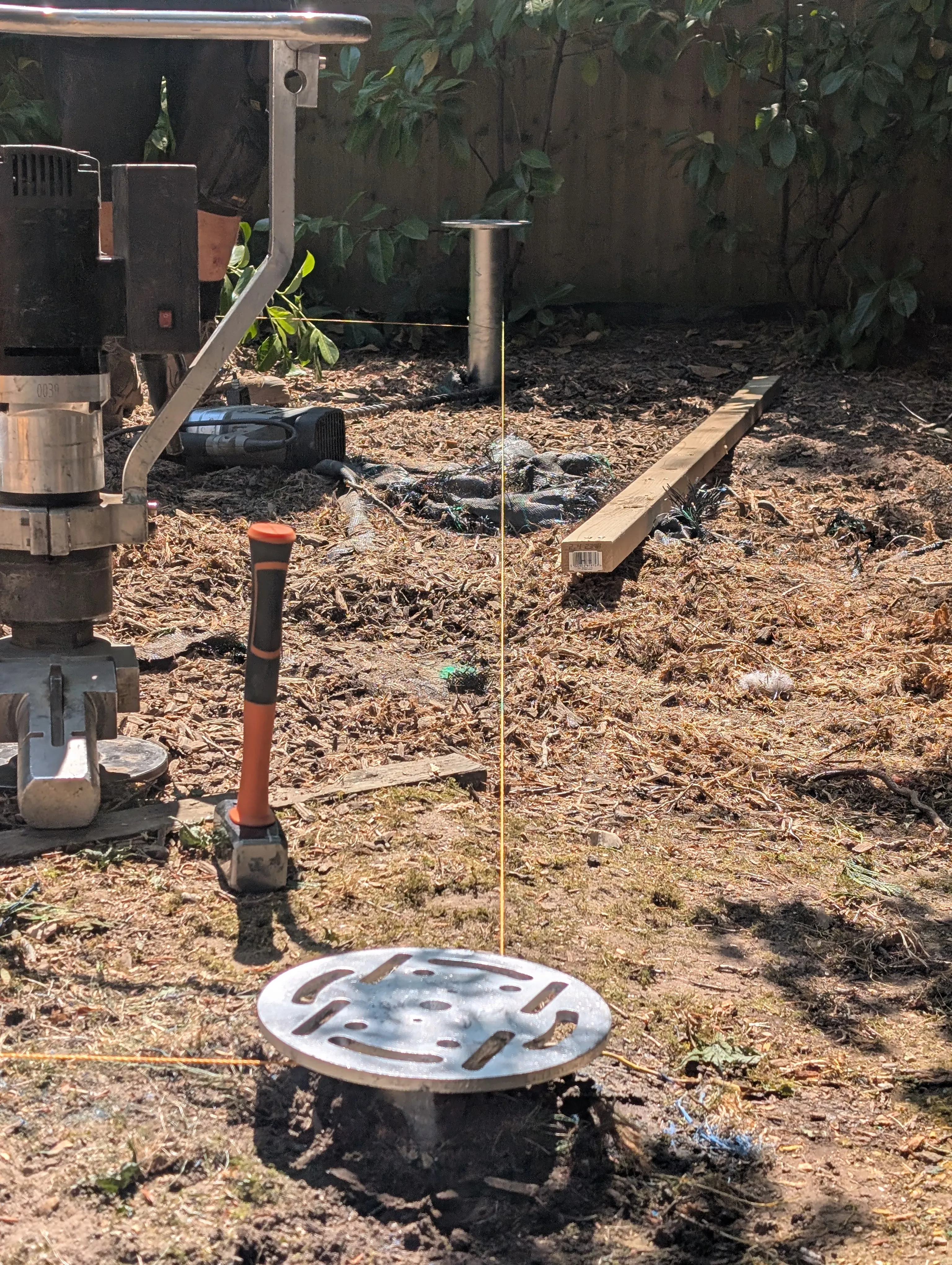
Ground screw testing in Fleet
JustBases offers standalone ground screw testing in Fleet for trial installations and suitable existing supports, including screws installed by others. We discuss the required pull-out, compression or lateral evidence and quote the recorded results, written report and project-specific load calculations agreed for the work.
Ground screw tests we offer
Testing starts with the load the foundation needs to be assessed against. Upward, downward and sideways loading have different purposes, and the agreed work must obtain the evidence required for that project.
If you have been asked for a ‘load test’, you can send the request without deciding the method yourself. We can discuss which direction and scope need clarifying before the work is quoted.
Pull-out testing
A pull-out test applies force upwards and records the screw’s response. It provides evidence about uplift resistance under the agreed conditions, with the loading and acceptance requirements established for the intended assessment.
Learn more: Pull-out testingCompression testing
A physical compression test applies force downwards and records the resulting response. It is direct evidence of downward loading. Compression calculations based on another test are identified separately and used only through a method applicable to the screw and project.
Learn more: Compression testingLateral testing
A lateral test applies force sideways to investigate horizontal response. The required direction and test arrangement are agreed for that foundation requirement. This can be booked independently or with other specified physical tests.
Learn more: Lateral testingInstallation torque monitoring
Monitoring records turning resistance while a screw is driven into the ground. It is a separately arranged installation service, price on application, not an automatically included load test. The reading is installation information rather than a universal measure of foundation capacity.
Specialist torsional testing
A torsional test applies an agreed twisting load to examine the response. This is a separate specialist service, price on application. It differs from the resistance recorded during installation and is not automatically supplied with pull, compression or lateral testing.
Ground screw testing prices in Fleet
The physical-testing guide below helps you discuss the service needed. The written price relates to the agreed tests and practical arrangements, including the results, report and project-specific calculations commissioned.
The number of selected points, loading directions and work needed for a safe setup can affect the scope. Existing connections and any required preparation should be discussed before attendance. Insertion-torque monitoring and applied torsional testing each have a separate price-on-application scope.
Local guide prices start with our Ringwood prices, adding 0.1% for each one-way road mile to the town, then rounding up to a whole pound. Your written quotation confirms the price for your site and agreed work.
- Pull test (tensile or uplift test)
- From £508
- Load test (compression test)
- From £1,016
- Lateral test (sideways load)
- From £498
- Installation torque monitoring
- Price on application
- Specialist torsional load test
- Price on application
Each additional test
Each extra charge applies to an additional test of the same type, at the same location on the same day. The first test of each type is priced separately.
- Pull test (tensile or uplift test)
- £160 extra
- Load test (compression test)
- £320 extra
- Lateral test (sideways load)
- £155 extra
No VAT is added to the guide prices shown. Guide prices are subject to site conditions, access and the written quotation.
Ask about a ground screw test
Give the postcode and explain why testing is needed. If another person has requested it, you can forward their wording or tell us what decision the evidence is intended to support.
Existing screw details, photographs or a testing brief are helpful when available, but you can start without them. Use the form, call 01202 039753 or send a WhatsApp message to discuss the next step.
Request your free quote
Give us your contact details and a short description of the testing you need. You can ask before the technical requirements are complete.
Your enquiry
Ground screw testing in Fleet
How ground screw testing works
Before testing, the loading and criteria must be established for the foundation question. We agree how the work can be carried out and what information will be supplied, so the test has a defined purpose and scope.
Establish the testing requirement
We discuss the proposed test positions and the evidence needed with the relevant project requirements. The responsible designer or assessor specifies the required loading and acceptance criteria. The quotation confirms the test scope and any project-specific calculations to be provided.
Carry out the agreed loading
We assess access, the connection and the practical setup for the selected screw. Once safe arrangements are established, we apply the agreed loading and record its response under the specified procedure. The test limits and the effect on any connected structure form part of planning that work.
Provide the commissioned findings
We supply recorded results and a written report, together with the project-specific load calculations agreed in the quotation. The findings describe the evidence obtained from the commissioned work for the responsible project party to assess. They are not an automatic complete foundation-design service.
Testing existing screws and trial installations
A trial can be commissioned while the main foundation is being considered. Agree what the trial is intended to investigate and whether supplying and installing its screw is part of the work requested. That avoids leaving trial installation outside a testing-only quotation when it is also needed.
A screw already carrying a frame or building needs a safe test arrangement appropriate to that structure. Tell us what is attached and what you can see from a safe position. Any opening, unloading or temporary support must be planned by the responsible competent parties; leave load-bearing connections in place when making the enquiry.
What your test report tells you
The report makes the evidence from the agreed test clear: the applied loading and measured response, with the project-specific calculations commissioned. Where compression is derived through an applicable pull-test calculation, its basis and assumptions are identified rather than presented as direct downward-test results.
Your designer or assessor uses those findings against the project’s requirements. The report concerns the commissioned testing; it does not approve the complete building or establish the suitability of every other structural component and connection.
Arranging testing in Fleet
For new foundations as well as evidence, see Fleet ground screw installation. Our Fleet base services explain the other construction methods, and the Hampshire service area helps with another location. A test can be booked without buying an installation.
Areas we cover around Fleet
We welcome enquiries from Fleet, the surrounding Hampshire villages and adjoining border communities below. Give the site postcode so we can confirm the work, travel and visit arrangements for the actual address.
Examples include GU51 and GU52 around Fleet and the Crookhams; GU10 at Ewshot and Crondall; RG27 around Winchfield, Dogmersfield, Hartley Wintney and Hook; RG29 around Odiham and North Warnborough; GU17 around Blackwater, Hawley and Darby Green; and GU46 at Yateley.
Standalone ground screw testing is available in Farnborough (GU14), Aldershot (GU11), Farnham (GU9), Camberley (GU15), Frimley and Mytchett (GU16), and Sandhurst (GU47). Tell us why evidence is needed and whether upward, downward or sideways response has been requested. An existing test brief and photos of the connections help us agree the test arrangement and written report; you can ask for help clarifying the scope.
See the separate Farnborough, Aldershot and Farnham services, or where we work in Hampshire.
Fleet and its residential areas
The centre, North Fleet, Blue Triangle area, West Fleet, South Fleet, Calthorpe Park area, Courtmoor, Court Manor, Ancells Farm, Pondtail, Dinorben, Velmead Road area, Basingbourne, Oakley Park area, Elvetham Heath, Edenbrook and Hareshill.
Church Crookham and Crookham Village
Church Crookham, Gally Hill, Sandy Lane Triangle, Queen Elizabeth area, Tweseldown Road area, Quetta Park, Wakefords Park, Crookham Village, Zebon Copse and Netherhouse Moor.
Crondall and Ewshot
Crondall, Rye Common, Ewshot, Beacon Hill, Warren Corner, Dora’s Green and Dippenhall.
Dogmersfield, Winchfield and Hartley Wintney
Dogmersfield, Pilcot and Pilcot Hill, Winchfield, Winchfield Hurst, Winchfield Court, Beauclerk Green, Shapley, Shapley Heath, Potbridge Road area, Hartley Wintney, Phoenix Green, Hartfordbridge, Dipley, West Green, Elvetham, Hook, Murrell Green and the Bartley Heath area.
Odiham and nearby villages
Odiham, North Warnborough, Greywell, Long Sutton, Well and South Warnborough.
Other nearby Hart communities
Rotherwick, Mattingley, Hound Green, Hazeley, Hazeley Lea, Hazeley Bottom, Hazeley Heath, Heckfield, Bramshill, Eversley Village, Eversley Centre, Eversley Cross, Eversley Street, Up Green, Lower Common, Yateley, Darby Green, Frogmore, Blackwater, Hawley, Hawley Green, Minley and Hartland Village.
Neighbouring towns and the county borders
Farnborough, Cove, Southwood and Aldershot in Hampshire; Farnham, Camberley, Frimley, Frimley Green and Mytchett in Surrey; Sandhurst, Little Sandhurst, College Town and Owlsmoor in Berkshire.
Feedback on Craig’s earlier work
Feedback on Craig’s earlier groundwork and customer service.
"Craig and the team are absolutely fantastic. From courtesy, to standard of work, to tidiness — everything exceeded expectations. The job was arranged, booked and done extremely quickly and we are very happy with the results. Nothing was too much trouble, and communication was easy."
"Craig and his crew were excellent from the first communication, quote, timing of work and quality of work. Highly recommended."
Frequently asked questions
Answers about requesting a test, understanding its evidence and arranging the work.
I have been asked for a load test. How do I start?
Send the request if you have it, or explain what is being supported and why evidence is needed, with the postcode. You do not need to translate the request into a technical procedure yourself. We can discuss what must be clarified with the responsible project party before a particular test is agreed.
Which forces can you test a screw against?
Pull-out testing investigates upward force, compression testing investigates downward force and lateral testing investigates sideways force. The relevant direction follows the foundation requirement, and more than one may be specified. We quote the required evidence rather than treat one direction as a direct measurement of all the others.
Can the testing be separate from whoever installed the screws?
Yes. JustBases considers suitable third-party screws for standalone testing, with no requirement to buy an installation from us. Tell us what is already fitted and the intended assessment. The screw and its connections need to be considered with the proposed setup before the work can be confirmed.
Can I arrange evidence before a complete foundation is installed?
Yes, an agreed trial can help inform a foundation decision before wider work proceeds. Its product, position and installation need to be relevant to the intended question. Let us know whether you also require the trial screw supplied and installed, or whether another party is arranging that work, so the quotation covers the correct scope.
Can a support beneath an attached building be considered?
It can be assessed for the proposed test, but the structure it supports affects the safe arrangements. The responsible parties may need to plan preparation or temporary support before a load is applied. Start by describing the building and connection; suitability is confirmed from that assessment rather than assumed from a visible screw head.
Should I uncover or loosen anything before asking for a quote?
No. Describe what you can safely see and send photographs or records already available. A loaded connection should stay intact while the test is being discussed. If opening up or other structural preparation is necessary, its method and responsibility must be agreed safely before that work is undertaken.
Who specifies the loading and acceptance requirements?
The responsible designer or assessor identifies the load evidence needed for the project and the criteria it will be judged against. We agree the test arrangement and quoted work to address that requirement. You can enquire before those details are complete; they need to be resolved before testing, not before the first conversation.
Is calculated compression the same evidence as pushing down on a screw?
No. A direct compression test applies the downward load and measures the response. An applicable method may instead support a project-specific compression calculation from pull-test data, with its assumptions and basis stated. That calculation must be identifiable as such, and it is not automatically suitable for every screw, site or requirement.
When should I request insertion-torque monitoring?
Ask while arranging installation, because monitoring records turning resistance as the screw is driven. Monitoring is separately priced on application and is not automatically included.
How does a torsional test differ from monitoring installation?
Specialist torsional testing deliberately applies a twisting load to investigate rotational response. Monitoring instead records the resistance encountered during insertion. Each is separately scoped and price on application, and neither should be substituted for a specified upward, downward or lateral load test.
Which documents and calculations are supplied?
The agreed service provides recorded results, a written test report and the project-specific load calculations included in your quotation. Tell us about any requested information while the scope is being established. The calculation and reporting work is defined for the commission, rather than assuming a complete design package is included with every test.
Does a test report settle every part of the building design?
No. It supplies the agreed test evidence for the responsible designer or assessor to use. The complete building and foundation have further design and connection requirements beyond the selected test. A report does not automatically grant building-control approval or carry a warranty that the whole structure is suitable.
What if space around the proposed test position is limited?
Show or describe what is around the support and how it can safely be reached. The tester needs a suitable connection and space for an arrangement that applies the agreed force. We assess that practicality before confirming the visit, and any necessary preparation has to be agreed with the people responsible for the site and structure.
What needs agreeing before a testing visit is booked?
You should have a written scope and price that address the required evidence and deliverables. The practical setup and any preparation also need an agreed responsibility before attendance. Start with the purpose and postcode, and we can work through the further information needed to reach that point.
What does each additional ground screw test cost?
At the same location on the same day, each additional compression test costs £320 extra, each additional pull, tensile or uplift test costs £160 extra, and each additional lateral test costs £155 extra. These fixed charges are for further tests of the same type. The first test of each type is priced separately, using the starting price for your location. The extra-test charges stay the same in every location.
What happens next
Tell us where the foundation is and what you need to establish. We can help clarify the proposed tests and provide a written quotation identifying the work and agreed reporting and calculations.
Send your testing enquiry, call 01202 039753 or use WhatsApp. The initial description can be brief; technical details are agreed before the test is carried out.