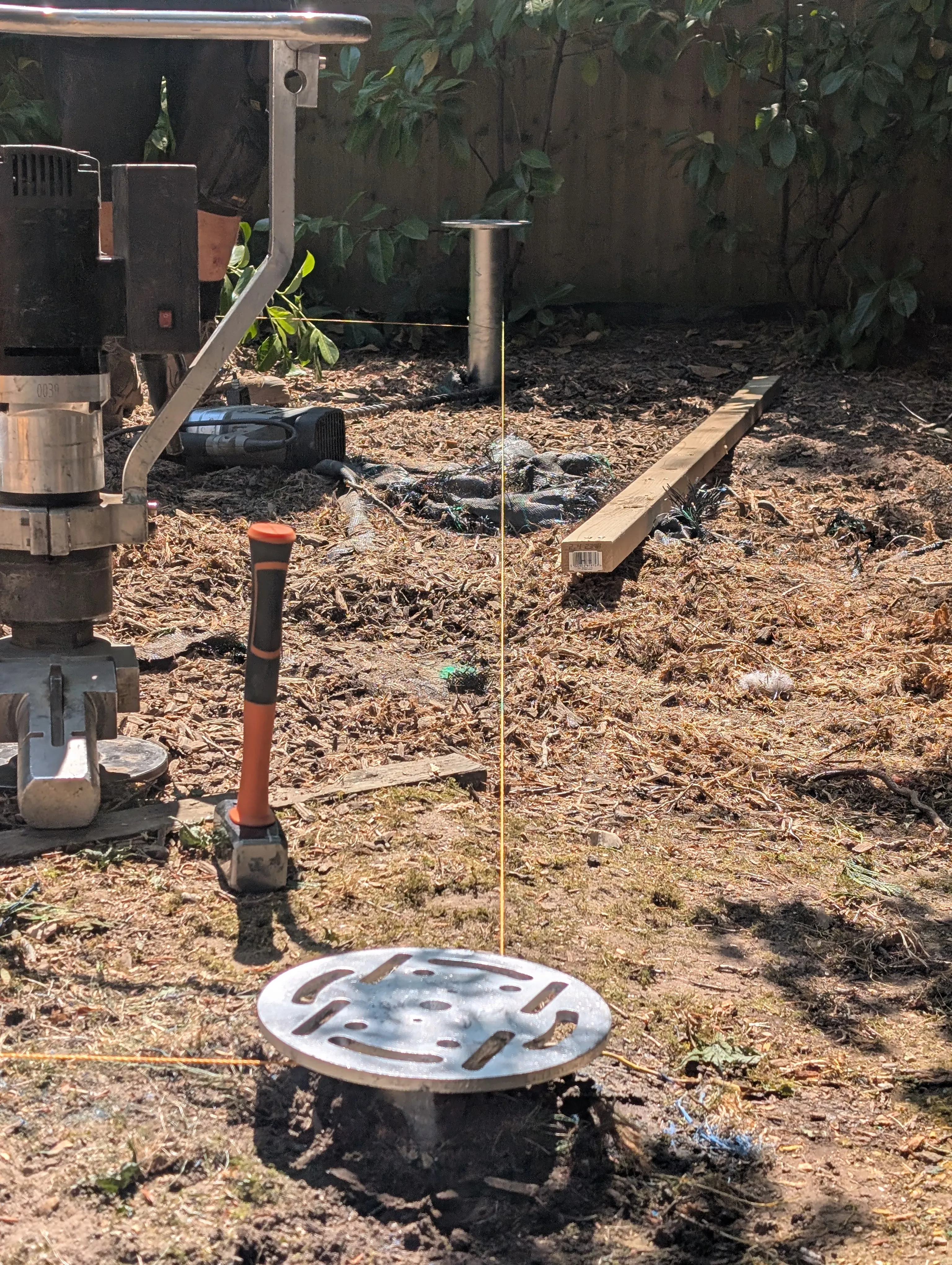
Ground screw testing in Gosport
For measured information about a screw foundation in Gosport, JustBases offers pull-out, direct compression and lateral testing. You can commission a test independently for suitable trial or existing screws, including supports supplied or installed by another company. The agreed service provides recorded findings, a written report and project load calculations within scope.
Pull-out, compression and lateral tests
Each method measures response to a particular direction of force. The proposed building or foundation assessment determines which evidence is required; we then agree a practical programme with the responsible assessor.
Pull-out testing
The test pulls upwards on a selected screw to examine uplift resistance. Applied loading and the resulting response are recorded, providing evidence for the specified upward-force requirement at that support.
Learn more: Pull-out testingDirect compression testing
A downward load is applied to the screw and its movement is measured under the agreed conditions. This is a physical compression test. Any compression value calculated from pull-test information is a separate derived assessment using an applicable agreed method.
Learn more: Direct compression testingLateral testing
Sideways loading measures horizontal response. The programme defines the relevant force direction and arrangement for the foundation being assessed. It is a distinct test, not an inference from the upward or downward result.
Learn more: Lateral testingGround screw testing prices in Gosport
The physical-test guide fees are below. A quotation is based on the programme you actually need, including the methods and positions, the practical setup, travel and any calculation work. Tell us about proposed stages or additional visits so they can be allowed for.
There are also two distinct torque services. Insertion-torque monitoring records turning resistance as a screw is driven. Specialist torsional testing applies a separate twisting action to examine rotational response. Both are price on application and separately commissioned; neither is automatically included with installation or a physical load test.
Local guide prices start with our Ringwood prices, adding 0.1% for each one-way road mile to the town, then rounding up to a whole pound. Your written quotation confirms the price for your site and agreed work.
- Pull test (tensile or uplift test)
- From £499
- Load test (compression test)
- From £998
- Lateral test (sideways load)
- From £489
- Installation torque monitoring
- Price on application
- Specialist torsional load test
- Price on application
Each additional test
Each extra charge applies to an additional test of the same type, at the same location on the same day. The first test of each type is priced separately.
- Pull test (tensile or uplift test)
- £160 extra
- Load test (compression test)
- £320 extra
- Lateral test (sideways load)
- £155 extra
No VAT is added to the guide prices shown. Guide prices are subject to site conditions, access and the written quotation.
Discuss the test you need
Start by saying what needs to be established and where the site is. You may be arranging work for a designer, an installer or your own building project. We can discuss the available service before the detailed technical requirement has been completed.
Share existing instructions or records if you have them, or explain what is currently known. The form below, WhatsApp and 01202 039753 all provide a straightforward way to speak with Craig about a standalone quotation.
Request your free quote
Give us your contact details and a short description of the testing you need. You can ask before the technical requirements are complete.
Your enquiry
Ground screw testing in Gosport
From a testing request to recorded findings
The programme must be clear before testing begins. The person responsible for the foundation assessment sets the required loading and acceptance criteria, while the test arrangement must be practical and safe for the selected supports.
Define the required evidence
Identify the foundation, why testing is requested and which force directions matter. Agree the positions, loading programme and deliverables with the responsible assessor, including any load calculations to be commissioned.
Confirm a safe loading arrangement
Review the screws, connections and work area for the proposed test. Establish the necessary access and preparation, with any work affecting a supported structure allocated to competent people before attendance.
Carry out and document the agreed work
Apply the specified test loading and record the response and relevant observations. Provide the agreed report and calculations for the assessor to review, including any limitation or departure encountered during the work.
Choosing a useful testing stage
Testing can take place while a foundation is being developed or after screws have been installed. A trial gives evidence to inform the proposed design. A test on an installed support examines the selected screw in its existing arrangement. The programme should be timed so the findings can be considered before dependent building work proceeds.
Where a frame or building is attached, the effect of applying test loads has to be assessed with that structure. Send safely visible information and leave its connections intact. Opening-up, unloading or temporary support, if required, must follow a competent agreed plan; a testing appointment does not by itself include those building works.
Understanding the written findings
A useful written record explains the response under the loading that was actually applied. The force direction, tested support and test circumstances give those measurements their meaning. Keep that information together when using the findings, including any test stopped early or point not completed as planned.
The responsible assessor uses the measured response against the project’s criteria and decides what it permits the design to do next. The test report provides evidence for that assessment; it does not automatically certify the building or grant Building Control approval. Any additional professional or regulatory requirement needs its own agreed scope.
Preparing for a Gosport testing visit
Use the agreed quotation to organise the site for the visit. Check which supports and force directions are included and which preparatory tasks are being supplied by someone else. Where trial installation is needed, make sure it is ready for testing; its supply and fitting are separately identified in the scope.
Before confirming attendance, let us know who will meet the team and how to reach the work area. That contact should have the agreed preparation detail available and be able to keep the required space clear. We discuss practical questions while the booking is being settled.
You can keep testing separate from construction. If you also need new supports, see Gosport ground screw installation. Our Gosport base services explain the wider foundation offer, while the Hampshire locations help you check other nearby towns.
Areas we cover around Gosport
Send the full site postcode for a testing enquiry in Gosport or the neighbouring places listed below. We confirm the test requirement and travel for the particular address in the written quotation.
Local enquiries commonly use PO12 or PO13, with parts of PO14, PO15, PO16, PO17 and SO31 relevant to the adjoining named places. You can ask about a site between those places as well as one in the town.
- Gosport town and nearby neighbourhoods: the town centre and harbourside, Stoke Road, Newtown, Leesland, Forton, Camdentown and Ann’s Hill.
- Alverstoke and adjoining areas: Anglesey, Gomer, Clayhall, Haslar, Stokes Bay, Brockhurst and Privett.
- Elson and Hardway: Priddy’s Hard, Royal Clarence Yard and the surrounding Gosport neighbourhoods.
- Rowner and north Gosport: Holbrook, Bridgemary, Bedenham, Fleetlands and Peel Common.
- Lee-on-the-Solent and nearby areas: Cherque Farm, Browndown, Grange and Alver Valley.
- Adjoining Fareham-area places: Stubbington, Hill Head, Titchfield, Catisfield, Fareham, Portchester, Wallington, Downend and Funtley.
- Further nearby enquiries: Titchfield Common, Hook, Warsash, Locks Heath, Park Gate, Sarisbury Green, Swanwick, Burridge and Whiteley, plus Wickham and Knowle.
Feedback on Craig’s earlier work
Feedback on Craig’s earlier groundwork and customer service.
"Craig and the team are absolutely fantastic. From courtesy, to standard of work, to tidiness — everything exceeded expectations. The job was arranged, booked and done extremely quickly and we are very happy with the results. Nothing was too much trouble, and communication was easy."
"Craig and his crew were excellent from the first communication, quote, timing of work and quality of work. Highly recommended."
Ground screw testing FAQs
You can enquire in ordinary terms, then develop the loading brief and practical arrangements with the people responsible for the assessment.
Can I request testing while using my own foundation installer?
Yes. Tell your installer that testing is being arranged so the selected supports can be ready at the agreed stage. We review a suitable method for the product and connections, then quote the testing and written evidence on its own. The scope identifies our service and the work your installer will complete separately.
What do the three physical test directions tell me?
Pull-out testing examines response to an upward force, direct compression applies downward loading and lateral testing examines sideways response. They address different actions on a foundation. A project may require one or several, so the assessor identifies the relevant measurements rather than treating the methods as substitutes.
What is a proof test intended to establish?
It checks a selected installed support against an agreed loading requirement and response criteria. The programme sets how the test is carried out and when it should stop. The findings then need to be considered by the responsible assessor for that purpose, with the tested screw and arrangement clearly identified.
Can testing happen before the frame arrives?
That can be a useful stage when the selected supports and loading arrangement are accessible. The test must still be planned around the foundation requirement, with the designer’s criteria and the installation sequence agreed. Discuss it early enough for the findings to be reviewed before the next construction stage relies on them.
Can a screw be tested while it supports a building?
It may be possible for a suitable selected support, but the structure and test loads need a safe combined assessment. Leave fixings undisturbed when enquiring and describe what is attached. Any required access work, unloading or temporary support must be designed and arranged by competent people before testing.
How much working space does testing need?
The requirement depends on how the load is applied and safely opposed, not only on whether the screw head is visible. Describe the surrounding frame, ground and access so the tester can assess a workable arrangement. We settle the required preparation before confirming the visit.
Will every screw in the foundation be tested?
Only the positions agreed in the programme are included. The assessor determines the evidence needed for the foundation, which may involve selected supports or a more extensive set of tests. The report identifies what was actually examined, and a result remains tied to that work.
Who decides how much load should be applied?
The responsible designer or assessor defines the required loading and how the response will be judged. We establish a practical programme against that requirement before carrying it out. If you have only received a general request for testing, share it and we can clarify the next technical discussion.
Can I share an existing manufacturer’s test report?
Yes, send it if available and explain the evidence needed for your current project. The responsible assessor can consider it with the foundation information and decide whether further on-site measurements are required. We can then discuss the requested new testing and how its findings will contribute to that assessment.
Does insertion-torque monitoring replace a physical test?
It records turning resistance while a screw is being installed, not the movement under a later upward, downward or sideways load. Its role in a capacity assessment needs a justified relationship applicable to the product and conditions. Monitoring is a separately specified service and is price on application.
What does specialist torsional testing involve?
It applies an agreed twisting action to assess rotational response. That is distinct from recording installation turning resistance and from a lateral force acting sideways. Share the rotational requirement so the appropriate setup and evidence can be scoped; specialist torsional testing is priced on application.
How is a calculated compression value distinguished from a measured one?
A direct compression result comes from applying downward load and measuring response. A derived compression assessment uses a calculation, potentially based on pull-test data, under an applicable agreed method and assumptions. The reporting must identify which evidence produced the figure so its use in the project remains clear.
Can several test types be priced together?
Yes, describe the full requirement so the programme can be quoted as a whole. The test positions, loading setups, site readiness and reporting may affect how the work is arranged. We confirm what can practically be included in a visit and identify any additional attendance or calculations in the price. At the same location on the same day, each additional compression test costs £320 extra, each additional pull, tensile or uplift test costs £160 extra, and each additional lateral test costs £155 extra. These fixed charges are for further tests of the same type; the first test of each type is priced separately.
What should I have ready before asking for a testing quote?
Only the testing purpose and postcode are needed to start. If you know who requested the evidence, what the screws support or when the findings are needed, add that information. A complete brief, records and safe preparation are developed before the work is booked, not demanded before the first enquiry.
Arrange the testing discussion
Tell Craig the question you need answered and the postcode using the testing form, WhatsApp or 01202 039753. Existing files are optional for that initial discussion.
We will explain what needs confirming, agree the appropriate work and provide a written quotation before arranging attendance.