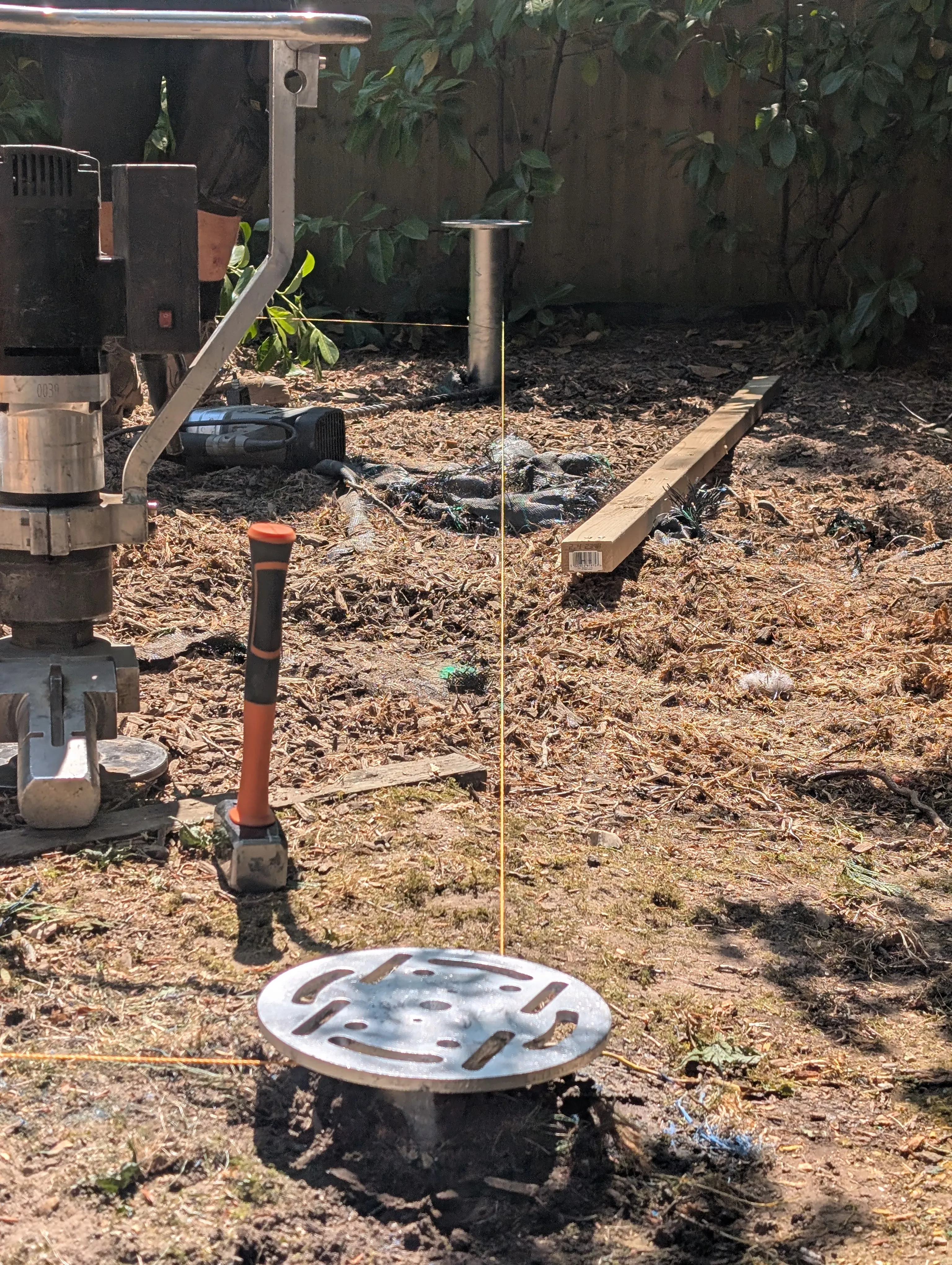
Ground screw testing in Lyme Regis
JustBases offers standalone ground screw testing in Lyme Regis, including suitable trial screws and existing foundations installed by others. We apply the agreed test loads and record the response, supplying results and a written report. Project-specific load calculations are provided within the scope agreed in your quotation.
Ground screw tests we offer
The loading direction matters to the evidence a test provides. We discuss the foundation question and agree the relevant method before attendance. Upward, downward and sideways testing are available as separate physical services.
Two further services concern turning forces. Recording resistance during installation and applying a separate twisting test are distinct from one another and from the three physical load directions below.
Pull-out testing
An upward load measures the tested screw’s response to uplift. The result relates to the screw, position and loading conditions recorded for the agreed assessment.
Learn more: Pull-out testingCompression testing
A direct compression test loads the screw downwards and measures its response. Where an applicable method is agreed, compression capacity can also be calculated from pull data; that is identified as calculated evidence, not a direct downward test.
Learn more: Compression testingLateral testing
A sideways load measures horizontal response in the required direction. This addresses a lateral requirement rather than substituting for an upward, downward or twisting test.
Learn more: Lateral testingInstallation torque monitoring
Turning resistance is recorded while the specified screws are driven. Monitoring must be arranged for installation and is separately priced on application; it is not automatically part of installation or load testing.
Specialist torsional testing
An applied twisting action assesses the rotational response required by the project. This is a specialist test with its own scope, separately priced on application and not automatically included with monitoring or other tests.
Ground screw testing prices in Lyme Regis
Use the guide below for the physical test services. Your written quotation confirms the methods, selected positions and site arrangements, including travel. The scope and method for any project-specific calculations are agreed with that work.
Recorded results and a written report are normal testing deliverables. Installation torque monitoring and specialist torsional testing each require a separate price on application; neither is an automatic addition to a physical test.
Local guide prices start with our Ringwood prices, adding 0.1% for each one-way road mile to the town, then rounding up to a whole pound. Your written quotation confirms the price for your site and agreed work.
- Pull test (tensile or uplift test)
- From £510
- Load test (compression test)
- From £1,019
- Lateral test (sideways load)
- From £499
- Installation torque monitoring
- Price on application
- Specialist torsional load test
- Price on application
Each additional test
Each extra charge applies to an additional test of the same type, at the same location on the same day. The first test of each type is priced separately.
- Pull test (tensile or uplift test)
- £160 extra
- Load test (compression test)
- £320 extra
- Lateral test (sideways load)
- £155 extra
No VAT is added to the guide prices shown. Guide prices are subject to site conditions, access and the written quotation.
Ask about a ground screw test
Explain the decision the test needs to support, or pass on the request you have received. Let us know the work postcode and whether screws are proposed or already in place. We can discuss the enquiry before a complete testing brief exists.
If available, attach a product record, layout or photographs. We will establish what further details are needed to agree a safe test and useful evidence for the project.
Request your free quote
Give us your contact details and a short description of the testing you need. You can ask before the technical requirements are complete.
Your enquiry
Ground screw testing in Lyme Regis
How ground screw testing works
The test is arranged around the required evidence and the screw that will be loaded. We confirm the work in writing before carrying out the agreed testing.
Agree what needs to be measured
The responsible designer or assessor identifies the loading requirement and acceptance criteria. We agree the method, positions, records and calculation scope needed to address that requirement.
Prepare a safe test arrangement
We assess how a safe connection and reaction can be achieved, allowing for access, working space and any load or structure already on the screw. Existing structural fittings should remain undisturbed while this is assessed.
Test and supply the findings
The agreed load is applied and the screw’s response recorded. We supply the results and a written report, together with the project-specific calculations agreed in the quotation.
Testing existing screws and trial installations
Trial testing can help the project team evaluate a proposed screw installation before the whole foundation is fitted.
Existing foundations need their current arrangement considered. A visible head may already carry a floor or frame, so we assess both the connection available for testing and the loads already present. You can enquire about another installer’s screws; share any information you hold and leave the connections in place.
What your test report tells you
The report presents the recorded evidence from the agreed tests: which points were tested, the method and loads used, and the measured response. This lets the project’s responsible designer or assessor consider the findings against the required criteria.
Project-specific load calculations are supplied as agreed in the quotation. The basis of a calculated value needs to be clear, particularly where compression is derived using an applicable method rather than measured by downward loading. The report supports the foundation assessment; it does not by itself certify the complete building or grant approval.
Arranging testing in Lyme Regis
We welcome testing enquiries from homeowners, building suppliers and project teams in the places below. For a new foundation as well as testing, see Lyme Regis ground screw installation. Our town services page explains the other base methods, and the Dorset service area helps you check other locations.
Areas we cover around Lyme Regis
Ask us about work in Lyme Regis and the neighbouring Dorset and Devon villages below. Send the full work address or postcode so we can confirm the job arrangements and include travel in the written quotation.
Useful district examples are DT7 around Lyme Regis, Uplyme and Rousdon; DT6 around Charmouth, Marshwood and Bridport; EX13 around Axminster, Hawkchurch and Kilmington; EX12 around Axmouth; and TA20 around Thorncombe. Please give the complete postcode for the proposed work.
For nearby projects, you can also explore our services in Axminster, Seaton and Bridport, or check the Dorset service area.
Lyme Regis centre, Cobb and adjoining areas
Town centre, Cobb, Silver Street, Pound Street, Coram Court, Holmbush and West Hill.
Woodmead, Colway and adjoining areas
Woodmead Road, Hill Road, Colway Mead, Colway Lane, Lym Close, Charmouth Road, Anning Road, Kingsway, Summerhill Road, Fairfield Park, Pine Ridge, Queens Walk, Henry’s Way, Timber Hill, Dragon’s Hill, Haye Lane, Haye Close, Haye Gardens, St George’s Hill, Woodroffe Meadow, Somers Road and Uplyme Road.
Uplyme and its hamlets
Uplyme, Yawl, Burrowshot, Ware, Cannington, Shapwick, Holcombe, Woodhouse Hill, Cathole, Springhead, Rocombe and Harcombe.
Raymond’s Hill and the Axminster area
Raymond’s Hill, Hunters Lodge, Blackpool Corner, Monkton Wyld, Axminster, Kilmington and Musbury.
Rousdon, Combpyne and the Axmouth area
Rousdon, Combpyne, Whitlands, Dowlands, Pinhay, Axmouth and Seaton.
Charmouth and Char Valley villages
Charmouth, Catherston Leweston, Wootton Fitzpaine, Whitchurch Canonicorum, Fishpond Bottom, Ryall, Morcombelake and Stanton St Gabriel.
Marshwood and nearby border villages
Marshwood, Birdsmoorgate, Bettiscombe, Thorncombe and Hawkchurch.
Chideock and Bridport area
Chideock, Seatown and Bridport.
Feedback on Craig’s earlier work
Feedback on Craig’s earlier groundwork and customer service.
"Craig and the team are absolutely fantastic. From courtesy, to standard of work, to tidiness — everything exceeded expectations. The job was arranged, booked and done extremely quickly and we are very happy with the results. Nothing was too much trouble, and communication was easy."
"Craig and his crew were excellent from the first communication, quote, timing of work and quality of work. Highly recommended."
Frequently asked questions
Answers about choosing and commissioning the evidence your project needs.
Can you test screws supplied or installed by another company?
Yes, suitable third-party screws can be considered for standalone testing. We need to establish the product and current arrangement sufficiently to plan the test and interpret its evidence. Start with what is on site and the reason for testing; purchasing a new foundation from us is not required.
What does a pull-out test measure?
It applies an upward force and records how the screw responds under the agreed loading. That provides evidence about uplift resistance at the tested position. The load requirement and acceptable response relate to the project assessment, so the result needs to be used with its recorded conditions.
When is a direct compression test the right enquiry?
It is the relevant direction when the project requires measured response to a downward load. We agree the procedure and loading requirements before testing. If a brief says only load testing, explain what the foundation supports or share the request so the intended direction can be clarified.
What information comes from lateral testing?
It records the response to an applied sideways load in the required direction. This can address the horizontal part of a foundation requirement. Upward and downward tests do not directly measure that same response, and a lateral test is also different from applying a twisting action.
Can a trial be arranged before the full foundation is installed?
Yes. Testing at the planning stage can provide information for deciding the foundation specification. The project team agrees what is to be investigated and which trial positions and product are relevant.
Can an existing screw be tested while supporting a building?
We first assess the existing loads, access and the way a test connection could be made safely. Some arrangements need further consideration before a screw can be loaded. Send details or photos you already have, but do not loosen a head or frame connection to prepare for an enquiry.
What if I do not know which test the project needs?
Tell us what you need to find out, who has asked for evidence if relevant, and the postcode. We can discuss the options in ordinary terms. The method, loading and criteria must be established before testing takes place, but you do not need to write a procedure before contacting us.
How many positions should be tested?
The programme depends on the question being investigated, the foundation layout and the available site and product information. The responsible designer or assessor helps establish the required coverage.
Who sets the test loads and acceptable movement?
The responsible designer or assessor establishes what the foundation needs to resist and the acceptable response for the assessment. The test arrangements are agreed to address those criteria.
Can an uplift result be used to calculate a compression value?
Where a suitable method is applicable to the product, site and project, an agreed compression calculation can use pull-test evidence. Its assumptions and basis must be identified. That produces a calculated value; it does not turn an upward test into a direct measurement under downward load.
What will I receive after the test?
You receive the recorded results and a written test report, with the project-specific load calculations agreed in the quotation. The report explains the test evidence and its scope for the assessment. It is not automatic certification of the building or a replacement for all required foundation design work.
How is installation torque monitoring arranged?
Ask about it while the installation is being planned, because it records turning resistance as the screw is driven. The required monitoring is separately priced on application and is not automatically included in installation or physical testing. A later test cannot recreate the original driving record.
What is specialist torsional testing for?
It assesses response to a deliberately applied twisting action where the project has a rotational requirement. That is distinct from recording insertion resistance and from upward, downward or lateral load testing. The method and price are agreed for the specialist scope; it is separately priced on application.
How do I start a testing quotation and what affects the cost?
Give us the postcode and purpose, plus anything you already know about the screws and current construction. The test methods, number of positions, practical site arrangements and travel affect the quoted work. We also agree the calculation scope so the written price corresponds to the evidence being commissioned. At the same location on the same day, each additional compression test costs £320 extra, each additional pull, tensile or uplift test costs £160 extra, and each additional lateral test costs £155 extra. These fixed charges are for further tests of the same type; the first test of each type is priced separately.
What happens next
Start a testing enquiry or call 01202 039753 with the purpose and postcode. We will discuss the test requirement, confirm the written scope and price, and agree arrangements for the visit.