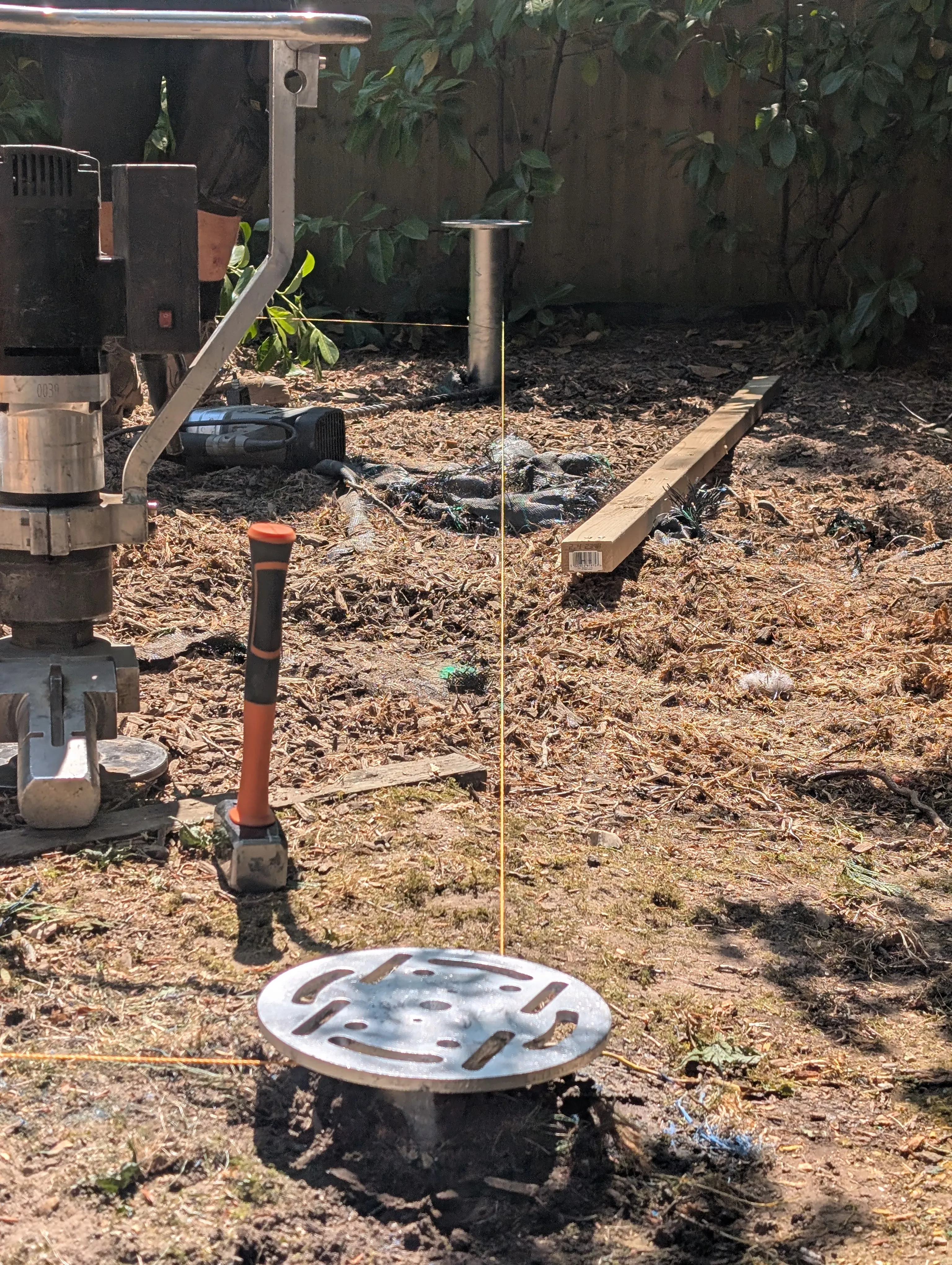
Ground screw testing in Lymington
Book ground screw testing in Lymington as a separate service, including for suitable screws fitted by another installer. We can discuss pull, compression and lateral testing, then agree a visit that answers the foundation question your project needs to resolve.
Choose the load direction you need checked
Testing applies an agreed load and observes the screw's response. A designer may need evidence about uplift, downward support or sideways restraint, and the proposed tests should match that requirement. We can help clarify the service when you send the request you have received.
A compression result can be obtained by applying a downward load directly. Some instructions instead call for an applicable compression calculation using pull-test evidence. Where that approach is agreed for the particular product and project, the calculation and its assumptions must be identified separately from a direct compression measurement.
Pull testing
An upward load checks the screw's response to uplift. The agreed loading stages and movement readings provide evidence for the specified tension requirement.
Learn more: Pull testingCompression testing
Direct downward loading examines how the screw supports compression. Ask for this where your project requires physical downward-load evidence, with the test arrangement and acceptance requirements agreed in advance.
Learn more: Compression testingLateral testing
A sideways test investigates horizontal resistance in an agreed direction. The point at which the load is applied and the allowable movement are important parts of that instruction.
Learn more: Lateral testingGround screw testing guide prices
Use the guide below to plan the testing budget, then ask for a quotation describing the tests and visit you need. The number of positions, loading method, safe access and written report requirements all help define the work.
Installation torque monitoring records turning resistance while a screw is inserted. A specialist torsional test applies an agreed twisting load as a separate test. Both are price on application and must be requested and scoped separately; neither is automatically included in a pull, compression or lateral testing booking. An insertion torque reading is not a direct load-test result.
Local guide prices start with our Ringwood prices, adding 0.1% for each one-way road mile to the town, then rounding up to a whole pound. Your written quotation confirms the price for your site and agreed work.
- Pull test (tensile or uplift test)
- From £488
- Load test (compression test)
- From £975
- Lateral test (sideways load)
- From £478
- Installation torque monitoring
- Price on application
- Specialist torsional load test
- Price on application
Each additional test
Each extra charge applies to an additional test of the same type, at the same location on the same day. The first test of each type is priced separately.
- Pull test (tensile or uplift test)
- £160 extra
- Load test (compression test)
- £320 extra
- Lateral test (sideways load)
- £155 extra
No VAT is added to the guide prices shown. Guide prices are subject to site conditions, access and the written quotation.
Enquire about testing in Lymington
You can start with the postcode and a sentence about the project: for example, whether you are planning the foundation or need an existing installation checked. Drawings, screw records and a designer's instruction are helpful when you have them, but you do not need a complete technical brief to make the first enquiry.
Request your free quote
A short explanation of why you need testing is a useful starting point. Add the postcode and we can discuss the visit.
Your enquiry
Ground screw testing in Lymington
Agreeing and carrying out a test visit
The useful starting point is the decision waiting on the result. It may be a designer assessing a proposed foundation, a contractor checking installed work, or an owner gathering evidence before taking the project further. We use that purpose to establish what can be tested and what the report needs to answer.
Define the decision
Share the question or instruction that led you to request testing. We identify the required load direction and whether the work concerns trial screws, installed supports or both. Any decision about foundation suitability remains with the person responsible for its design.
Set the test schedule
The schedule identifies the screws to test, target loads, loading sequence and acceptance criteria supplied or agreed for the project. We also check access and the space needed for a suitable test and reaction arrangement. Required preparation and the written scope are confirmed before the appointment.
Apply and observe the load
Testing follows the agreed procedure, recording the applied loads and associated movement. Clear identification of each tested position makes the observations usable afterwards. Any departure from the planned procedure or condition affecting the test is recorded with the findings.
Review the recorded outcome
The results are issued in the agreed report so the designer or other responsible reviewer can consider them. If the evidence calls for a different foundation detail or more investigation, that next step can be defined before further construction is committed.
Testing before the building goes up
There is often a useful opportunity to test while the screw heads and surrounding area remain accessible. If a designer needs trial evidence before deciding on the foundation, discuss testing before the main installation is ordered. This allows the trial work and the decision that follows it to fit into the programme.
A trial screw has a defined role in the investigation. Agree who provides and installs it, what loading it will receive, and whether it is intended to be retained afterwards. The effect of the test matters to that last decision, so the designer should confirm any proposed reuse.
Testing can also concern screws already installed for the building. If another company supplied them, we will need enough information to assess a suitable test arrangement and permission to carry out the work. Their product details and installation records can be provided as the enquiry progresses; tell us initially which records you can obtain.
Give the building installer the testing and review dates before arranging to cover or load the foundation. Keeping that stage coordinated can leave room for the reviewer to ask questions while the test positions are still accessible.
Make the results useful to your designer
Keep the testing instruction with the written results so your reviewer can see how the requested check was carried out. The record identifies the tested screws and shows the loading and observed response, with any changes to the planned work made clear. Measurements and subsequent calculations are labelled separately; the basis of any pull-derived compression assessment belongs with that calculated result.
Allow a review stage after the report is issued. Your designer needs to consider what the evidence means for the foundation as a whole and tell the project team whether to proceed, change the proposal or investigate further. If you need a specified reporting format or a witness at the test, raise that before booking so the agreed service supplies what the reviewer needs.
Getting ready for the appointment
We will agree where the testing team can enter, which area needs to be kept clear and who can provide access on the day. A photo showing the screw heads and the surrounding working area is more useful for this than a distant view of the completed building. Let us know about items or surfaces that must remain in use beside the test area.
If a building is already on the screws, safe access and structural support need particular attention. Leave connections and supports in place until the responsible person has agreed the method. Where testing requires unloading, opening up or temporary support, arrange that work with competent people before the visit; it must be included in the preparation plan rather than improvised on site.
Provide the full address and any entrance directions when arranging the appointment. For a shared or managed site, confirm access with the owner or manager and make the testing date known to other contractors. We can then agree a practical sequence for preparation, testing and issuing the results.
Testing enquiries around Lymington
We welcome testing enquiries from Lymington town centre, Buckland, Pennington, Lower Pennington and the residential streets around Woodside. Nearby areas include Efford, Everton, Hordle, Tiptoe, Downton, Leagreen, Broadmead, Gordleton and Flexford, along with Milford on Sea, Lymore and Keyhaven.
You can also enquire from Boldre, Pilley, Pilley Bailey, Battramsley, Sandy Down, Portmore, Walhampton, South Baddesley, Norley Wood, East End and East Boldre; from Sway, Shirley Holms, Setley and Brockenhurst; and from New Milton, Ashley, Bashley and Barton on Sea. The full address lets us confirm travel and the arrangements for your particular site.
SO41 covers many of the Lymington-area addresses, with SO42 examples around Setley and Brockenhurst and BH25 addresses around New Milton. Send the full postcode rather than only the district, and mention the entrance to use if it is different from the postal address.
Feedback on Craig’s earlier work
Feedback on Craig’s earlier groundwork and customer service.
"Craig and the team are absolutely fantastic. From courtesy, to standard of work, to tidiness — everything exceeded expectations. The job was arranged, booked and done extremely quickly and we are very happy with the results. Nothing was too much trouble, and communication was easy."
"Craig and his crew were excellent from the first communication, quote, timing of work and quality of work. Highly recommended."
Ground screw testing questions
Can I book testing without buying a new screw foundation?
Yes. Testing can be commissioned on its own for suitable trial or existing screws, including another installer's work. Tell us the reason for the check and the stage the project has reached. We can then establish whether the proposed test can be carried out and quote the testing work separately.
What should I send with my first enquiry?
Give us the postcode and explain what you hope to establish. If someone has asked you for a test, their email or brief can help us understand the request. You can enquire before collecting every drawing or product record; we will explain which further information is needed to agree a test.
How do I know which kind of load test to ask for?
Send the requirement from your designer or describe the foundation concern. Uplift calls for a different loading direction from downward support or sideways restraint. Where the requirement is still being developed, it should be clarified with the person responsible for the design so the booked test produces the evidence they can use.
What will a pull test tell me?
It records how the tested screw responds as an agreed upward force is applied. The resulting load and movement evidence can be assessed against the project's tension requirement. The interpretation relates to that screw and test arrangement, with its stated criteria and limitations set out for the reviewer.
Can you physically test a screw under downward load?
A direct compression test applies downward loading to the screw and measures its response. It needs a suitable arrangement for applying and reacting against that load. Tell us when direct compression evidence is required so it can be scoped explicitly, including the available working space and the designer's loading requirements.
How can I tell whether compression was tested directly?
Read how the value was obtained. A direct compression result comes from loading downwards, whereas a pull-derived figure is an assessment based on upward-test data. For the latter, the designer needs the method, its assumptions and confirmation that it applies to this screw and project. Agree the required evidence before booking.
What needs to be specified for a lateral test?
The instruction needs to identify the sideways direction, load application point and required loading and movement criteria. Those details matter to what the result means for the proposed support. A drawing or designer's note can be supplied once available, while a description of the intended check is enough to start discussing the visit.
When is the best time to arrange a trial screw?
Arrange it while the foundation choice or design can still respond to the findings. The designer can then identify a useful trial position and test requirement before the main work is committed. Allow time after the visit for the results to be reviewed and any resulting changes to be agreed.
Can you test screws if I do not know who fitted them?
We can discuss the enquiry, but identifying the product and understanding the installation may be necessary to scope a suitable test. Send any visible markings, photographs or records you can obtain without disturbing the structure. We will explain what remains to be established before agreeing to proceed.
What if the building is already standing on the screws?
Tell us that at the outset and show which supports can be reached safely. Testing may require a plan for unloading, access or temporary support, agreed with the responsible designer and competent contractors. Do not loosen a connection or move a support to expose a test point yourself.
Will a tested screw still be available for the building?
That depends on the test loading, movement and the role assigned to the screw. A test can affect its condition or suitability for later use, particularly where the investigation intentionally approaches a limit. Agree the intended treatment in advance, and have the designer confirm any retention or replacement decision.
Does the test report approve the whole foundation?
The report documents the scoped tests and their results. The foundation designer uses that evidence with the building loads, support arrangement and connections to reach a design decision. If you need an inspection, formal approval or another person's sign-off as well, identify that separately when setting the brief.
Is torque monitoring the same as a torsional load test?
No. Monitoring observes the turning resistance during insertion; torsional testing deliberately applies a specified twisting load. They answer different questions, and neither substitutes for direct pull, compression or lateral evidence. Both services are price on application and separately agreed, so request the one your project actually requires.
Can I arrange the next building work as soon as testing is finished?
Allow for the report and the required review, not just the time spent on site. The result may confirm the intended next step or lead the designer to ask for changes. When booking, tell us your programme so the timing of testing and written results can be agreed before you commit the following work.
What does each additional ground screw test cost?
At the same location on the same day, each additional compression test costs £320 extra, each additional pull, tensile or uplift test costs £160 extra, and each additional lateral test costs £155 extra. These fixed charges are for further tests of the same type. The first test of each type is priced separately, using the starting price for your location. The extra-test charges stay the same in every location.
Book the next step for your foundation
Call 01202 039753 or use WhatsApp if you want to discuss the testing request. You can also send the form above with the postcode and project purpose; we will help establish the information needed for a scoped quotation.
If you are still choosing the foundation, see ground screw installation in Lymington, local concrete base installation or the Lymington base overview. Our main testing guide explains the services, and the Hampshire page lists the county's town links.