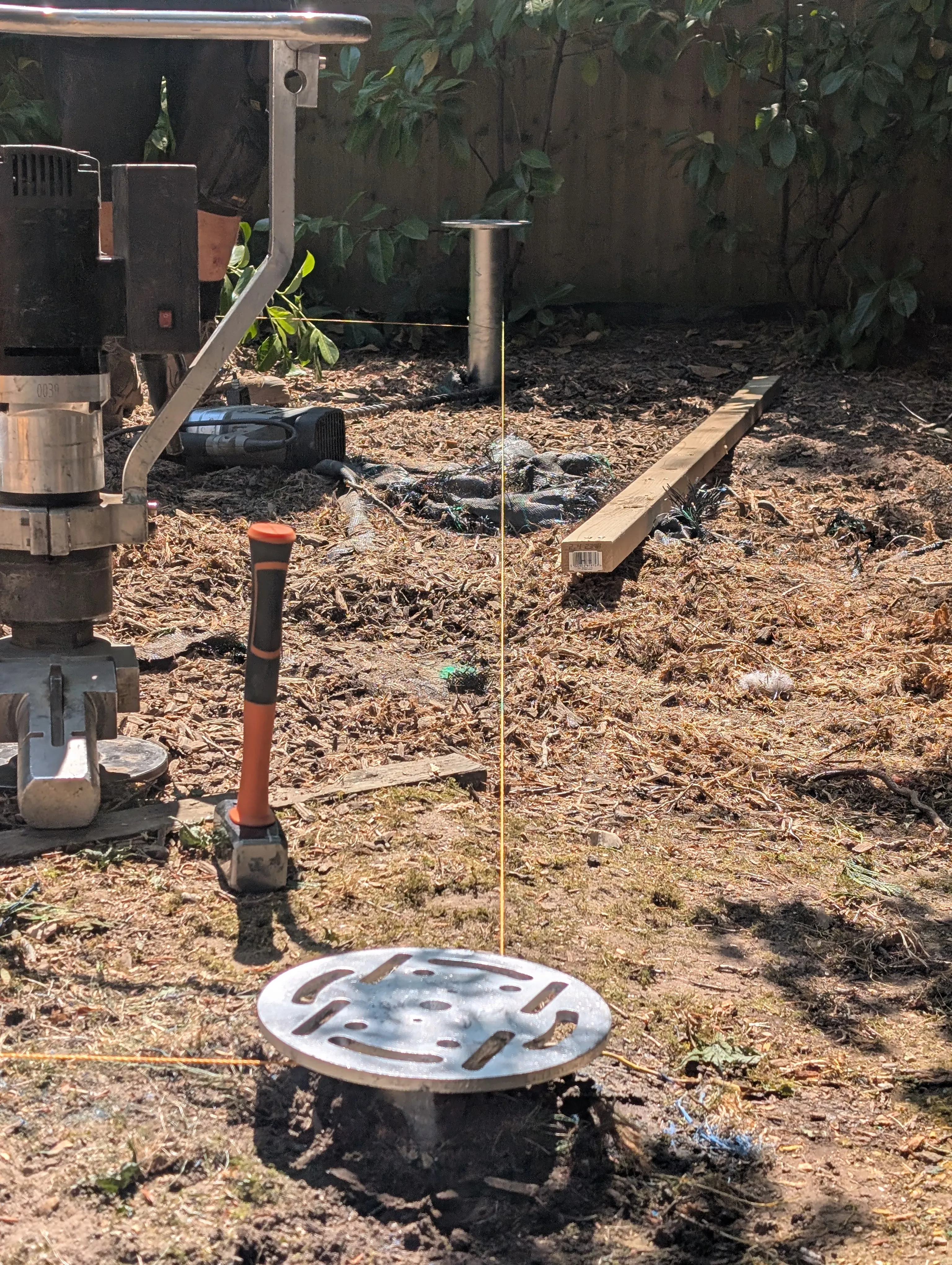
Ground screw testing in Pewsey
JustBases offers standalone ground screw testing in Pewsey, including suitable trial installations and existing screws fitted by others. We apply the agreed loading and record the response, supplying results and a written report. Tell us the purpose and postcode to start; any project-specific calculation work is agreed within the quotation.
Ground screw tests we offer
The direction of the force matters. An upward test, a downward test and a sideways test investigate different requirements, so the requested method should match the evidence your project needs.
We also offer installation torque monitoring and specialist torsional testing as separate commissions. Monitoring records resistance during insertion; a torsional test deliberately applies a twisting action. Each has its own scope and price rather than being an assumed part of the three physical load tests.
Pull-out testing
An upward force is applied to examine the screw's response to uplift. The required loading, observations and stopping arrangements are agreed for the test, with the results recorded against the tested position.
Learn more: Pull-out testingCompression testing
A direct compression test applies a downward load and measures the response. Request this method when the project requires direct downward evidence. Any applicable calculation using pull-test evidence is identified separately and is not described as a direct compression test.
Learn more: Compression testingLateral testing
A sideways load examines the response in the agreed horizontal direction. The loading arrangement needs to suit the test position and purpose; evidence from this test should be identified as lateral, not treated as an upward or downward result.
Learn more: Lateral testingGround screw testing prices in Pewsey
The guide prices below describe the available physical testing services. Your quotation confirms the requested methods, number of positions, site setup and access arrangements. Recorded results and a written report are part of the testing service; project-specific load calculations and their method are agreed in the scope.
Installation torque monitoring: price on application. Specialist torsional testing: price on application. Neither service is automatically added to a physical test or to an installation.
Local guide prices start with our Ringwood prices, adding 0.1% for each one-way road mile to the town, then rounding up to a whole pound. Your written quotation confirms the price for your site and agreed work.
- Pull test (tensile or uplift test)
- From £500
- Load test (compression test)
- From £999
- Lateral test (sideways load)
- From £489
- Installation torque monitoring
- Price on application
- Specialist torsional load test
- Price on application
Each additional test
Each extra charge applies to an additional test of the same type, at the same location on the same day. The first test of each type is priced separately.
- Pull test (tensile or uplift test)
- £160 extra
- Load test (compression test)
- £320 extra
- Lateral test (sideways load)
- £155 extra
No VAT is added to the guide prices shown. Guide prices are subject to site conditions, access and the written quotation.
Ask about a ground screw test
Tell us where the screws are and why the test is needed. You can enquire before the test loads or an engineer's request have been settled; we will explain what must be agreed to carry out the work.
Use the form, call 01202 039753 or message Craig on WhatsApp. Add any available brief, installation information or photographs if they help explain the request.
Request your free quote
Give us your contact details and a short description of the testing you need. You can ask before the technical requirements are complete.
Your enquiry
Ground screw testing in Pewsey
How ground screw testing works
A useful test starts with a clear requirement and ends with recorded evidence of the work performed. Technical arrangements are resolved before loading so the visit can answer the agreed question safely.
Agree the test requirement
Establish the loading direction and the proposed positions with the responsible project people. The required loads and acceptance criteria need to be specified for the purpose, alongside the tester's practical method and the scope of any calculations.
Assess and carry out the loading
Confirm that the screw, connection and working area allow a suitable safe test setup. Apply the agreed loading and record the measured response, following the specified programme and stopping conditions.
Provide the findings
Supply the recorded results and written report for the testing carried out. Complete the project-specific load calculations agreed in the quotation, identifying their basis so measured and calculated evidence can be understood correctly.
Trial screws and existing foundations
A trial installation allows a test requirement to be investigated before the main foundation work is committed. Its specification, location and loading need to be agreed for that purpose.
For an existing foundation, we consider how the selected screw can be tested in its current arrangement.
Understanding the test report
The report sets out what was tested and the recorded load response, with the project-specific calculations commissioned in the quotation. It provides evidence for the agreed assessment, rather than automatic approval of the building. The person responsible for the design must determine how the findings meet the project's requirements.
Arranging testing in Pewsey
If a designer or building supplier has asked for evidence, send us the request in their own words if available. We can then discuss the proposed test against that requirement and the actual site, rather than asking you to translate it into a technical order first.
We offer testing independently of ground screw installation in Pewsey. For a new base of another type, see the Pewsey service overview; for other places, check the Wiltshire service area.
Areas we cover around Pewsey
Send the postcode for your Pewsey or surrounding-village project and we will confirm arrangements for the work you need. The following places help identify the enquiry area, including the smaller settlements between the larger villages.
Useful postcode examples include SN9 around Pewsey and Woodborough, SN8 around Huish, West Stowell and Burbage, and SN10 around Marden. Coverage and visit arrangements are confirmed for the actual address; these examples do not include every property in those districts.
Pewsey and its smaller settlements
Central Pewsey, High Street, North Street and River Street; Pewsey Wharf, Southcott, Kepnal and Sharcott; and the Buckleaze, Knowle and King's Corner areas.
Wilcot and Milton Lilbourne side
Wilcot, Huish, Oare, West Stowell, Clench Common, Wootton Rivers, Clench, Fyfield near Milton Lilbourne, Milkhouse Water, Milton Lilbourne and Easton Royal.
Alton and Woodborough villages
Alton Barnes, Alton Priors, Honeystreet, Stanton St Bernard, Woodborough and Beechingstoke.
Cannings and Marden villages
Patney, Marden, Chirton, Conock, All Cannings and Allington near All Cannings.
Manningford and Upavon villages
Manningford Abbots, Manningford Bruce, Manningford Bohune, North Newnton, Bottlesford, Hilcott, Charlton St Peter, Wilsford, Rushall and Upavon.
Burbage and Grafton villages
Burbage, Durley, Stibb Green, Ram Alley, East Grafton, West Grafton, Wilton near Grafton, Marten and Wexcombe.
Bedwyn villages
Great Bedwyn, Crofton, St Katharine's, Little Bedwyn, Chisbury and Froxfield.
Further surrounding villages
Ham, Shalbourne, Buttermere, Tidcombe and Fosbury. Please include the postcode so we can discuss the particular site.
Feedback on Craig’s earlier work
Feedback on Craig’s earlier groundwork and customer service.
"Craig and the team are absolutely fantastic. From courtesy, to standard of work, to tidiness — everything exceeded expectations. The job was arranged, booked and done extremely quickly and we are very happy with the results. Nothing was too much trouble, and communication was easy."
"Craig and his crew were excellent from the first communication, quote, timing of work and quality of work. Highly recommended."
Ground screw testing questions
These answers explain what can be commissioned, the evidence provided and the details needed before a test takes place.
Can I book testing without a foundation installation?
Yes. Testing is a service in its own right, available to property owners, contractors and project teams. You do not have to buy an installation from JustBases. Start with the reason for the test and the site postcode; we then assess the proposed work and agree the method, technical requirements and price.
What do the three loading directions tell me?
Pull-out tests examine response to an upward force, compression tests to a downward force, and lateral tests to a sideways force. Each provides evidence in its own direction and agreed setup. Explain the loading question your project needs to answer so the appropriate method can be specified, rather than assuming one result answers all three.
Can a direct downward test be requested on its own?
Yes. We offer direct compression testing as a distinct service, applying the agreed downward load and recording the screw's response. It does not have to be commissioned as an assumed add-on to a pull test. Identify any request for direct measured compression evidence so the quotation and test arrangements reflect that requirement.
Can you consider screws another company supplied?
Yes, subject to assessment of whether the proposed test can be carried out suitably and safely. Share the product or installation information already available, together with the reason evidence is needed. Missing records can be discussed at enquiry stage; suitability and the scope of the work must be confirmed before the visit.
Can testing inform a foundation that is still being planned?
A properly scoped trial can provide evidence relevant to the proposed foundation. Agree the trial screw, its position and the loading requirement before installation and testing, involving the responsible designer where needed. The result describes the tested arrangement; its use for the planned foundation depends on the justified assessment, not an assumption that it represents every support.
How are test positions and loads agreed?
They follow the project's evidence requirements and the proposed foundation, with the responsible designer or project team establishing the required loads and acceptance criteria. We assess the practical test method and setup against those requirements. Both need to be resolved before loading; there is no single pass load suitable for every screw and building.
What if the screws are already carrying a frame?
Tell us that the foundation is in use and show the arrangement as it stands, if photographs can be taken safely. The existing loading and attachments need to be considered before a suitable test procedure is confirmed. Do not loosen connections or lift the frame to prepare an enquiry; any necessary structural preparation must be agreed and safely managed.
What can I send before there is a technical brief?
Describe what has prompted the test, the site location and whether the screws are proposed, installed or already in use. A supplier's message, a simple description or available photographs can be enough to start the discussion. We will identify the technical decisions needed next; you are not expected to choose test loads before contacting us.
Do you supply the results in writing?
Yes. Ground screw testing supplies recorded results and a written report. We also agree the required project-specific load calculations in the quotation, so their scope and method are clear before the work. Additional engineering or design services should be identified separately rather than being assumed within the test report.
How are calculated compression figures identified?
Where an applicable, justified method derives compression information from pull-test evidence, the calculation and its basis must be identified as such. It is different from applying a downward load and measuring the response directly. Tell us if the recipient requires direct compression evidence so the agreed service provides the right kind of information.
What is recorded installation torque used for?
It describes the turning resistance recorded while a screw is being inserted. That information is considered in the context of the actual installation and product; it is not itself a measured uplift, compression or lateral load response. Installation torque monitoring is a separate commission, price on application, and its interpretation must not rely on a universal conversion rule.
What makes a torsional test separate?
Specialist torsional testing applies a twisting action under an agreed test scope. It is not the same as recording insertion resistance while installing a screw, and a sideways load test is not a torsional test either. This specialist service is quoted on its own basis: price on application. Request it explicitly if that is the evidence your project needs.
Does the report include approval of the building?
No. The report provides evidence of the agreed testing, not automatic sign-off of the building or a complete foundation design. The responsible designer must use the findings within the project's assessment and approval requirements. The full 10-year installation guarantee relates to installation workmanship and supplied foundation materials, not a warranty on standalone test results.
What determines the quote for a testing visit?
The required methods and number of test positions matter, along with the setup, access and site arrangements needed to perform them. The quotation also defines any agreed calculation work while keeping the normal recorded results and written report clear. Tell us the purpose and address first; we can work through the particulars before confirming the price and visit.
What does each additional ground screw test cost?
At the same location on the same day, each additional compression test costs £320 extra, each additional pull, tensile or uplift test costs £160 extra, and each additional lateral test costs £155 extra. These fixed charges are for further tests of the same type. The first test of each type is priced separately, using the starting price for your location. The extra-test charges stay the same in every location.
What happens next
Send the testing purpose and postcode. We will discuss the requirement, confirm the proposed scope and written price, and arrange the test once the necessary technical and site details are agreed.
You can use the call and WhatsApp options here for the same enquiry. Buying a new screw foundation from us is not a condition of booking a suitable test.