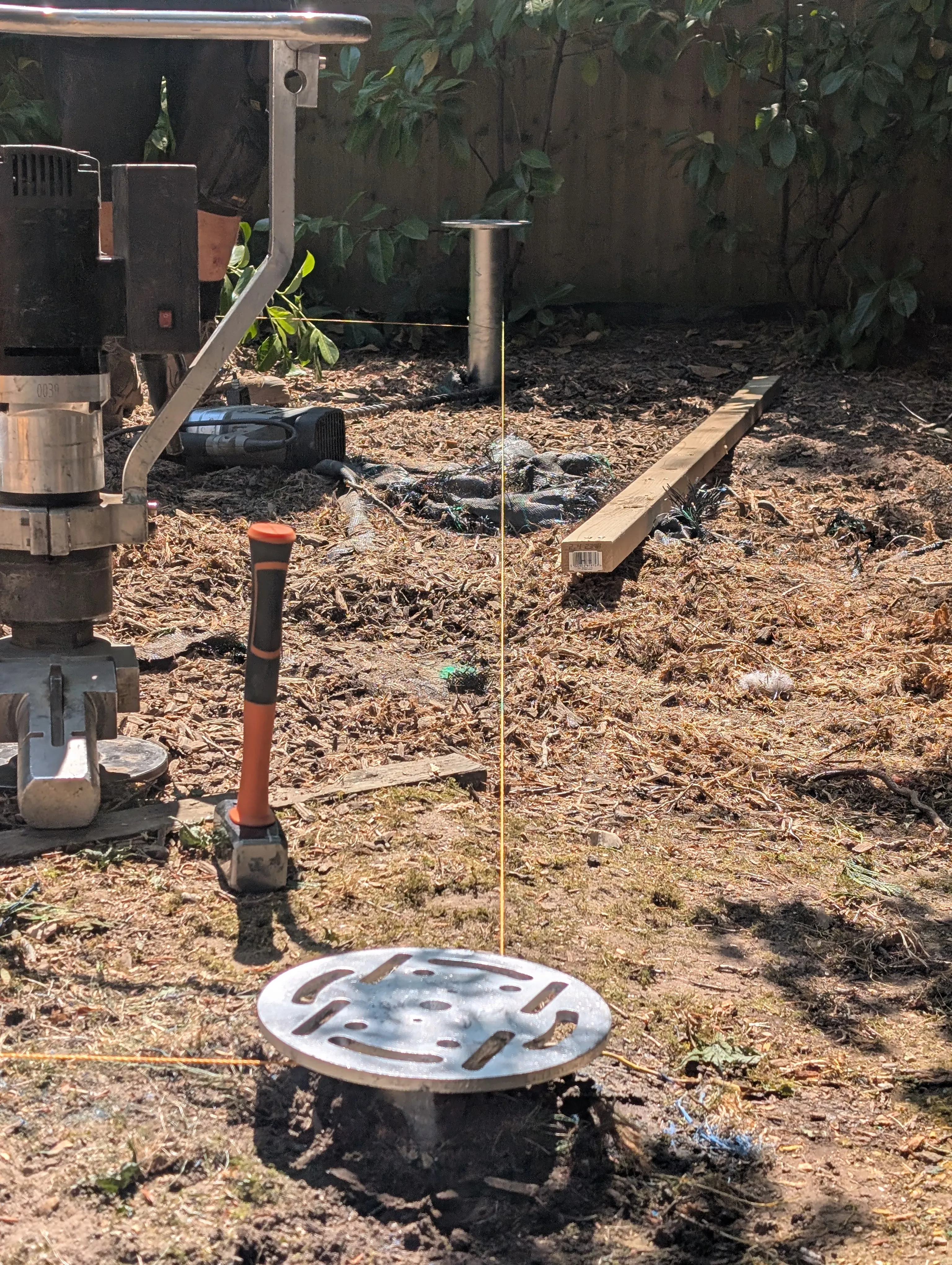
Ground screw testing in Chippenham
JustBases offers standalone ground screw testing in Chippenham and nearby villages. Ask us about pull-out, compression or lateral testing for suitable trial or installed screws, whether fitted by us or another installer.
Ground screw tests we offer
The force on a foundation can act in different directions. A test applies an agreed load to investigate the response in the direction relevant to your project. The three physical methods below answer different questions, so discuss the intended assessment before choosing a test.
Recorded turning resistance is a separate type of information. Insertion torque monitoring observes resistance while a screw is driven into the ground; specialist torsional testing instead applies a specified twisting load. These are distinct price-on-application services, neither automatically included. A torque record is not a direct physical load test, and any calculation based on it must have a justified basis applicable to the product and project.
Pull-out testing
An upward force investigates the screw's response in tension. The agreed test records the applied loading and movement, providing evidence for the project's assessment of uplift resistance.
Learn more: Pull-out testingCompression testing
A physical compression test pushes downward and records how the support responds under that load. This provides direct downward-load evidence; a compression value calculated from another type of evidence must be identified separately.
Learn more: Compression testingLateral testing
A sideways load investigates lateral response in the specified direction. The relevant connection height and test arrangement are part of agreeing what the result will represent.
Learn more: Lateral testingGround screw testing prices in Chippenham
The physical test guides provide a starting point for budgeting. The quotation confirms the tests and positions commissioned, the practical setup and access, and the results or written report required. Tell us the purpose of the exercise so the scope can be settled before a visit is booked.
Insertion torque monitoring and specialist applied torsional tests are separately price on application. If either is requested, we will discuss that particular scope rather than assuming it is part of a physical test or installation package.
Local guide prices start with our Ringwood prices, adding 0.1% for each one-way road mile to the town, then rounding up to a whole pound. Your written quotation confirms the price for your site and agreed work.
- Pull test (tensile or uplift test)
- From £507
- Load test (compression test)
- From £1,013
- Lateral test (sideways load)
- From £496
- Installation torque monitoring
- Price on application
- Specialist torsional load test
- Price on application
Each additional test
Each extra charge applies to an additional test of the same type, at the same location on the same day. The first test of each type is priced separately.
- Pull test (tensile or uplift test)
- £160 extra
- Load test (compression test)
- £320 extra
- Lateral test (sideways load)
- £155 extra
No VAT is added to the guide prices shown. Guide prices are subject to site conditions, access and the written quotation.
Ask about a ground screw test
Start with the postcode and the question the test needs to answer. Mention whether the screws are proposed, already installed or carrying a building. If someone has requested the test, you can pass on their brief when available.
Use this form, WhatsApp or 01202 039753 to discuss it with Craig. Existing screw details, drawings or photos can help the later assessment, but a short enquiry is enough to begin.
Request your free quote
Tell us why testing is being considered and where the site is.
Your enquiry
Ground screw testing in Chippenham
How we agree and carry out the test
A useful test needs a defined purpose as well as a practical method. We discuss what evidence is being requested, establish the work that can be undertaken safely and agree the scope and price before carrying it out.
Establish the required loading and evidence
The responsible designer or project requirement establishes the loading, positions and acceptance criteria needed for the assessment. We clarify which test is being commissioned and what the report must contain. If those requirements are still being developed, we can identify the information needed to progress the enquiry.
Assess safe access and the test setup
We consider how a test can be applied to the chosen supports, the space available and any existing structure or connection. The proposed setup must allow the agreed load to be applied and its response recorded safely. Further inspection or preparation may need to be agreed before a test can proceed.
Record results and provide the agreed report
The test produces recorded results for its specified arrangement and loading. The commissioned written report identifies the evidence obtained, with any agreed project load calculations distinguished from measurements. The responsible designer uses that information in assessing the foundation.
Testing trial and existing supports
A trial enquiry can be for testing alone. If you also need trial screws supplied or installed, ask for that work to be included in the quotation.
For an existing foundation, the starting point is what the screws currently support and how their heads and connections can be reached. Tell us whether the building is already attached. We need to assess the structural and practical implications of loading a selected support before confirming a suitable test arrangement.
Leave load-bearing connections intact while making the enquiry. Do not loosen the building or remove a support to expose a screw for us. If access or temporary support work is necessary, its method and responsibility must be established safely as part of planning the test.
Using the test report
The results should answer the question for which the test was commissioned: what load was applied, in which direction and arrangement, and how the tested support responded. Direct measurements and calculated values must be recognisable as different evidence. In particular, an applicable calculation of compression performance from other data is not a record of a downward load having been applied.
The written test report supplies evidence for the responsible designer's assessment. It does not approve the complete building or replace the design of the frame, connections and foundation.
Arranging a test in the Chippenham area
We confirm visit arrangements once the test scope and practical requirements are clear. Give the actual site location with the postcode, particularly where access is from another lane or entrance, and discuss when the supports will be available to test. This helps arrange the visit around the stage the foundation has reached.
Testing enquiries around Chippenham
Enquiries are welcome from Chippenham centre, Cepen Park, Derriads, Hunters Moon, Hardenhuish, Hardens, Lowden, Rowden, Monkton Park, Pewsham, Sheldon, Frogwell, Queens Crescent, Redland, Englands, Bumpers Farm, Patterdown and Showell.
Around the Langley and Kington villages, we welcome enquiries from Langley Burrell, Kellaways, Kington Langley, Kington St Michael, Easton Piercy, Stanton St Quintin, Lower Stanton St Quintin, Draycot Cerne, Sutton Benger, Seagry, Upper Seagry, Lower Seagry, Christian Malford, Great Somerford, Little Somerford and Startley.
The surrounding enquiry area also includes Bremhill, Bremhill Wick, East Tytherton, Tytherton Lucas, Foxham, Charlcutt, Spirthill, Stanley, Avon, Ratford, Derry Hill, Old Derry Hill, Studley, the rural Pewsham area, Bowood, Sandy Lane and Calne.
Villages around the western side include Allington, Lanhill, Yatton Keynell, West Yatton, Giddeahall, Long Dean, Broomfield, Tiddleywink, Kents Bottom, Biddestone, Slaughterford, Castle Combe, Grittleton, Littleton Drew, Leigh Delamere, Sevington, Foscote, The Gibb, Hullavington, Bradfield, Nettleton, Burton and North Wraxall.
We also welcome enquiries from Lacock, Reybridge, Notton, Bowden Hill, Bewley Common, Lackham, Hartham, Thingley, Corsham, Pickwick, Gastard and Neston. Useful district examples are SN14 around western Chippenham and nearby villages, SN15 around the centre, east and many northern villages, SN13 around Corsham and SN11 around Derry Hill and Studley. Give us the full postcode and service required so we can confirm arrangements for the property.
Feedback on Craig’s earlier work
Feedback on Craig’s earlier groundwork and customer service.
"Craig and the team are absolutely fantastic. From courtesy, to standard of work, to tidiness — everything exceeded expectations. The job was arranged, booked and done extremely quickly and we are very happy with the results. Nothing was too much trouble, and communication was easy."
"Craig and his crew were excellent from the first communication, quote, timing of work and quality of work. Highly recommended."
Ground screw testing questions
Can you test ground screws fitted by another installer?
We consider standalone testing of suitable screws installed by others. Tell us what is known about the foundation and why evidence is needed, including whether a building is attached. We can then assess whether the requested test can be arranged safely and usefully. Product records and installation information can support that discussion when available.
How do I know which loading direction needs testing?
The relevant direction follows the forces that the foundation assessment needs to consider. An upward force is investigated with pull-out testing, a downward force with compression testing, and a sideways force with lateral testing. The designer can identify the loading case and required evidence. Ask them to clarify the test direction if it is not stated in the request.
What information does a pull-out test provide?
It records the response when an upward load is applied under the agreed test arrangement. That evidence is relevant to resistance against tension or uplift at the tested support. The required loading and acceptance criteria determine how the result will be assessed. A pull-out measurement concerns that force direction; any further calculation using the data should be identified and justified for its proposed use.
What happens in a direct compression test?
The support is loaded downward and its response is measured as specified for the test. The resulting load and movement records provide physical compression evidence for the assessed position. Arranging it requires suitable access and a safe way of applying the load, so we consider the foundation's current condition and connections before confirming the work.
Why might lateral testing be specified?
A foundation may need evidence about its response to a sideways force. Lateral testing investigates that response using the direction and load application agreed for the project. Details such as the connection and height at which the load acts help define the test. Its results are used with the relevant design requirements when assessing the support's lateral performance.
How is a calculated compression value different from a compression test?
A calculation uses other evidence and an applicable method to derive a value; a direct compression test physically loads the support downward. The calculation's inputs, assumptions and applicability need to be clear to the person using it. Ask for the report to distinguish these forms of evidence, especially where the project requirement specifically calls for measured downward loading.
Who sets the test load and the acceptance criteria?
Those requirements come from the responsible designer or the project's specified assessment. The test has to provide the evidence they need to compare against the required performance. We agree the practical testing scope with those requirements in view. If a request has arrived without loads or criteria, we can discuss what needs to be clarified before committing to a test.
Can I arrange trial testing before ordering the complete foundation?
Yes, a trial can be considered while a foundation is being developed. Its value depends on selecting a product and test positions that serve the proposed assessment. Raise the enquiry at that stage and explain what decision the trial needs to inform. Testing, provision of trial screws and their installation should each be included explicitly where commissioned.
Can testing be considered when a building is already on the screws?
Yes, subject to assessing the existing structure, connections and available access. Applying a test load to a support carrying a building needs careful planning so the work does not compromise the structure. Tell us the current arrangement and send available photographs if useful. Keep the connections and supports in place; any required alteration or temporary support must be safely agreed beforehand.
What does insertion torque monitoring record?
It records turning resistance during installation. The information relates to how the screw was driven into the ground and may be relevant to an appropriately supported assessment. It is not the same as applying an upward, downward or sideways test force. Request monitoring when discussing installation: it is separately price on application and is not automatically included.
What is a specialist torsional test?
It investigates response to an agreed twisting load, rather than recording resistance as the screw is inserted. Share the project requirement so the purpose, setup and required information can be discussed. This specialist service is price on application and requires its own agreement. It is distinct from insertion monitoring and from the three physical pull, compression and lateral methods.
What will I receive after the test?
The agreed service provides the recorded results and commissioned written test report, together with project load calculations where these are included. Before booking, confirm what information the assessment needs so the scope matches it. The report should make clear what was physically tested and what, if anything, was calculated from the evidence.
Does a successful test approve the complete foundation?
The result provides evidence for the specified test and support arrangement. The responsible designer assesses its significance for the foundation, including the required loads and how the building and frame connect to the supports. A test report alone does not approve all those design elements or certify the whole building; it contributes the agreed evidence to that wider decision.
Can I start an enquiry before a technical test brief is ready?
Yes. Explain what prompted the enquiry and give the site postcode. Tell us whether the work concerns a proposed foundation, trial screws or supports already in service. We can discuss what needs to be established and which further details will help agree a suitable scope. Send existing records or a designer's brief when they become available.
What does each additional ground screw test cost?
At the same location on the same day, each additional compression test costs £320 extra, each additional pull, tensile or uplift test costs £160 extra, and each additional lateral test costs £155 extra. These fixed charges are for further tests of the same type. The first test of each type is priced separately, using the starting price for your location. The extra-test charges stay the same in every location.
Talk to us about the evidence you need
You can ask about testing without buying a new installation. Describe the purpose and postcode through the enquiry form, on WhatsApp or by calling 01202 039753. We will discuss feasibility, agree the work and written price, then arrange the test.