The JustBases advice journal
What is the best foundation for an amateur radio mast?
Compare concrete mast bases, guy anchors and engineered helical systems, with practical advice on wind loads, tilt-over access and installation planning.
By JustBases 9 min read
Explore the installation service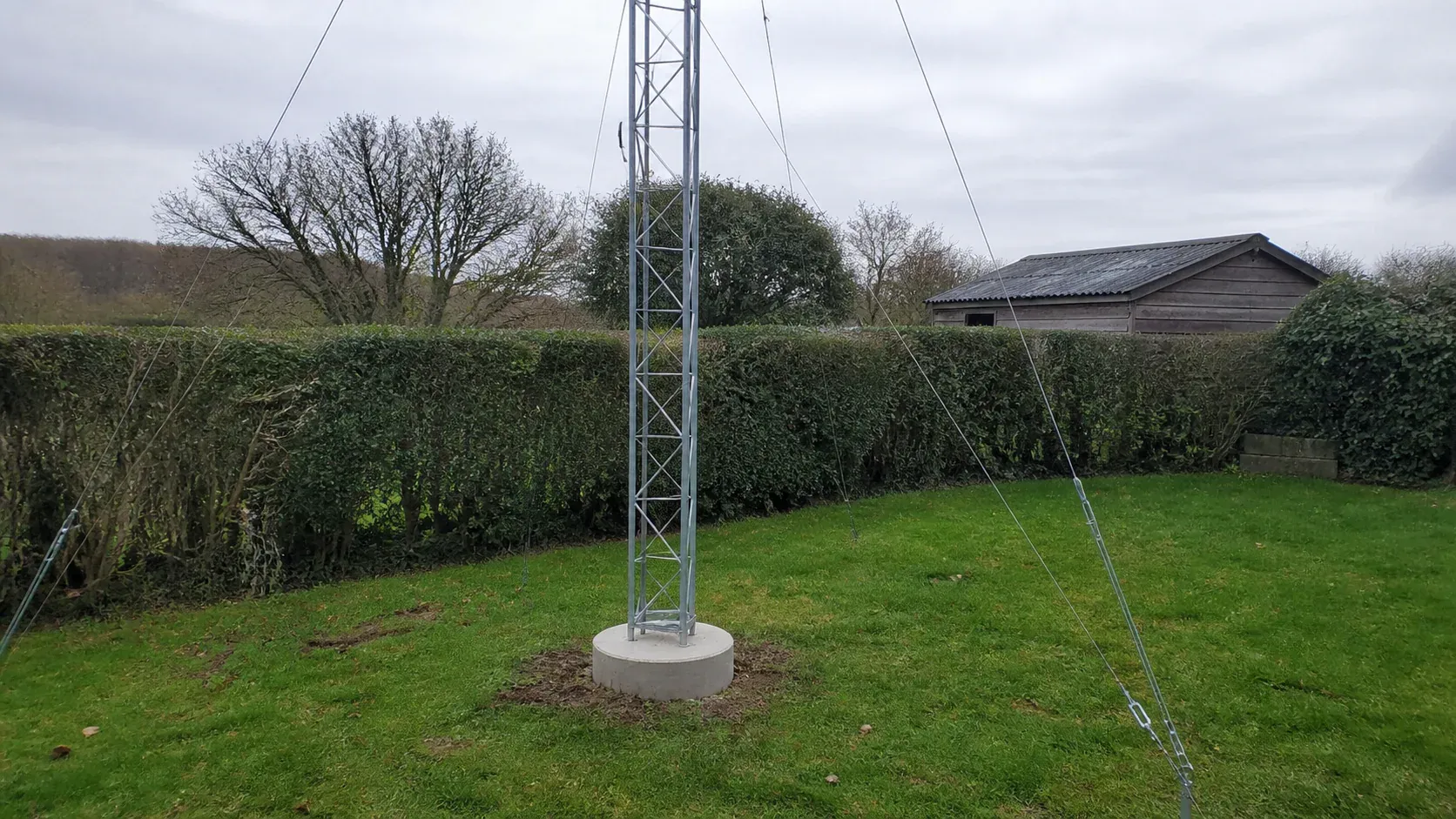
In this article
The best foundation for an amateur radio mast is the manufacturer’s or structural engineer’s approved system for the mast, antennas, exposure and ground. For many permanent towers, that means a defined concrete base and, where required, separate guy anchors. Engineered helical anchors can be suitable in selected systems, but ordinary garden-building ground screws are not a universal replacement for a tower footing.
The biggest mistake is choosing a base from mast weight alone. Wind acting on the tower and antennas can create substantial leverage, and different mast systems transfer those forces differently. Our amateur radio mast foundation service constructs the approved ground support ready for the specialist mast installer.
Identify the mast before digging
Begin with the make, model and intended configuration. A freestanding lattice tower, a guyed mast, a crank-up tower and a tilt-over pole do not necessarily use the same foundation principles.
Second-hand equipment needs particular care. If the manufacturer or model is unknown, obtain identification and an appropriate assessment before selecting a foundation. A tower that stood safely elsewhere may have had different antennas, exposure or support conditions.
ROHN’s foundation notes explicitly tie its standard designs to assumed site conditions and verification during construction. This is useful manufacturer evidence for the need to check assumptions, not a UK foundation detail to copy into another mast project.
Ask the supplier for the complete foundation and guy layout, including any hinge, socket or anchor cage. A drawing of the tower above ground is not enough to price the ground support accurately.
Comparing the main support systems
| System | Advantages | Limitations |
|---|---|---|
| Concrete base with approved tower connection | Defined permanent support and accurate interface | Excavation, curing and a model-specific design |
| Concrete base plus separate guy anchors | Suits a complete guyed system | Requires space, correct geometry and ongoing inspection |
| Engineered helical guy anchors | Can reduce concrete in an approved system | Capacity, direction, corrosion and soil need verification |
| Proprietary temporary or mobile support | Can suit equipment designed for that use | Operating limits and setup procedures still apply |
| Reused existing foundation | Avoids new material where adequate | Must be assessed for the exact new configuration |
Concrete tower bases
A concrete foundation can provide the anchorage and stability required by a permanent mast. Its geometry, reinforcement and connection arrangement should follow the selected tower’s approved detail.
The advantage is a clear permanent interface. A bolt cage, planted section, socket or hinge can be set out accurately and checked before the mast arrives. Each is part of a particular system, rather than an interchangeable way of attaching metal to concrete.
The disadvantages include excavation, spoil and the need to coordinate curing with erection. A tower should not be installed or operated simply because the top of the base looks hard. The designer and installer should agree when it is ready for the intended loads.
Do not add concrete around a standard detail without understanding the consequences. Bigger is not a substitute for checking the ground or the connection. A changed shape may affect the way the foundation behaves and should be accepted by the designer.
The top level and orientation matter. A hinge pointing in the wrong direction can make lowering impossible, while a misplaced bolt group may prevent the mast fitting. Verify those details against the site layout before pouring.
Guyed masts and separate anchors
A guyed system uses a wider area than the mast’s footprint. The guy anchors are structural components and must be included in the foundation plan and quotation.
Their position, angle and connection affect the load path. Moving an anchor closer to avoid a flower bed is not a harmless landscaping adjustment. The mast designer should approve any change to the specified geometry.
Concrete anchor blocks may be part of the system. Their design and installation need to match the relevant forces and ground conditions. They should not be replaced by buried scrap or improvised blocks because those items appear heavy.
The guy layout also has practical consequences for the garden. Consider walking routes, mowing, access and the space needed to inspect connections. A technically possible layout may be inconvenient if it divides the usable garden into narrow corridors.
The mast installer should specify guy components, tensioning and inspection. Foundation contractors provide the agreed anchors; they should not independently decide the operating setup of the tower.
Helical anchors and ground screws
An engineered helical anchor can be appropriate for selected guy systems where the mast designer accepts its capacity and connection. This can reduce concrete and may simplify removal in suitable circumstances.
We favour ground screw foundations where the complete approved design offers those benefits. In mast work, it is essential to distinguish an anchor resisting a guy force from a vertical foundation supporting a frame. Their design duties differ.
The soil and installation matter as much as the visible anchor. Required capacity should be established using the approved process, and corrosion exposure and inspection need consideration. A generic product capacity cannot simply be assumed for every ground condition.
ROHN’s tower catalogue discusses site assumptions and inspection, including corrosion considerations for anchors in contact with soil. Use the actual mast and anchor supplier’s current detail for the project rather than transferring another system’s specifications.
Sustainability should include the steel, installation, any adapters and removal. Avoiding concrete can be valuable, but substituting an unapproved anchor is not an environmental improvement. The correct comparison is between complete systems that both meet the design requirements.
Freestanding, bracketed and temporary arrangements
A tower designed to stand freely is different from one relying on guys or building brackets. Do not remove a support because the mast feels rigid at a lower height, or assume a bracketed installation can become freestanding with a slightly larger base.
If a building bracket is part of the design, the building connection must be assessed. The wall, fixings and mast foundation work together. A strong bracket fixed to unsuitable masonry does not provide a reliable structural system.
Temporary and mobile masts also need their approved setup and operating limits. Portability does not make them immune to wind loads or remove the need for appropriate support. The operator should follow the manufacturer’s procedures for erection, use and lowering.
Paving-slab bases or a timber platform may be useful around a radio installation, but they should not be assumed to provide mast anchorage. Keep general garden construction separate from the tower’s structural support unless a designer explicitly combines them.
Antennas and future additions
Tell the designer about the actual antennas, rotator, cables and any dishes or panels. Their exposed area and position can matter more than the mast’s bare weight.
It is sensible to discuss likely future additions, but they need a defined allowance. “Room for something bigger later” is not a structural specification. Ask what configuration the foundation and mast are approved to support and keep that information with the installation records.
Changing an antenna can alter the loads even if it weighs less than the old one. A broader shape or different mounting height may change the effect of wind. Check the new configuration with the supplier before installation.
Avoid using internet examples as proof of capacity. Other owners’ towers may have different exposure, soil, height and support arrangements. Their experiences can suggest useful questions, but cannot establish your foundation design.
Tilt-over space and erection access
For a tilt-over mast, plan the complete lowering arc and working area. The base location needs to suit the mast when it is down as well as when it is upright.
Check buildings, fences, trees and access routes before fixing the hinge orientation. Overhead services require particular attention from the mast installer. The erection and maintenance procedure should be planned by competent specialists.
Delivery and lifting can also decide the foundation location. A base hidden in a garden corner may be difficult to reach with the equipment needed to erect the tower. Confirm the route and temporary working area before construction.
Keep that access available later. A new shed or mature hedge can obstruct the lowering area even if it does not touch the upright mast. Record the required clear space so future landscaping does not compromise maintenance.
Earthing, lightning protection and buried services
Coordinate any electrical, RF and lightning-protection provisions before reinforcement, ducts or bonds are concealed. The radio and electrical specialists should specify the required arrangement.
Do not assume that a ground screw, anchor or concrete reinforcement automatically provides the necessary electrical function. Structural support and electrical protection are separate design matters that must be coordinated.
Buried service locations constrain both the main base and guy anchors. A small anchor excavation or driven screw can still encounter important infrastructure. The contractor should work from appropriate service information and site checks.
Cable routes should also suit raising, lowering and maintenance. A rigid or poorly placed route can obstruct the mast’s intended movement. The specialist installer should confirm those details before the base is complete.
Planning and long-term care
Check the planning position for the actual mast and location before constructing a permanent base. RSGB’s planning FAQ explains that dimensions, position and the property context matter and provides a route to specialist advice. A radio licence should not be treated as approval for the physical structure.
The foundation type does not remove any applicable planning requirement. A mast on screws can still be a permanent structure with the same visible effects as one on concrete.
Agree an inspection and maintenance plan with the mast supplier. Anchors, guys, connections and corrosion protection may need periodic attention. Keep drawings and installation records so later changes can be checked against the original design.
If movement or damage is observed, seek the mast specialist’s advice rather than trying to correct it through improvised tensioning or packing. The whole system should be assessed.
A quotation built around the approved system
Ask for the main base and every required guy anchor to be included. The quote should identify the mast configuration, drawing revision, ground assumptions, excavation, spoil, concrete or anchors, templates and reinstatement.
Clarify who provides the cage, socket or hinge and who checks orientation. Mast erection, antenna work, working at height and commissioning should be assigned to the appointed specialist team.
Contact JustBases about your radio-mast foundation with the mast details and site photos. An early discussion can establish the practical groundwork while the manufacturer or engineer confirms the final design.
Frequently asked questions
How much concrete does an amateur radio mast need?
There is no universal amount. The mast, antennas, support system, wind exposure and soil determine the foundation. Use the manufacturer or engineer’s approved detail.
Can ground screws replace guy-anchor blocks?
Engineered helical anchors may be suitable in an approved system. Their capacity, load direction, connection and ground conditions must be verified. Ordinary garden screws are not automatically equivalent.
Can an unidentified second-hand tower be installed?
Identify the equipment and obtain the necessary design information or engineering assessment first. Its previous use does not establish a safe foundation or configuration for a new site.
Does JustBases erect and tune the mast?
Our standard scope is the approved foundation groundwork. Mast erection, antenna installation, electrical protection and commissioning remain with the appropriate specialist contractors.
More advice for your project
What is the best base for a garden observatory?
Compare ground screws, timber floors and concrete observatory bases, with advice on isolated telescope piers, roof tracks, drainage and cable routes.
What is the best foundation for a lathe or milling machine?
Compare existing workshop slabs, dedicated concrete pads and isolated foundations for lathes and mills, including alignment, anchors and delivery planning.
What is the best foundation for a memorial or headstone?
Understand memorial foundation slabs, ground anchors and monolith systems, with respectful advice on cemetery approval, stability and long-term care.