The JustBases advice journal
What is the best foundation for a lathe or milling machine?
Compare existing workshop slabs, dedicated concrete pads and isolated foundations for lathes and mills, including alignment, anchors and delivery planning.
By JustBases 10 min read
Explore the installation service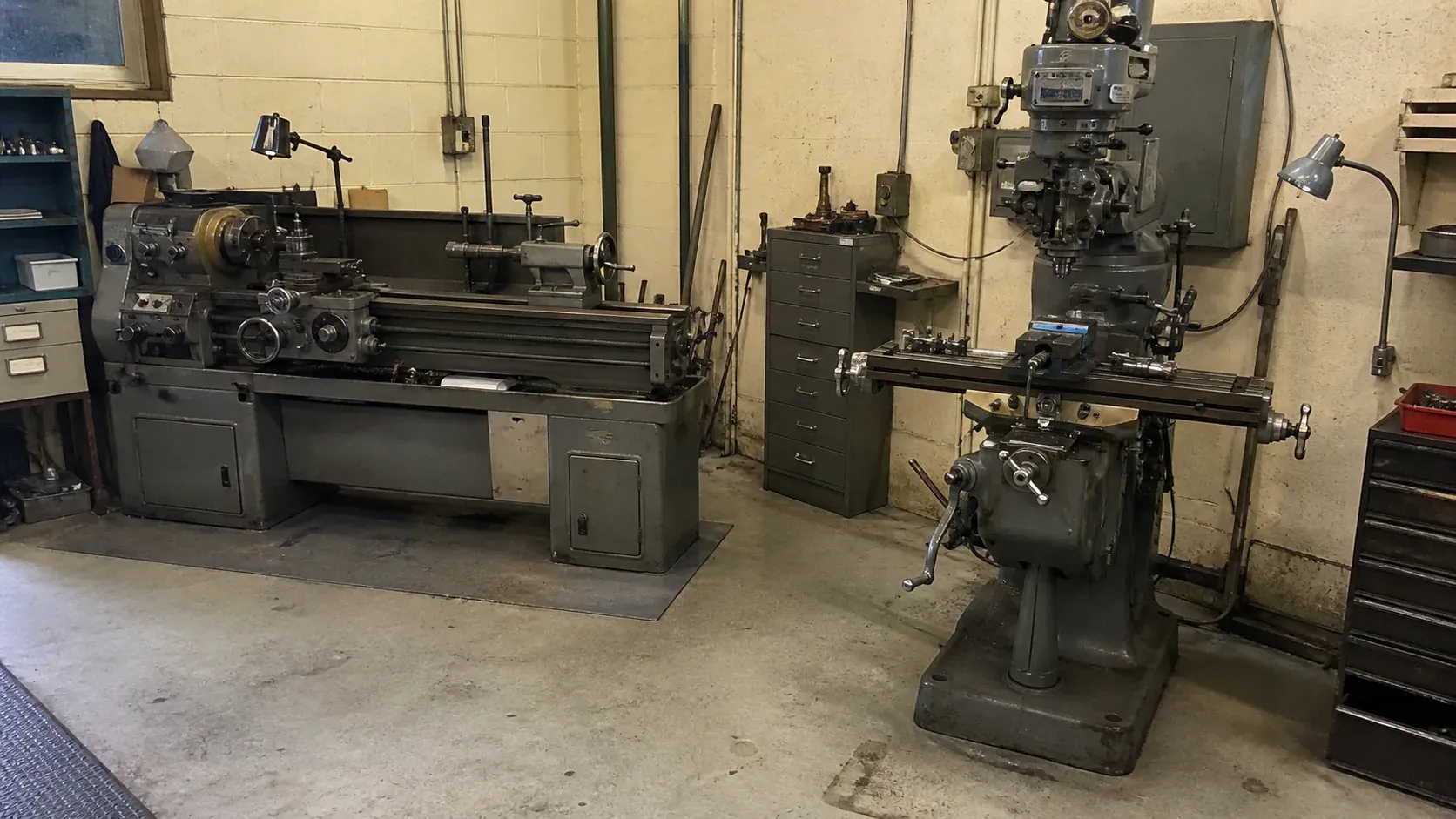
In this article
The best foundation for a lathe or milling machine is often a verified industrial concrete floor that meets the exact machine’s installation requirements. Larger, more sensitive or differently configured machines may need a dedicated pad or isolated block. Start with the manual and the intended accuracy, rather than assuming every machine requires either a huge foundation or no foundation work at all.
Garden-building bases are not interchangeable with machine-tool support. A timber floor that is comfortable to walk on may move differently under concentrated machine feet, and an ordinary screw-supported platform is not automatically suitable for precision equipment. Our lathe and milling-machine foundation service constructs the approved concrete support ready for the rigger and machine technician.
Why a machine tool cares about its floor
A machine tool needs to remain aligned while it operates. Its weight is transferred through particular support points, and movement between them can affect the geometry the installer has carefully set.
This is particularly easy to understand with a long lathe bed. A floor that settles differently beneath its supports can alter the starting conditions for alignment. A milling machine has its own support and movement requirements, so the correct detail is model-specific.
Haas UK’s first-machine guidance explains that many of its machines can use appropriate industrial floors, while some need different foundation or anchoring provisions. It directs buyers to the individual installation requirements. That is a useful starting principle, not a specification for every lathe and mill.
Tell the supplier what work the machine will perform and where it will be installed. Precision inspection, heavy interrupted cuts and a small hobby workshop do not necessarily create the same requirements. The foundation should suit the actual machine and duty.
Comparing the support options
| Foundation | Advantages | Limitations |
|---|---|---|
| Verified existing concrete slab | Avoids unnecessary construction and downtime | Construction, joints, condition and support must be known |
| Dedicated reinforced pad | Defined support and anchor arrangement | Requires excavation, curing and coordination with the old floor |
| Isolated concrete block | Can address demanding vibration and alignment needs | Specialist design and careful service connections required |
| Approved machine feet or mounts on a suitable floor | May suit the manufacturer’s intended setup | Feet do not correct an unsuitable slab underneath |
| Bench or stand for compact equipment | Practical for machines specifically designed for it | Stand and underlying floor still need adequate stiffness and support |
Reusing an industrial floor
If the existing floor meets the machine’s requirements, reuse can be the most sensible option. It avoids unnecessary concrete, demolition and interruption to the workshop.
The assessment should consider what the slab is made of, how it is supported and where the machine feet will sit. Cracks, joints, old trenches and repairs may affect suitability. A floor can look continuous while concealing a very different structure beneath one end of the machine.
Haas’s TM-0P pre-installation guide requires stable concrete support for that model and discusses continuous slabs, vibration, access and final levelling. Its numerical requirements belong to that machine and should not be copied to another product.
Ask the supplier or appropriate engineer to accept the proposed location. Do not rely only on the fact that a forklift drives over the floor or another machine stands nearby. Concentrated support loads, anchors and precision requirements differ from general traffic.
Keep the assessment with the installation records. If the machine is replaced later, that information gives the next team a starting point without implying that every heavier or faster model is also covered.
A dedicated concrete pad
A concrete foundation can be appropriate where the floor is unsuitable, its construction is uncertain or the machine requires a particular support arrangement. It creates a defined area with the specified levels, anchors and bearing conditions.
The main benefit is clarity. The machine installer can work from a known foundation rather than adapt to an irregular existing floor. Anchor pockets or grout zones can be coordinated before the equipment arrives.
The disadvantages include breakout, excavation, material handling and curing. Inside an operating workshop, dust, access and downtime can be as important as concrete volume. Plan the work around the facility rather than pricing it as an open outdoor slab.
The new pad’s relationship to the surrounding floor needs design. It may need a joint or a particular connection, depending on its role. Do not join or separate it by habit; follow the supplier and engineer’s detail.
The finished level should also suit material handling and operator use. A raised block can complicate access or create awkward edges if it was not part of the machine layout. Agree the complete workstation arrangement before construction.
Isolated foundations for demanding work
An isolated block may be needed where the machine is sensitive to vibration or where its operation would disturb nearby equipment. It combines the support structure with a designed isolation arrangement.
The benefit is addressing a defined performance problem. The trade-off is a more specialised design and construction process. The isolation materials, block, machine connection and services must work together.
Do not choose an isolated foundation simply because it sounds premium. A manufacturer may intend the machine to stand on a suitable industrial slab with approved feet. Adding a different support system without approval can change the machine’s behaviour.
Where isolation is required, protect it during construction and later fit-out. Grout, rigid pipework, cable containment or a floor finish can create a connection across a separation intended to remain effective.
The machine and vibration specialists should define the performance checks. A foundation contractor can build the approved detail, but cannot guarantee machining accuracy solely from a successful concrete pour.
Levelling feet, mounts and anchors
Machine feet and mounts are part of the installation system, not a replacement for an adequate floor. They may provide adjustment or a specified degree of isolation, but they still depend on the support beneath them.
Use the components and procedure accepted by the manufacturer. Improvised rubber pads, timber packing or loose metal shims should not be introduced because they seem likely to improve the setup.
Anchoring is also model-specific. Some machines use defined anchor kits; others use pockets, grout or particular levelling arrangements. The fact that a machine has holes in its base does not establish the correct anchor type or tightening sequence.
Clarify who supplies anchors, installs them and performs final levelling. These tasks can fall between the groundworker, rigger and service technician unless they are assigned explicitly.
For a lathe, the technician may need to check bed alignment as part of setup. A spirit-level reading on the concrete is not the same as completing the machine’s alignment procedure. The foundation provides the starting support; the specialist establishes the final machine condition.
Compact machines, benches and home workshops
A small bench lathe or mill may be designed for a suitable stand rather than a dedicated ground block. Follow its manual and assess the stand and floor together.
The stand needs to support the intended points without excessive movement, while the floor carries the assembled machine and stand. Bolting a flexible bench to an unsuitable floor does not automatically make the system rigid.
Domestic garages deserve particular care because their floor construction may be unknown. A surface that has supported a car is not necessarily verified for a machine’s feet, anchors or accuracy requirements. Ask the supplier what information is needed before placing the equipment.
Timber-frame bases are useful for compatible garden buildings, but a shed floor should not automatically be treated as a precision machine foundation. A separate concrete machine pad may be appropriate within a workshop while the enclosure uses a different foundation system.
That separation should be planned before the building is completed. It is easier to coordinate the machine support and floor opening early than to cut apart a finished workshop later.
Where ground screws can still help
We prefer ground screw foundations where suitable structures can be supported with less concrete and excavation. A framed workshop enclosure may be a good candidate, even where the lathe or mill needs its own concrete foundation.
The machine support should not be assumed suitable merely because the workshop frame is strong enough for general use. Precision, concentrated loads and operating vibration need the machine supplier’s assessment.
Any proposed screw-supported equipment frame would require explicit engineering and manufacturer approval for the complete duty. Ordinary garden screws and joists are not interchangeable with a specified machine pad.
The environmental comparison should include the entire project. Retaining an adequate existing slab may avoid more material than installing a new alternative. A mixed workshop design can also concentrate concrete beneath the machine while using screws elsewhere.
Avoiding unnecessary concrete is worthwhile; omitting required support is not. Reliable alignment and avoiding remedial reconstruction belong in the sustainability discussion alongside initial material quantities.
Layout before delivery
Mark the machine’s full working envelope on the floor, including doors, control cabinets, coolant tanks, chip conveyors and any bar feeder or material-loading area. The brochure footprint may omit the space needed to use and maintain it.
Think about the route from delivery to final position. The rigger needs suitable access, lifting capacity and a plan for moving over the floor. A finished foundation in an inaccessible corner can turn a straightforward delivery into a complicated operation.
Keep room for major maintenance. A removable tank or conveyor should not be trapped against a wall simply because the main machine fits. Future servicing often needs more clearance than everyday operation.
The operator’s environment matters too. Lighting, doors and temperature changes may affect practical use and precision. The machine supplier should help assess the location, especially for work with demanding tolerances.
Services, coolant and cleanliness
Plan electrical supply, compressed air and any other services before foundation work. Openings or ducts should not conflict with anchors, levelling points or isolation details.
Coolant and swarf handling need their own practical arrangement. The base should suit the machine’s maintenance and cleaning procedure without creating inaccessible pockets. The supplier should specify any drainage or containment detail rather than leaving it to the concrete contractor to improvise.
Avoid rigidly connecting isolated structures through pipe supports or containment. Where separation is required, the service designers should provide an accepted connection detail.
Record concealed routes and foundation construction. Workshop layouts change, and accurate information helps future contractors avoid drilling into services or making assumptions about an old machine block.
Comparing quotations and organising handover
Ask quotes to refer to the exact machine, installation manual and approved foundation drawing. Include floor breakout, excavation, spoil, concrete, reinforcement where specified, anchors or pockets, ducts and reinstatement.
Clarify the programme for curing, rigging, grout and final levelling. The equipment delivery date should follow the agreed foundation readiness, not force the contractor to guess when the concrete is adequate.
For existing-floor proposals, identify who checks suitability. For isolated blocks, include the specialist components and inspection stages. A low price that leaves those tasks unassigned is not a complete comparison.
You can contact JustBases for a machine-tool foundation quotation with the model, workshop location and any manual or floor information available. We can discuss the practical groundwork while the machine supplier confirms the final support requirements.
Frequently asked questions
Does every lathe need a separate concrete block?
No. Many machines can use a suitable verified industrial floor, while others require a dedicated pad or isolated foundation. The exact manual, ground support and intended performance should decide.
Can a milling machine stand on paving slabs?
Do not assume ordinary paving is suitable. Individual slabs and bedding can move, and may not provide the required anchor or support arrangement. Follow the machine manufacturer’s approved installation detail.
Will a thick slab guarantee machining accuracy?
No. Foundation stability is one factor. Machine condition, alignment, tooling, operation and the surrounding environment also matter. Final levelling and setup belong with the machine technician.
Does JustBases move or level the machine?
Our standard scope is the approved foundation. Machinery moving and final alignment should be carried out by the appointed rigger and machine specialist, with responsibilities agreed before delivery.
More advice for your project
What is the best base for a garden observatory?
Compare ground screws, timber floors and concrete observatory bases, with advice on isolated telescope piers, roof tracks, drainage and cable routes.
What is the best foundation for a memorial or headstone?
Understand memorial foundation slabs, ground anchors and monolith systems, with respectful advice on cemetery approval, stability and long-term care.
What is the best foundation for a telescope pier?
Compare isolated concrete pier foundations, existing slabs and alternative supports, with advice on vibration, mount height, anchors and future upgrades.