The JustBases advice journal
What type of base is best for an outdoor aviary?
Compare concrete, paving, natural ground and ground-screw platforms for aviaries, including drainage, cleaning and secure perimeter details.
By JustBases 9 min read
Explore the installation service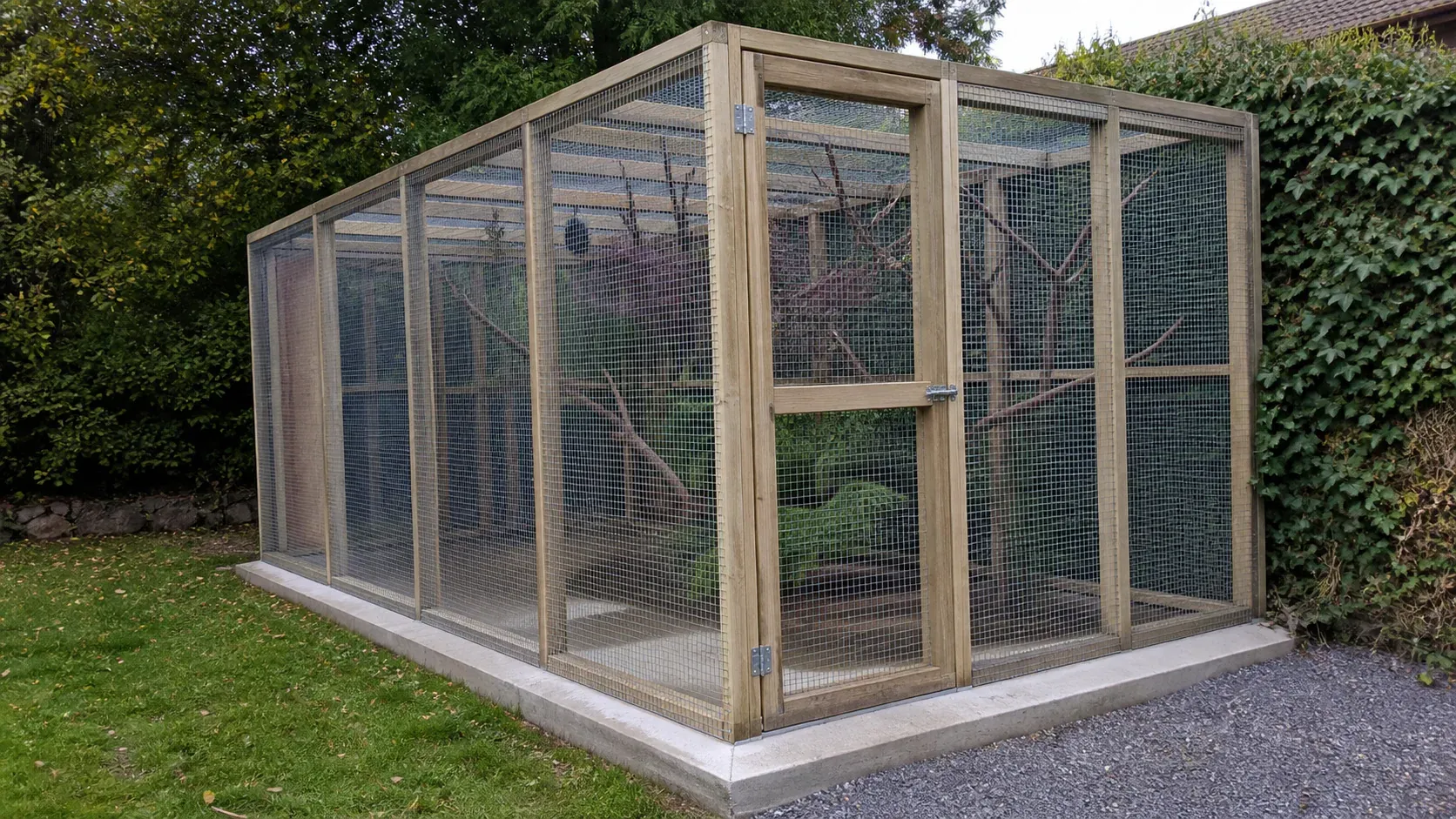
In this article
For many permanent walk-in aviaries, concrete is the most practical base because it provides a continuous surface that can be cleaned and detailed around the enclosure. If your aviary includes a separate raised bird house with its own floor, ground screws can be a good choice beneath that building. A planted aviary may need a different combination, with structural foundations around carefully managed natural areas.
There is no useful answer based only on the word “aviary”. A covered budgie flight, a planted finch enclosure and a large parrot aviary do not have identical floors or cleaning routines. Start with the birds’ accommodation requirements and the enclosure supplier’s design, then select foundations that support them.
Our aviary base service can help turn that arrangement into a practical groundwork plan. The following comparisons explain where each option earns its place.
The foundation and the birds’ floor are different decisions
The foundation keeps the enclosure stable and supports its posts, walls and shelter. The surface above it is where food falls, people walk and some birds forage. Those functions overlap, but they should not be confused.
For example, a concrete slab can support removable substrate trays without requiring the whole aviary to remain bare concrete. A natural planted area can sit within a designed perimeter foundation. Ground screws can carry an enclosed bird house without providing the floor of the adjoining outdoor flight.
Omlet’s budgie aviary guidance discusses concrete floors for cleaning and resistance to animals burrowing through the floor area. It also recognises planting as part of the layout. Those are useful design considerations, although the details must suit your birds and site. See Omlet’s aviary planning guide.
Avoid treating a single material as a guarantee against all pests. Even a continuous slab has edges, doors, drain openings and connections to inspect. Good foundations make a secure enclosure easier to build; they do not replace it.
A quick comparison of the main choices
| Base system | Useful for | Upsides | Downsides |
|---|---|---|---|
| Concrete slab | Permanent, regularly cleaned flights | Continuous cleanable substrate and reliable setting-out surface | Permanent, requires excavation and a suitable finish |
| Ground screws and framed platform | Raised bird houses and compatible enclosed units | Can reduce concrete and maintain separation from damp ground | Needs a complete floor and carefully protected edges |
| Paving slabs | Some smaller domestic aviaries | Replaceable surface and possible reuse of existing paving | Joints, movement and anchoring require attention |
| Designed perimeter foundation with natural infill | Planted aviaries planned around species needs | Combines structural support with living surroundings | More complicated cleaning, drainage and perimeter security |
| Loose gravel or soil alone | Surface within a managed enclosure | Easy to alter and potentially inexpensive initially | Does not provide dependable enclosure foundations |
The best layout may combine two systems. A concrete service aisle and raised shelter, for example, can serve different jobs without forcing the entire site into one construction method.
Concrete: practical for routine cleaning
A concrete aviary base creates a stable platform for the enclosure and a continuous substrate for its intended floor treatment. Food and debris are easier to see than on a deep loose surface, and the floor can be formed around the chosen cleaning and drainage arrangement.
The important word is “arrangement”. A slab that simply tips water towards a doorway may be awkward to use. Consider where you will stand, whether a hose is part of the cleaning routine and where dirty water will be collected. The structure itself may need level bearing points even when selected floor areas have a designed fall.
Concrete’s drawbacks include its hard surface and the need to make it appropriate for the actual birds. Substrate, resting areas and environmental enrichment should come from species-specific accommodation advice. The base contractor should not casually prescribe one universal floor covering for every species.
Concrete also needs preparation and curing. Poor ground beneath it cannot be corrected by making the visible top look neat. The final dimensions must allow the enclosure to fit, with the intended overhang, door clearances and anchors.
If you expect to alter the flight arrangement, discuss that now. A fixed drain or post position can constrain later changes. A little planning around removable internal partitions may preserve flexibility without building a much larger slab than you need.
Ground screws: strongest as a raised-building solution
We like ground-screw foundations for compatible timber bird houses because they can support a raised floor without covering the entire footprint in concrete. That is particularly useful where the building already comes with a designed bearer or joist system.
A timber frame base connects the supports and carries the floor at the required points. Ground separation can help keep structural timber away from wet soil, while the installation may require less material handling than a full slab.
The floor still needs to be suitable for birds, people and cleaning. If the supplier expects a lined, dry-cleaned interior, establish how joints and edges are protected. Do not assume a raised timber floor can be regularly flooded simply because the screws beneath it tolerate outdoor conditions.
Raised systems also create an underside to manage. Keep it accessible for inspection, prevent feed accumulating beneath the building and detail pest protection without blocking necessary ventilation. An attractive skirt is only useful if it remains compatible with those jobs.
For an open flight, screws alone do not provide a digging barrier or a floor that can be cleaned. They may form part of an engineered frame foundation, but the perimeter and ground surface still require a complete design. That makes them an option to evaluate, rather than a default answer for every aviary.
Paving slabs: sensible when their limitations are accepted
A paving slab base may suit a small aviary if the enclosure manufacturer accepts the surface and fixing arrangement. It can be convenient where a sound patio already exists and retaining it avoids unnecessary work.
You can replace individual damaged units, and matching paving can create a pleasant route around the enclosure. For a keeper carrying food, water and cleaning equipment, a usable approach is a worthwhile part of the overall design.
The challenge is the joints. They can retain small debris or open as slabs move, making cleaning and perimeter sealing more difficult. A slab that rocks under a person’s foot should not be treated as a dependable anchor point for a wind-exposed enclosure.
Dedicated post foundations may be required beneath the paving. Check this before installation: drilling the enclosure feet wherever they happen to land may leave fixings near weak edges or joints.
Also look at existing falls. Patios are often designed to move rain away from a house, which may not match the aviary’s door or panel levels. Reusing paving is worthwhile when it genuinely fits the new purpose, rather than simply because it is already there.
Natural floors: attractive, but they require a management plan
A planted aviary can offer a very different environment from an entirely hard-surfaced flight. The trade-off is that soil and planting complicate cleaning, waste removal and the prevention of burrowing access.
The Queensland Finch Society’s aviary guidance compares concrete and earth floors and discusses the need to coordinate drainage, services and perimeter protection in natural-floor designs. Its specific construction examples reflect its context and should not be copied as a universal UK specification. Read its aviary design guidance.
Ask yourself how planted areas will be reached for maintenance and how you will remove soiled material. Keep feed stations and busy working routes in places that can be managed easily. An inaccessible corner behind dense planting may look attractive at first but become difficult to inspect.
A useful compromise can be contained planting or replaceable substrate areas over an otherwise manageable layout. The choice depends on the species, enclosure size and cleaning routine. Get appropriate bird-care advice before deciding what the animals will stand on or ingest.
Bare earth alone should not be expected to keep posts upright, prevent settlement or hold a door square. Structural support and the natural surface need to be designed as separate layers of the same project.
Doors, drains and feed stations deserve early attention
Aviary mistakes often occur at the junctions. A secure panel meets a drain opening; a level frame meets a sloping path; a raised shelter meets an outdoor flight. Draw those transitions before the foundations are installed.
Think about an entrance lobby where the enclosure design requires one, including both door swings and your standing space. A lip that is manageable when empty-handed may be awkward with a bucket or carrier. The floor should allow controlled entry without creating a hidden gap beneath the door.
Plan where food is stored and served. Spilled seed should remain visible and reachable rather than collecting under a low platform or behind an inaccessible edge. This is a maintenance decision as much as a cleanliness decision.
Rainwater from the roof should not pour into the busiest doorway. Equally, water used for cleaning needs a suitable collection and disposal arrangement. A drain hole is not helpful if it becomes an access route for unwanted animals or cannot be cleared safely.
Finally, preserve access around the outside where possible. Mesh, panel fixings and the edge of the floor all benefit from inspection. Building tightly against a boundary can make future repair far harder than expected.
Cost, lifespan and environmental priorities
Compare complete aviary-ready systems. Include foundations, structural frame if required, finished floor, planned drainage, perimeter details and the route to the entrance. A low headline foundation price can conceal substantial work needed above it.
Ground screws can offer an environmental advantage for suitable raised bird buildings by reducing concrete and excavation. Steel production and coating, timber sourcing, transport and eventual removal still matter. We would not make a blanket claim that screws are always greener when a separate concrete flight floor remains necessary.
Retaining a suitable existing patio or limiting concrete to the areas that need it can also reduce unnecessary material. Durability matters: a surface that repeatedly needs rebuilding because it cannot cope with the cleaning routine is rarely economical or resource-efficient.
Our pricing guide can help frame the discussion. The actual quote depends on access, ground conditions, enclosure dimensions, support points and any agreed drainage or removal work.
Start with the birds and the building you have in mind
You can contact JustBases before every detail is settled. Tell us what kind of aviary you are considering, whether it includes a bird house and where it would go. A supplier link and photographs of the area help, but they are not a barrier to a first conversation.
We can discuss which base routes appear sensible and what needs confirming with the enclosure supplier. The final groundwork should follow the agreed layout, with clear responsibility for the aviary structure and animal-care details.
Ask for advice on your aviary base or call 01202 039753. A good foundation makes the daily routine easier while supporting the secure environment your birds need.
Frequently asked questions
Is concrete the best aviary floor?
It is a practical foundation and cleanable substrate for many permanent aviaries. The final surface, substrate and planted areas should suit the birds and their management, so concrete need not mean a completely bare enclosure.
Can an aviary use ground screws?
They can support a compatible raised bird house or a suitably designed structural frame. They do not create the outdoor floor or secure the gaps beneath enclosure panels by themselves.
Can I build an aviary on paving slabs?
Possibly, if the slabs are stable and the enclosure supplier accepts the anchoring arrangement. Joints, edge gaps, falls and any dedicated post foundations all need checking.
Is a natural earth floor unsuitable?
Not automatically. It needs a deliberate species-appropriate design covering cleaning, drainage, planting and protection against burrowing access. Leaving ordinary garden soil inside a frame is not equivalent to designing that system.
More advice for your project
What type of base is best for a bird room?
Ground screws, concrete and paving compared for bird rooms, with advice on dry floors, cage loads, cleaning, insulation and connected flights.
What type of base is best for a cattery or cat run?
A practical comparison of concrete, paving and raised ground-screw foundations for private cat enclosures and boarding catteries.
What type of base is best for a chicken coop?
Compare raised ground-screw bases, concrete, paving and natural run surfaces for chicken coops, with practical cleaning and access advice.