The JustBases advice journal
What is the best base for an outdoor air conditioning unit?
Compare concrete pads, prepared slabs, brackets and approved screw-supported frames for air conditioning condensers, including noise and access.
By JustBases 9 min read
Explore the installation service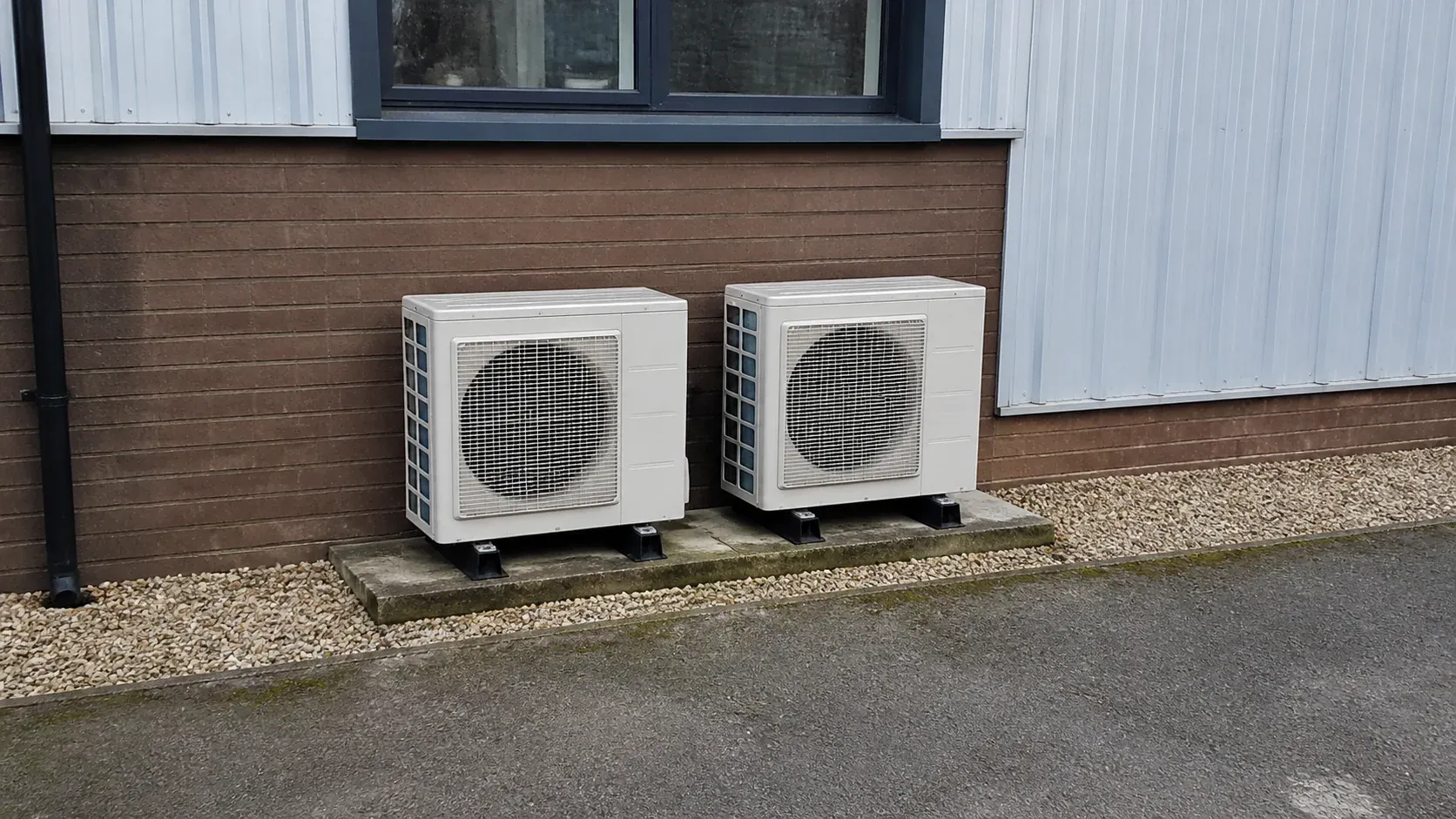
In this article
For an outdoor air conditioning unit at ground level, an installer-approved concrete pad or prepared paving base is usually the simplest place to start. An engineered frame on ground screws may be a good option where the site benefits from raised support and less excavation. Wall brackets can also work, but they move the structural and vibration questions into the building wall.
The best choice is the one that supports your exact condenser securely while preserving airflow, drainage and maintenance space. A base is a relatively small part of an air conditioning project, yet changing it after the pipes have been connected is disproportionately inconvenient. Our air conditioning unit base service helps get that part coordinated before equipment arrives.
Decide where the unit works before deciding what it stands on
The most discreet corner is not always the most suitable location. Your air conditioning installer needs to consider air entering and leaving the unit, access to panels, pipe routes and the effect of its position on noise.
Daikin’s guidance on slabs and brackets explains that installation conditions influence the mounting choice and that inappropriate ground mounting can contribute to vibration or noise. It is useful manufacturer context, but the installation manual for the actual UK model should settle the detail.
Begin by marking the outdoor cabinet position and the surrounding space required by the installer. Include the open service panel, rather than only the closed box. A neatly poured pad behind a fence offers little value if the fence then prevents the unit being serviced.
If you are adding screening later, tell the installer now. Screening can change the effective installation environment. It should be planned as part of the layout instead of built around the equipment after everyone else has left.
How the common supports compare
| Option | What it does well | What needs care |
|---|---|---|
| Concrete pad | Stable continuous platform and agreed fixing positions | Ground preparation, curing, drainage and amount of material |
| Prepared paving | Manageable components and straightforward local repairs | Supplier acceptance, bedding stability and concentrated foot loads |
| Ground screws with equipment frame | Raised levels with less extensive ground levelling | Frame stiffness, ground suitability and mounting approval |
| Proprietary support feet or rails | Matches an accepted equipment mounting arrangement | The surface beneath must still be structurally suitable |
| Wall brackets | Frees ground space and raises the unit | Wall capacity, fixings, access and vibration transmission |
Concrete pads: reliable when properly planned
A concrete base is a familiar option for a permanent condenser. It can provide a clean mounting platform and accept the anchoring arrangement approved by the installer. Where several outdoor units are grouped together, concrete also allows the plant area to be set out clearly.
That does not mean every installation needs a large slab. Match the support to the equipment and the surrounding access requirement. An unnecessarily broad paved plant area may add cost and runoff without making the condenser itself more stable.
Concrete’s disadvantages include excavation, handling and curing. In a rear garden with narrow access, moving material can represent a meaningful part of the job. A quotation should include the actual route to the site, not assume a delivery vehicle can park beside the base.
The finish needs thought. The unit’s support surface must meet its mounting requirements, while nearby surfaces need an appropriate water route. A sloping pad should not be used to solve drainage if the condenser must stand level. These are two details to coordinate, not a compromise to improvise when the concrete arrives.
Paving slabs: useful, but preparation is the foundation
Paving-slab bases can suit some smaller units where the supplier accepts the arrangement. Individual slabs are easier to carry into awkward spaces, and they can be lifted if later work is required beneath the area.
The visible slab is only the top of the system. Its support beneath matters because the condenser transfers weight through particular feet or rails. Weak bedding, disturbed soil or a joint beneath an unsuitable support point can introduce movement.
For that reason, there is a considerable difference between constructing an approved paved base and putting a condenser on an old patio. Ask whether the existing surface has settled, whether water collects there and whether anyone knows how it was laid. If it is rocking now, the equipment will not improve it.
Paving also offers less freedom for structural anchors than a properly designed concrete pad. The installer must approve how the unit is secured. Do not assume that a fixing intended for structural concrete is suitable in an individual paving stone.
Proprietary feet do not remove the need for a suitable base
Outdoor equipment is often shown on rubber feet, mounting rails or a prefabricated support. These products can be useful parts of an approved mounting and vibration arrangement. They should not be confused with the supporting ground construction.
A rail may distribute equipment loads differently, but it still needs a surface capable of supporting it. A vibration mount may reduce transmission under specified conditions, but it cannot correct unstable bedding below. Ask the installer to describe both layers: the ground foundation and the equipment mounting system.
Trane’s outdoor-unit engineering manual illustrates this distinction by discussing solid support, level bearing points, steel or concrete bases and drainage. Its dimensions are specific to its equipment; the general lesson is to coordinate the support and unit together.
Ground screws and a raised equipment frame
Where the design permits, ground screw foundations offer a route to a level equipment frame without casting a broad concrete platform. This can be attractive on sloping ground or where minimising excavation would make the installation considerably less disruptive.
We favour screws when suitable because the complete arrangement can reduce concrete and spoil, and some systems can be removed more readily when the site changes. The frame and equipment interface still need design. The condenser’s feet, anchors and any isolation components must land where the equipment supplier expects them.
The frame should be considered as equipment support, not ordinary garden decking. Stiffness, corrosion protection and the way vibration reaches neighbouring structures all need approval. A lightweight platform that seems satisfactory under a person’s weight may behave differently beneath an operating compressor.
Ground conditions and buried services are equally important. Screws cannot simply be placed wherever there is spare soil beside the wall. Their positions must be coordinated with pipes, drains and cables. The environmental assessment also includes steel manufacture, the frame and transport; avoiding concrete is useful, but it is not a complete carbon calculation.
Should the unit go on wall brackets instead?
Wall brackets may make sense when ground space is limited or the approved installation needs the condenser raised. They can leave a passage clearer and avoid constructing a pad directly below the unit.
Their limitations are different from a ground base. The wall needs to be suitable, the fixings correctly specified and the equipment accessible. A bracket is only as useful as its connection to the building. An unsuitable wall cannot be made appropriate merely by using a larger bracket.
Noise also deserves attention. A connection to the building can create a path for vibration, and the installer should consider the room behind the wall as well as the outdoor sound. Ask them to explain why the proposed bracket and isolation arrangement suit that position.
Higher is not automatically better. Routine maintenance and replacement become more difficult if the unit is placed where safe access is awkward. Compare the long-term working arrangement, not just how much ground space the brackets save.
Water, leaves and the surrounding ground
Rainwater and condensate need an appropriate route. Some air conditioning equipment also operates in heating mode, so the installer should confirm the relevant drainage behaviour for your system rather than assume it behaves like a cooling-only unit.
The foundation should not trap water against the building or discharge it across a frequently used path. Equally, decorative gravel is not a drainage design on its own. Its performance depends on what lies beneath and where water can actually go.
Leave room to clear leaves and debris. A condenser squeezed between a fence and a planted border may be difficult to keep clean. Think about autumn conditions, not just the freshly cleared space at installation.
If the ground falls towards the base, deal with that wider surface-water route. Raising the equipment can protect its position in some designs, but does not remove the need to understand ponding or erosion around the supporting structure.
Planning for replacement and expansion
Air conditioning layouts sometimes grow: another room is added, the outdoor unit changes or a second condenser is proposed. It is sensible to discuss likely plans before the first base is built, but avoid pouring a large speculative slab for equipment that may never be installed.
Instead, agree a layout that leaves useful options. Keep service routes identifiable and avoid blocking likely access. If spare ducts are worthwhile, their position and size should come from the installer. Empty space on a pad is not necessarily usable expansion capacity.
When replacing an existing unit, compare its mounting drawing with the new one. Similar cabinet dimensions do not guarantee the same feet, anchors or connection positions. Reusing a good base can save work, provided the new equipment is genuinely compatible with it.
What to ask when comparing prices
Ask each contractor to price the same completed arrangement. Does the quotation include removing the old base, preparing the ground, taking away spoil, providing the mounting frame and reinstating adjacent surfaces? Are the equipment feet supplied by the air conditioning installer or included with the foundation?
The timetable should include any curing period and the handover to the equipment team. If the unit is replacing an existing system, coordinate temporary removal and reconnection so the base work does not become an unexpected interruption.
You can start with a photo, the proposed model and a rough description of access. We can discuss the suitable base options while your installer finalises the equipment detail. Ask JustBases for a written quotation and mention whether concrete, paving or an approved screw-supported frame is being considered.
Frequently asked questions
Can an air conditioning condenser sit directly on soil?
Do not assume soil is an acceptable permanent support. The unit needs the stable mounting arrangement stated by its manufacturer, including any required frame or feet. The installer should choose a suitable prepared foundation for the site.
Is a concrete pad quieter than wall brackets?
There is no universal answer. Noise and vibration depend on the unit, position, structure and mounting system. Ask the air conditioning installer to compare the proposed locations and isolation arrangements, particularly where bedrooms or neighbouring properties are nearby.
Can ground screws support several outdoor units?
Potentially, with a frame designed and approved for the selected equipment, ground and operating loads. Multiple units make coordination more important: their support points, service clearances and vibration arrangements must all be addressed.
Does JustBases fit the refrigerant pipes and electrics?
Our standard work is the agreed ground foundation and any quoted associated groundwork. The competent air conditioning contractor installs and connects the equipment, carries out the relevant specialist work and commissions the system.
More advice for your project
What is the best base for a heating oil tank?
Compare concrete and properly constructed paved oil-tank bases, with advice on continuous support, replacement access and avoiding unsuitable frames.
What is the best base for an air source heat pump?
Compare concrete, paving and approved ground-screw frames for heat pumps, with practical advice on vibration, airflow, defrost water and installation.
What is the best base for outdoor solar battery storage?
Compare concrete plinths, existing floors, wall mounting and approved framed bases for outdoor battery storage, with practical installation advice.