The JustBases advice journal
What is the best base for an air source heat pump?
Compare concrete, paving and approved ground-screw frames for heat pumps, with practical advice on vibration, airflow, defrost water and installation.
By JustBases 9 min read
Explore the installation service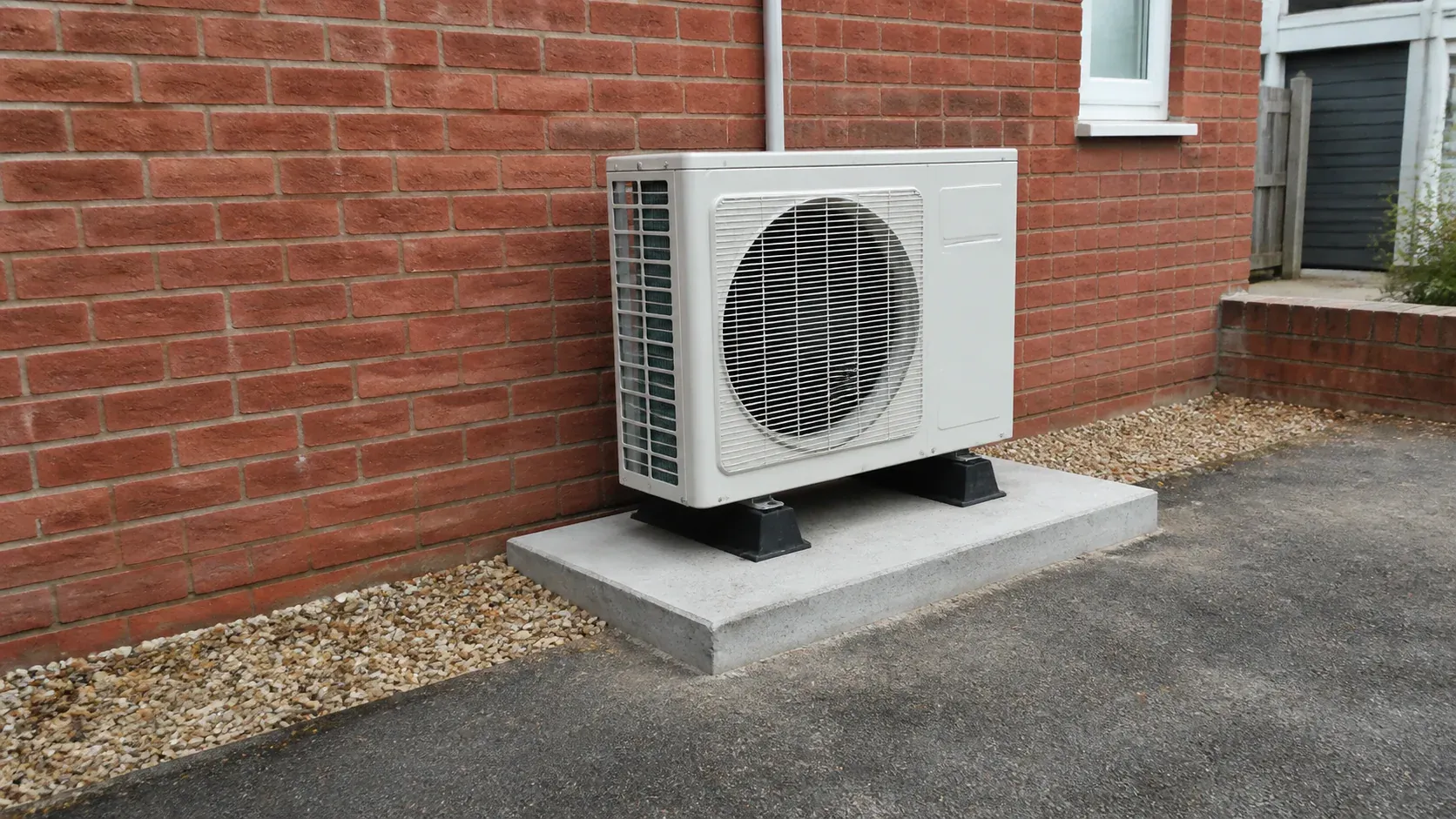
In this article
For most ground-mounted domestic air source heat pumps, the best base is the compact, stable support specified by the heat-pump installer: often a concrete pad or properly prepared paving beneath approved feet. A ground-screw-supported equipment frame can be an attractive alternative on suitable ground, particularly where raising the unit avoids extensive levelling. The important starting point is the selected heat pump and its mounting instructions, rather than deciding that every outdoor unit needs the same little slab.
That might sound rather technical for something that looks like a box beside the house. In practice, it makes the buying decision simpler. Agree where the unit should go, how it will be supported and where its water will drain, then compare foundations that deliver that arrangement. Our air source heat pump base service works around the agreed installation detail.
What the base actually needs to do
A heat pump needs stable support, but stability is only one part of the job. Its outdoor unit also needs airflow, access to service panels and somewhere appropriate for defrost water to go. A base that is beautifully finished but puts the fan too close to a fence has solved the wrong problem.
The current Grant Aerona 290 installation manual illustrates the model-specific approach: it discusses base construction, accepts suitable paving on compacted hardcore in its stated circumstances, and requires the installed unit to be level for drainage. Those details are an example for that product, not permission to use the same arrangement for every heat pump.
Ask your heating installer to identify the actual feet or rails. Cabinet width is not the same as mounting footprint. An outdoor unit can fit on a pad while its support points end up uncomfortably close to an edge, or its drain opening falls directly over solid concrete. Resolving that before groundwork is much easier than modifying a finished base.
The main options compared
| Base option | Main advantages | Main limitations | When to consider it |
|---|---|---|---|
| Concrete pad | Continuous, durable support; accommodates an agreed fixing layout | Excavation, concrete delivery and curing; drainage needs planning | Permanent ground-mounted equipment |
| Prepared paving base | Components can be carried through narrow access; replaceable surface | Depends on sound preparation and supplier acceptance; joints can move | Approved domestic units on suitable ground |
| Ground screws and equipment frame | Can reduce concrete and extensive levelling; useful raised support | Needs a designed frame, ground assessment and vibration approval | Slopes or sensitive access where the installer accepts the system |
| Proprietary mounting base | Designed around equipment support and isolation | Still needs suitable ground or a structural platform below | Where the heat-pump supplier specifies the complete product |
| Wall brackets | Keeps the unit clear of the ground | Transfers loads to the wall; structural and acoustic checks needed | Only where the installer approves wall mounting |
When concrete is the sensible choice
A correctly designed concrete base offers a straightforward platform for a permanent outdoor unit. It can receive the approved mounting rails or anti-vibration feet, provides a tidy surface for access and can be shaped around planned service entries.
The advantage is predictability. Once the size, level, fixing positions and drainage details are agreed, the heating team knows what it is arriving to install. Concrete can also be useful when several items of equipment share a plant area, although that does not automatically mean they should share the same structural pad.
The disadvantages are the wet construction process and the material involved. Excavated soil must go somewhere, concrete must reach the working area, and equipment cannot be installed simply because the top looks dry. The installer and base contractor should agree when the pad is ready to accept the unit and its anchors.
Avoid making the pad unnecessarily large. A broad patio surrounding a small heat pump may add cost without improving its support. It can also create more runoff to manage. A deliberately sized foundation, with a separate practical maintenance surface if needed, is often the more considered solution.
Can paving slabs be enough?
Sometimes, yes. The useful distinction is between a properly constructed paving-slab base and putting equipment on whichever old patio stones happen to be nearby.
Paving has real benefits where access is restricted. Individual units can be brought through a side passage without arranging a concrete delivery to the rear garden. The finished surface can be lifted or repaired, and a small approved installation may be achievable without a monolithic pour.
However, paving does not become structurally suitable merely because it feels firm when someone walks on it. The unit’s feet concentrate weight at particular points. The bedding and sub-base need to support the arrangement, and the heating installer must accept it. A rocking slab should not be corrected with improvised timber wedges or loose packing.
Existing paving deserves particular attention. Ask how it was constructed, whether it has settled and whether buried pipes run beneath the proposed feet. If the answer is unknown, inspecting and rebuilding a small area may offer better value than taking a chance beneath expensive equipment.
Where ground screws fit
We favour ground screw foundations where they are suitable because a well-designed system can reduce concrete use, spoil and disruption. For heat pumps, the screws normally support a compatible equipment frame. The unit is then fixed and isolated from that frame in the manner accepted by its installer.
This may be worth exploring on sloping ground. Instead of cutting a large level terrace, the frame can establish the agreed equipment level with a smaller footprint of ground disturbance. It can also help where the unit needs a raised position for an approved drainage arrangement.
The frame is not an incidental accessory. It needs to carry the actual support points, resist the relevant forces and provide enough stiffness for the equipment. A frame designed for a garden room floor cannot simply be assumed suitable for rotating machinery. The heat-pump supplier should approve the mounting and vibration arrangement before work begins.
Ground screws also require an assessment of soil, obstructions and buried services. They do not suit every site, and driving a screw near known utilities needs careful coordination. The environmental comparison should include the steel screws, frame, transport and installation as well as any concrete avoided. We recommend the suitable complete system, not an unsupported promise that one material is always greener.
Vibration: why the foundation and feet work together
It is tempting to ask for the heaviest base possible to make the heat pump quiet. A stable base matters, but sound and vibration also depend on the equipment, mounting system, pipe connections and its position relative to the building.
The foundation contractor should not choose isolation feet by appearance. Nor should extra rubber layers be inserted after installation because they seem likely to help. The heating installer needs to select and fit the approved components, including any flexible connection details.
Think about future maintenance as well. The feet should remain inspectable, fixings reachable and the space around the unit easy to keep clear. Decorative gravel can be useful around a base, but it should not conceal components that need checking or migrate into the equipment’s drainage openings.
Defrost water deserves its own conversation
Ask a very practical question before the base is installed: when the unit releases water, where will that water end up?
A convenient position beside the back door can become inconvenient if water crosses the main walking route. Equally, simply letting it disappear into a gravel strip is not an adequate plan if the underlying ground cannot accept it. The heat-pump designer should choose the destination and any required drainage detail.
The top of the support and the surrounding landscape do different jobs. The equipment may need a level mounting surface while nearby surfaces guide rainwater away. Do not slope the heat pump itself to solve a landscaping problem. Agree both levels together so the final installation works in wet weather as well as on the day it is photographed.
Keep gutters and downpipes in the conversation. A roof discharging onto the equipment area can undermine an otherwise sensible condensate plan. Moving the base slightly or dealing with that discharge first may be more useful than specifying a more elaborate foundation.
Plan the space for a person, too
Imagine a heating engineer removing the largest service panel, placing tools nearby and working at the unit. Then imagine replacing the outdoor unit later. A narrow decorative enclosure might hide the equipment well but make both jobs unnecessarily difficult.
Your heating installer should confirm clearances before fences, screens or raised beds are added. Mark the proposed cabinet position and maintenance space on the ground, using the installer’s dimensions. This often reveals clashes that are hard to spot on a quotation drawing.
Also agree who handles pipe and cable routes. A duct emerging in the wrong place can obstruct a foot or force an awkward connection. If the unit model changes after the base is ordered, pause and compare the new mounting drawing before proceeding. Similar-looking cabinets can have different supports and service entries.
Comparing quotations without buying unnecessary work
Compare a completed, installer-ready base with another completed base. A price for loose slabs is not directly comparable with a quotation that includes excavation, compacted sub-base, waste removal and a condensate trench.
For concrete, ask what is included in preparation, finish, anchor coordination and the installation timetable. For paving, confirm the proposed build-up and written acceptance by the heating installer. For screws, ask whether the frame, brackets, ground assessment and agreed equipment support arrangement are included.
Separate foundation work from heating-system work. It should be clear who supplies the vibration mounts, places the unit, connects services and commissions it. That prevents gaps where each contractor assumes the other is providing something essential.
For the broader installation, the Energy Saving Trust’s best-practice guide page points to guidance developed with MCS and other industry bodies covering design, installation, commissioning and the customer journey. It is a useful reference when discussing how the foundation fits into your heating contract, particularly if different companies are handling the groundworks and equipment.
You do not need a complete technical pack to start. A photo of the location, your postcode and the proposed heat-pump model are enough for an initial conversation. If the model is still being chosen, say so. We can help establish what the base quotation will need once the heating team confirms its design. Contact JustBases for a written quote when you are ready to discuss the site.
Frequently asked questions
Is concrete always required under an air source heat pump?
No. Some manufacturers accept properly prepared paving or proprietary mounting systems. An engineered frame on ground screws may also be possible with approval. The exact outdoor unit, ground conditions and installer’s detail determine which options are suitable.
Can I use my existing patio?
Possibly, after its support and condition are checked. A patio that is satisfactory for walking may not provide the right foundation or fixing arrangement for concentrated equipment feet. The installer also needs to approve airflow, service access and the drainage route.
Will ground screws make the heat pump quieter?
They should not be sold as a guaranteed acoustic improvement. Screws and a frame provide structural support; vibration isolation and noise depend on the equipment and its complete installation. The heating designer must accept the arrangement.
Does JustBases install and commission the heat pump?
Our normal scope is the agreed ground foundation and any included associated groundwork. The competent heat-pump contractor installs, connects and commissions the equipment. We coordinate the base with their requirements so the handover is clear.
More advice for your project
What is the best base for a heating oil tank?
Compare concrete and properly constructed paved oil-tank bases, with advice on continuous support, replacement access and avoiding unsuitable frames.
What is the best base for an outdoor air conditioning unit?
Compare concrete pads, prepared slabs, brackets and approved screw-supported frames for air conditioning condensers, including noise and access.
What is the best base for outdoor solar battery storage?
Compare concrete plinths, existing floors, wall mounting and approved framed bases for outdoor battery storage, with practical installation advice.