The JustBases advice journal
What is the best base for a heating oil tank?
Compare concrete and properly constructed paved oil-tank bases, with advice on continuous support, replacement access and avoiding unsuitable frames.
By JustBases 9 min read
Explore the installation service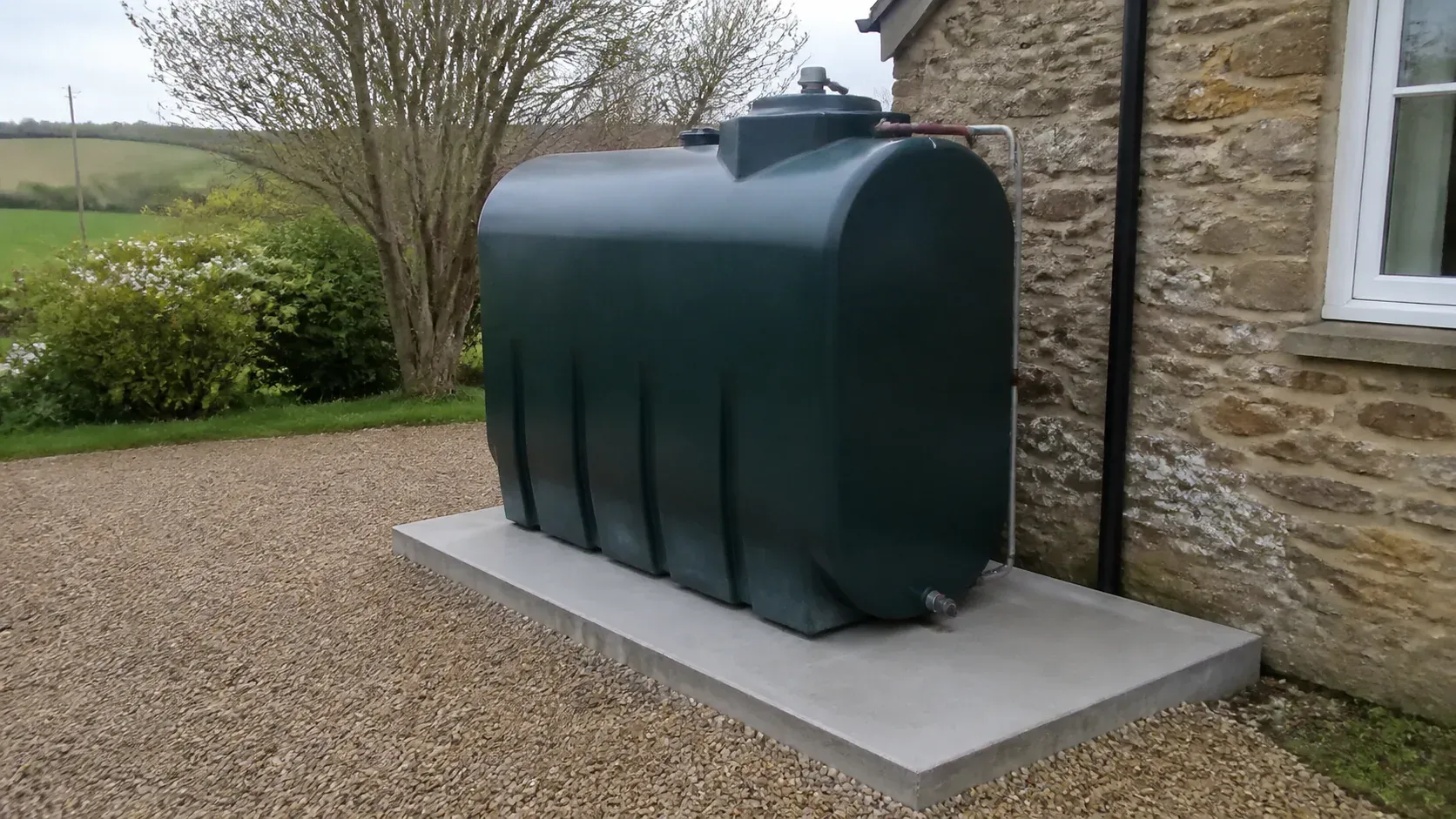
In this article
The best base for a heating oil tank is a stable, level, non-combustible support that meets the tank manufacturer’s and competent installer’s requirements. Concrete is often the straightforward option; correctly constructed paving or stonework may also be suitable. The decisive issue is continuous support for the tank and its contents, rather than whether the finished surface looks substantial.
This is one application where our usual preference for suitable ground screws does not translate into recommending a timber platform. Oil storage has specific support requirements. The sensible route is to agree the tank and siting with the oil installer, then build the accepted foundation. Our heating oil tank base service follows that agreed detail.
Why the full tank matters
An empty plastic tank can look surprisingly manageable. Once filled, the contents are a major part of the load, and the support must remain dependable as the ground changes through the seasons.
OFTEC’s tank-support guidance says the base should provide continual structural support, carry the tank and contents, and be level, non-combustible and imperforate. It identifies concrete, paving stones and stonework as base materials. The tank installer should apply the relevant requirements to your particular model and location.
That rules out a common misunderstanding: a few strong-looking support points are not necessarily equivalent to the continuous support the tank needs. A tank designed to bear over its base should not be perched on scattered blocks simply because those blocks seem capable of carrying its weight.
It also explains why a modest-looking defect deserves attention. A hollow beneath part of the tank or uneven settlement can change how the tank is supported. Foundation quality is about the whole bearing surface and the ground beneath it.
Compare the realistic base options
| Base type | Main benefits | Main drawbacks |
|---|---|---|
| Concrete slab | Continuous support, durable finish and clear construction detail | Excavation, material handling and curing |
| Properly prepared paving | Manageable components; can be suitable where accepted | Joints and bedding need care; not the same as loose patio stones |
| Approved stonework support | Can suit particular designed installations | Must provide the required bearing and stability |
| Reused existing base | Avoids unnecessary demolition and new material | Needs inspection and acceptance for the replacement tank |
| Raised proprietary support | May solve a specific approved installation requirement | Must be designed for the tank; improvised frames are unsuitable |
An ordinary timber deck, loose gravel bed or generic screw-supported garden frame should not be treated as another equivalent choice. Where a specialist support is proposed, the oil installer and tank manufacturer must approve it.
Concrete: a clear permanent solution
A concrete base makes it possible to form a continuous support surface with the required footprint and finished level. It is often a practical choice when installing a new tank or replacing a failed foundation.
The benefits are a coherent structure and a surface that can be inspected around the tank. The contractor can prepare the ground, form the perimeter and coordinate the final height before the oil installer brings in the vessel.
Concrete’s weakness is not usually the idea of the material but an inadequately planned installation. Poorly consolidated fill, insufficiently understood ground or an incorrect footprint can undermine the result. The construction detail should come from the competent design and installation team, not a generic online thickness recommendation.
Access affects cost. A small slab at the back of a property can involve substantial handling if material must be carried through a narrow route. Ask whether the quotation includes removing the excavated soil and reinstating any disturbed path or lawn.
The programme also matters. Arrange the tank delivery and filling sequence with the oil specialist so the foundation is ready for the intended load. The apparent hardness of the surface is not the basis for deciding when to place or fill the tank.
Paving stones: acceptable construction versus a casual patio
Paving-slab bases can be suitable when constructed and accepted for oil-tank support. OFTEC’s recognition of paving as a possible material is not permission to place a tank on any existing patio.
The advantage is that separate components can be transported through restricted access. Repairs or future removal may also be more manageable than breaking out a single concrete slab. For an approved arrangement on appropriate ground, that can make paving worth comparing.
The limitation is movement between components and beneath them. The bedding and sub-base must provide the required support, and the surface must remain level and continuous for the tank. A stone that rocks beneath someone’s foot is clearly not ready for this job.
Do not use gaps, loose packing or timber strips to reconcile an unsuitable surface with a new tank. If the existing paving does not meet the approved detail, rebuild the necessary area. The cost of proper preparation should be weighed against the inconvenience of moving a connected tank later.
The surrounding paving can be separate from the tank foundation. That allows a practical walking surface while keeping the actual support construction specific to the equipment. It also makes future inspection easier if the structural base remains clearly identifiable.
Existing bases and replacement tanks
Reusing a good base can reduce both cost and environmental impact. The oil installer should confirm its suitability for the replacement tank, including the required bearing area and the current condition of the installation.
A newer tank may have a different footprint or support arrangement even if its capacity seems similar. Bunded and other tank configurations can also change the overall dimensions. Order the base against the actual product drawing rather than the nominal storage capacity.
Look for signs that merit inspection: settlement, cracking, gaps, erosion, improvised packing or water persistently collecting nearby. These are useful observations to share with the installer; they do not establish the structural condition on their own.
A replacement project also involves the old tank and remaining fuel. Agree who safely manages them, when the tank is removed and how the new foundation work fits into the heating arrangements. Foundation contractors should not improvise moving or draining an in-service oil tank.
If the old tank cannot be removed until the replacement is ready, the installer may need a different sequence or location. Discuss that early. It is a project-planning issue that can affect the foundation quotation considerably.
Raised tanks and why improvised frames are a poor shortcut
Some installations have a defined reason for raising the tank. That should come from the system design, with the support specifically approved for the chosen vessel.
A raised support has to do more than carry weight. It must keep the tank stable, preserve the required bearing arrangement and provide a suitable installation environment. A stack of blocks or a timber platform made to the tank’s outside dimensions does not establish those properties.
Timber-frame bases are useful for compatible buildings, but an oil tank is not a timber garden room. Nor do ground screw foundations remove the need for the correct platform and tank support. Any specialised alternative needs explicit acceptance from the tank manufacturer and competent designer.
For most domestic enquiries, it is more productive to compare the approved concrete and paved arrangements than to search for a supposedly universal no-concrete shortcut. The best foundation is the one the tank can safely rely on throughout use.
Drainage and the surroundings
The tank should stand on the level surface its installer requires, while the surrounding area should manage rainwater appropriately. Do not tilt the tank base to encourage runoff unless that is expressly part of the approved design.
Look beyond the immediate footprint. A downpipe discharging beside the slab, a slope carrying water towards it or erosion at an edge may affect the long-term condition. Resolve those routes as part of the groundwork plan.
Keep the perimeter visible enough for inspection. Decorative borders, stored materials and vegetation should not conceal the base or make it difficult to see changes. A tidy accessible installation is easier to maintain than one closely boxed into landscaping.
OFTEC’s domestic oil-storage guide includes base subsidence among the warning signs to discuss with a competent technician and recommends visual checks as part of ongoing tank care. Keeping the support visible makes those checks more useful. If you notice a change, share it with the oil installer rather than trying to pack or level a connected tank yourself.
The oil installer should assess siting and any associated protection requirements. Foundation advice is not a substitute for that assessment. A sound slab cannot make an otherwise unsuitable position acceptable, so agree the location before committing to construction.
Choosing a lower-impact approach responsibly
Our preference for ground screws is based on their usefulness in suitable projects: they can reduce concrete and excavation for compatible framed structures. Oil-tank support is a clear example of why that preference must remain conditional.
There are still meaningful environmental choices within an approved oil-tank foundation project. Retaining a sound existing base can avoid demolition. Accurately sizing a new base avoids unnecessary material. Coordinating tank delivery and groundwork reduces repeat journeys and remedial work.
Paving may be repairable or removable, but that alone does not prove it has a lower total impact than concrete. Material manufacture, transport, support construction and expected service all matter. Compare real proposals for the site rather than assigning a universal environmental winner to one material name.
The most wasteful outcome is a base that must be rebuilt after the tank is installed. Taking the model-specific detail seriously is therefore part of both good value and responsible construction.
What should be included in the quotation?
A useful quotation identifies the approved tank model and base drawing, the required site preparation, excavation, waste handling, support construction and finished level. It should also state what happens to the surrounding surfaces.
Ask who checks the base before the tank is placed and who confirms it is ready for loading. Make the boundary between foundation work and oil-system work explicit. Tank supply, fuel handling, pipework and commissioning should be assigned to the relevant specialists.
For replacement work, compare the complete sequence. One price may assume a cleared site, while another includes removing an old foundation after the tank contractor has made the area ready. Those are different scopes, even if both are labelled “oil tank base”.
You can start with the tank size or model if known, a photo of the location and a brief explanation of whether this is new or replacement work. We can identify what the oil installer needs to confirm before the construction price is final. Contact JustBases for a written quotation to discuss the practical options.
Frequently asked questions
Is concrete better than paving for an oil tank?
Both may be suitable when they meet the tank and installer’s requirements. Concrete offers a continuous structure; paving can offer easier handling and removability. Ground preparation, support continuity and approval matter more than appearance.
Can an oil tank stand on ground screws?
An ordinary screw-supported garden frame is not an accepted substitute for the specified tank base. Any specialist proposal requires explicit manufacturer and designer approval, including the complete support surface and installation requirements.
Can I keep the existing base when replacing the tank?
Possibly. The oil installer should inspect it and confirm compatibility with the new tank, its footprint and loaded condition. Existing concrete should not be demolished unnecessarily, but neither should age alone be treated as proof of suitability.
Do I need all the tank paperwork before making an enquiry?
No. You can contact us with basic information and photographs. We can discuss the project and identify the tank or installer details needed before the foundation is finally specified and priced.
More advice for your project
What is the best base for an air source heat pump?
Compare concrete, paving and approved ground-screw frames for heat pumps, with practical advice on vibration, airflow, defrost water and installation.
What is the best base for an outdoor air conditioning unit?
Compare concrete pads, prepared slabs, brackets and approved screw-supported frames for air conditioning condensers, including noise and access.
What is the best base for outdoor solar battery storage?
Compare concrete plinths, existing floors, wall mounting and approved framed bases for outdoor battery storage, with practical installation advice.