The JustBases advice journal
What type of base is best for a bin store?
Compare paving, concrete and alternative foundations for domestic bin stores and commercial refuse areas, including wheels, gates and drainage.
By JustBases 10 min read
Explore the installation service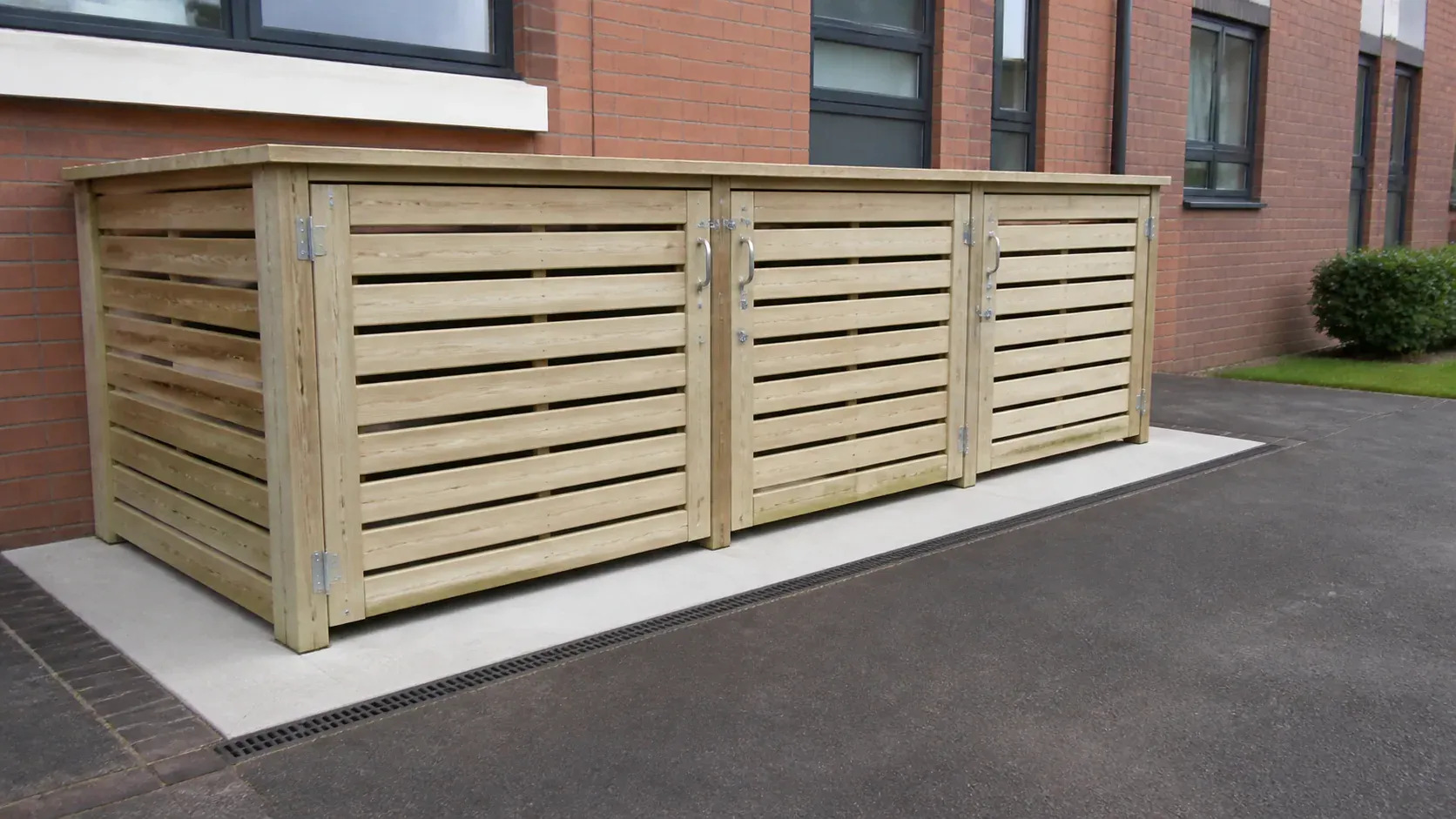
In this article
For a domestic wheelie-bin store, properly prepared paving is often the most practical choice. It gives the bins a firm surface and can connect neatly to the existing path. For commercial refuse areas with larger containers, heavy gates or repeated cleaning, a designed concrete base is usually a stronger starting point. Ground screws may support a particular enclosure structure, but they do not replace the wheeled working surface.
The best base should make collection day easy. It needs to support the store, let every bin roll out and remain manageable after rain or cleaning. A beautifully screened enclosure is less useful if the furthest bin cannot be removed without emptying the entire space.
Our bin store base service covers domestic and commercial arrangements. This guide explains how to compare their options.
Start with the bins in use
Count the actual bins and measure them, including handles, lids and wheels. Then draw the doors or gates fully open and trace the route each bin takes to the collection point.
Allow for the way people use the store. A bin may need to be tilted before moving; a lid may rise above the store’s nominal roof line; a gate may need space to stay open without blocking the path.
Domestic store manufacturer Premium Bin Stores discusses the need for an appropriate level base in its customer guidance. The relevant dimensions should come from the model you order, rather than a generic assumption based on bin capacity. See its bin-store FAQs.
For communal or commercial stores, include the collection team’s route and the largest container in normal use. Large wheeled bins and frequent movements can impose different demands from a pair of domestic wheelie bins.
The stored footprint is therefore only the beginning. The useful base often includes manoeuvring space and a sound approach beyond the enclosure.
Comparing the main options
| Base | Best starting use | Advantages | Limitations |
|---|---|---|---|
| Prepared paving slabs | Domestic stores and selected small communal areas | Firm wheel surface, replaceable units and matching paths | Joints and settlement require care |
| Designed concrete slab | Larger bins, commercial compounds and heavy gates | Durable continuous surface and structural fixing provision | Excavation, curing and drainage design |
| Existing verified hardstanding | Suitable established bin locations | Can reduce work and material | Condition, falls and anchor requirements need checking |
| Ground screws for approved enclosure supports | Certain lightweight screen structures | May reduce concrete beneath the structure | Separate bin floor and wheel route still required |
| Gravel or timber decking | Limited specialist arrangements | Can appear simple initially | Rolling resistance, cleaning and durability can be awkward |
Choose the enclosure foundation and the floor together, while recognising that they may perform different jobs.
Paving slabs: often right for household bins
A paving slab base is a sensible starting point for many domestic bin stores. It can provide a firm, tidy surface and connect to a garden or driveway path without introducing an entirely different finish.
Individual units can be replaced, and a suitable existing paved area may be reused. That can save both money and unnecessary demolition.
Preparation matters. Bins need a stable rolling surface, so rocking slabs or uneven joints should be corrected rather than hidden beneath the store. The sub-base and bedding should suit the use and ground.
The floor and enclosure may have different level requirements. The store should assemble square, while the exposed surface needs appropriate drainage. A slight overall slope that seems harmless may prevent a door closing correctly or encourage a bin to roll unexpectedly.
Paving’s main disadvantages are its joints and potential movement. Debris can collect between units, and settlement can create puddles or lips. It may also be unsuitable as the sole anchor substrate for a tall enclosure or heavy gate.
If the store requires fixed posts, dedicated foundations may be needed beneath them. That does not prevent paving from remaining the visible surface; it simply gives each component the support it needs.
Concrete: useful for demanding refuse areas
A concrete base is often the better choice for larger containers, frequent collection movements and commercial cleaning. It provides a continuous substrate that can be designed around wheel loads, gate posts and the intended finish.
The advantage is a coherent working area. Containers can be moved across fewer joints, and the enclosure’s structural anchors can be positioned on a known foundation. Channels or collection points can be incorporated where the drainage design requires them.
The slab must match the use. A surface suitable for domestic wheelie bins is not automatically designed for large commercial containers or vehicle access. Tell the designer whether collection vehicles enter the area or only stop outside it.
Concrete also needs the right finish. It should provide appropriate traction and tolerate cleaning without becoming unnecessarily difficult for small wheels. A rough surface may increase handling effort; an unsuitable smooth wet finish may create a different problem.
The disadvantages are excavation, curing and permanence. Once gate posts, channels and sockets are fixed, changing the layout may require alteration. Obtain the actual enclosure and bin arrangement before the base is built.
If the site already has adequate concrete, reuse may be worthwhile. Its condition, support and anchoring suitability should be checked rather than assumed.
Ground screws: useful for some screens, not the bin floor
We prefer ground screws where they can reduce concrete and excavation in a suitable structural system. A lightweight timber screen or proprietary enclosure might use approved screw supports.
However, the bins still need a firm rolling surface. A row of structural screws does not create a floor or make loose ground suitable for moving heavy containers. That limits the benefit compared with a raised garden building that already has a complete floor.
The enclosure’s wind loads and connections need checking. Tall solid panels can catch wind, and gate operation applies loads to posts. Do not substitute a generic screw beneath a post without a suitable design.
A timber frame base may be appropriate for a specific product, but a raised deck introduces threshold and cleaning issues. Bin wheels need to cross the edge, and spilled waste may collect between boards or beneath the platform.
For many bin stores, paving or concrete is therefore the more practical floor even where alternative supports are used for the enclosure. Sustainability should be judged on the completed working area, not on whether one component avoids concrete.
Gravel and bare ground: cheap to place, harder to use
Loose gravel can make wheeled bins harder to move, particularly when full. Small wheels may sink, turn awkwardly or push material ahead of them. It can also complicate cleaning after a spill.
Bare ground changes with weather and traffic. A neat dry patch in summer may become a rut at the exact point where every bin turns in winter. Adding a screen around it does not solve that surface problem.
Gravel can still have a role around a separate firm bin pad, for example as part of an appropriately designed landscape edge. Keep it out of the main wheel route unless the specific surface system is suitable.
Ordinary decking has similar practical trade-offs. Board joints and a raised edge can affect wheels, and the underside can become difficult to clean. A purpose-designed system may work, but it should not be assumed equivalent to a simple paved pad.
The cheapest material is not always the cheapest usable base. Repeatedly dragging full bins over a poor surface is a cost in effort every collection day.
Drainage: avoid puddles without creating a runaway slope
The base should drain appropriately, but bins and store doors need stable operating levels. Making the entire area steeply sloped to remove water can create an awkward handling problem.
Plan where rainfall arrives from the store roof and surrounding ground. Keep the route to the collection point usable, and avoid directing runoff towards the house or an adjoining property.
Commercial washdown water requires particular care. It may contain waste and cleaning products, so its discharge should follow an agreed drainage design. Do not assume a nearby rainwater drain is suitable merely because it is convenient.
If a channel is included, consider the bin wheels crossing it and how debris will be removed. A poorly positioned grate can become an obstacle or a place where lids, bags and litter collect.
For a small domestic store, an elaborate drain may be unnecessary if the surrounding levels and cleaning routine can be managed appropriately. The aim is a practical solution matched to the use, rather than adding infrastructure without a clear purpose.
Gates and lids change the required footprint
A bin store that fits the containers tightly may leave no room to operate it. Check the furthest bin, not just the one beside the door.
For double gates, allow the full swing and a place to secure them open where the product provides for it. Drop bolts and their sockets need planned positions. A socket drilled into the edge of an unsuitable slab can be a weak detail.
Posts carrying heavy gates may require foundations separate from the floor slab. The enclosure supplier’s drawing should identify those requirements. Do not let the paving contractor guess from the visible post size.
Lid-opening mechanisms can also affect the store height and rear clearance. Use the actual product details so bins can be used without being pulled out unnecessarily each time.
If additional recycling bins are likely, consider a layout that can be extended sensibly. Reserving space beside the store may be more useful than oversizing a fixed roof or slab now.
The collection route is part of the project
Trace the route to the collection point, including gates, changes in level and any shared pedestrian path. A good bin pad cannot compensate for a difficult step just beyond it.
For commercial premises, coordinate container movement with vehicles and pedestrians. HSE’s workplace transport guidance highlights planning routes and separating people from vehicles where possible. Read HSE’s workplace transport introduction.
Agree the layout with the site operator and relevant collection arrangements before construction. The groundworker should know whether containers are manually pulled out, mechanically handled or accessed by a vehicle.
During installation, keep an alternative refuse arrangement available if the current store is being replaced. Curing concrete and open excavations should not become an improvised route for moving bins.
These operational details can affect the programme and quotation, so mention them early rather than treating them as minor issues on the day.
Price and environmental impact
Compare the complete usable area: floor, enclosure foundations, gate sockets, approach, drainage and any removal or reinstatement. A quote based only on the stored-bin rectangle may exclude essential work.
Our price guide provides general context. Commercial compounds and heavy-container areas need a written price for their actual layout and use.
Retaining sound paving or concrete can reduce material and disruption. Where a new base is needed, accurately sizing it and choosing a durable suitable surface avoids waste.
Ground screws can be useful for approved enclosure structures, but the separate floor must be included in any environmental comparison. Steel, concrete, timber, aggregate and transport all carry impacts. For a bin store, an easy-to-maintain ground-level surface is often more practical than adding a raised platform simply to avoid a slab.
A straightforward starting point
Tell JustBases how many bins you have, whether the store is domestic or commercial and where collection takes place. A store link and photographs help if available; a rough description is enough to begin.
We can discuss paving, concrete or a coordinated alternative and produce a clear written groundwork scope. Ask about your bin store base or call 01202 039753.
Frequently asked questions
Are paving slabs suitable for a wheelie-bin store?
Often, for domestic stores on a properly prepared base. Check stability, drainage and the store’s fixing requirements, and include enough room to remove every bin.
Is concrete better for commercial bins?
It is often a practical choice for larger containers and frequent handling or cleaning. The slab still needs a design for the actual wheel loads, gates and any vehicle access.
Can a bin store sit on gravel?
Loose gravel is usually awkward for the main wheel route and cleaning area. A firm paved or concrete pad is commonly more usable, even if gravel remains around it.
Can ground screws support a bin enclosure?
A suitable approved enclosure may use them, but they do not provide the bin floor. The structural support, rolling surface and gate connections should be designed together.
More advice for your project
What type of base is best for a cycle hub or bike shelter?
Compare concrete, paving and ground-screw foundations for cycle hubs, with practical advice on racks, security anchors and easy wheel access.
What type of base is best for a mobility scooter store?
Compare concrete, paving and ground-screw platforms for mobility scooter storage, with practical advice on ramps, security and charging access.
What type of base is best for a smoking shelter?
Compare concrete slabs, post pockets, existing paving and approved screw systems for smoking shelters, including access and wind anchorage.