The JustBases advice journal
What is the best foundation for an EV charging pedestal?
Compare concrete, precast and engineered screw foundations for EV charger posts, with advice on cable ducts, positioning, access and future upgrades.
By JustBases 9 min read
Explore the installation service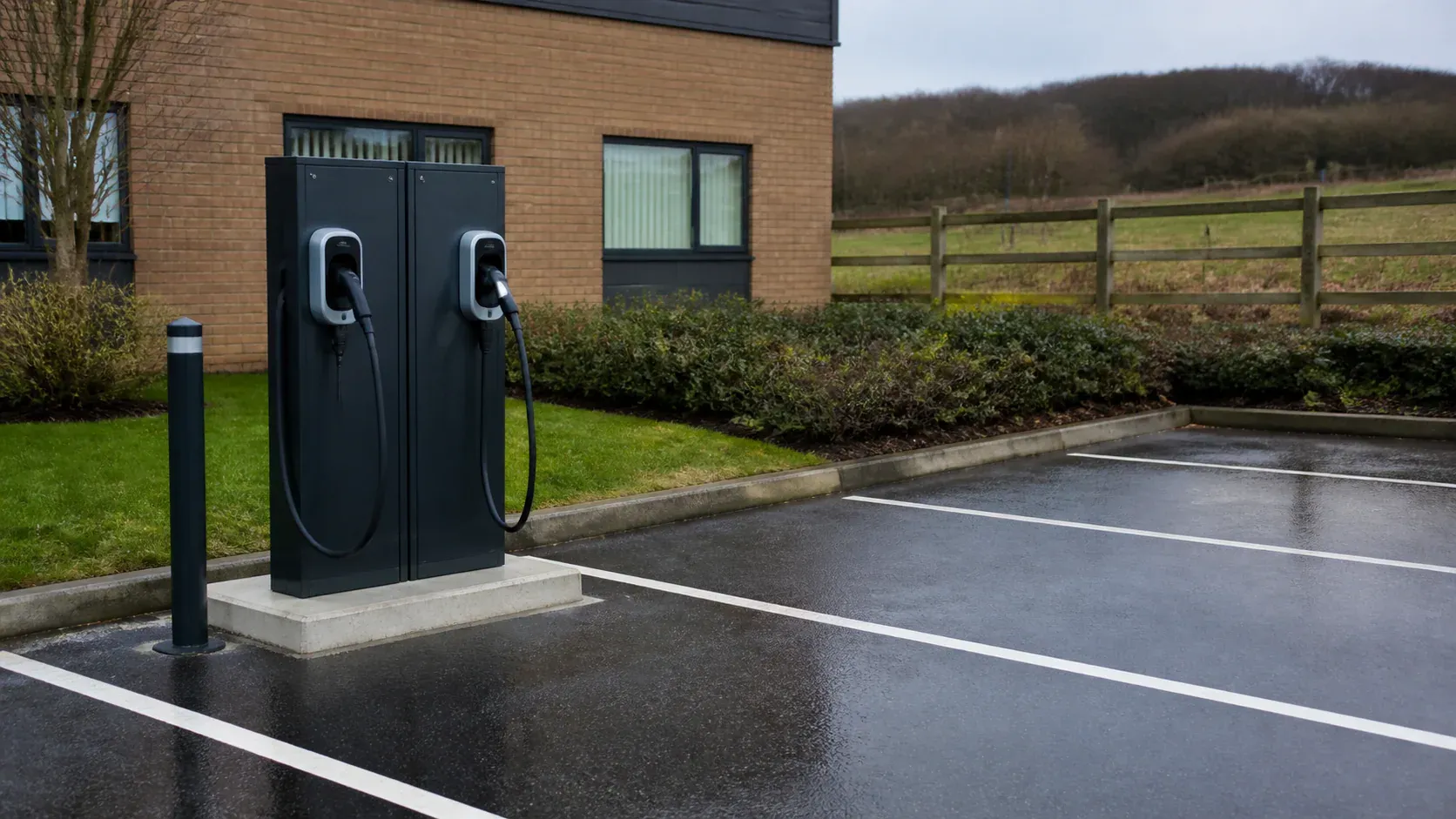
In this article
For an EV charging pedestal, the best foundation is the approved support that matches the charger post, site and cable route. A concrete footing is a familiar permanent solution. A compatible proprietary precast foundation can simplify installation. An engineered screw foundation can be especially attractive where it reduces concrete, excavation and disruption, provided the charger supplier and designer accept the complete system.
The pedestal may look like a simple metal post, but its foundation also has to coordinate fixings, underground cables, finished paving and the way people use the parking space. Our EV charging pedestal base service installs the agreed groundwork ready for the appointed charging installer.
Why a charger needs more than a convenient fixing point
The weight of the charger is only part of the problem. The post has height, the cable is handled repeatedly and the installation sits in an exposed working environment. Its stability and anchoring need to suit the actual equipment.
The surface can be misleading. Tarmac, block paving or a patio stone might look firm but may not provide the structural anchorage the pedestal requires. The foundation underneath and the connection to it are what matter.
ChargePoint’s pedestal installation instructions specify concrete requirements for the covered product. Other products use different systems. That is why the chosen pedestal’s manual should be available before a base is priced, and why dimensions from another charger should not be copied.
It is also worth distinguishing the charger from protective equipment. A foundation designed to keep a post upright is not necessarily designed to stop a vehicle. Any required impact protection needs its own coordinated design and position.
Comparing the options
| Foundation | Strengths | Limitations | Useful situation |
|---|---|---|---|
| Cast-in-place concrete | Flexible geometry and coordinated anchor/cable detail | Excavation, curing and reinstatement | Permanent installations with an approved footing design |
| Precast concrete foundation | Defined geometry and fewer wet operations on site | Component handling and exact product compatibility | Repeated or supplier-matched installations |
| Engineered screw foundation | Can avoid concrete curing and reduce excavation | Ground assessment, installation access and interface approval | Compatible pedestal systems on suitable ground |
| Proprietary foundation box | Integrated cable space and potentially easier replacement | Must be accepted for the equipment and site | Packaged systems with an approved detail |
| Existing structural concrete | Avoids new foundation material | Assessment and suitable anchor positions required | A verified compatible slab |
Cast concrete: adaptable and widely understood
A concrete base can be formed for the selected post and its fixing pattern. Cable ducts can be brought to the correct location and the top coordinated with the final parking surface.
This adaptability is useful where the site has unusual levels or the pedestal needs a particular bolt cage. It also allows a clear inspection point before the post is installed: the foundation geometry, ducts and fixing positions can be checked against the drawing.
The downside is the construction sequence. The excavation has to be prepared, concrete placed and allowed to reach the required readiness before the equipment and anchors are loaded. In a busy parking area, barriers and temporary access arrangements may be needed while the work is incomplete.
Avoid making the exposed top unnecessarily prominent. A large raised block can interfere with walking routes or the use of the charging cable. The installer and site designer should agree the finished level and any protection detail rather than treating appearance as an afterthought.
Concrete is also not a substitute for checking buried services. A small footing can still clash with existing ducts or drains, and a new cable trench can affect the ground beside it. Plan the foundation and trench together.
Precast concrete and proprietary boxes
A matching precast foundation can provide a predictable connection for a particular pedestal. It may reduce the amount of wet work and allow the installer to work with a defined component rather than setting individual anchors on site.
Its suitability depends on the whole detail: the correct product, prepared support beneath it, orientation, depth and cable entries. A precast block that nearly matches the post is not equivalent to the specified component.
Handling is another consideration. A factory-made foundation still has to reach the installation point. Access for delivery and positioning can decide whether it is genuinely simpler than a small on-site pour.
There are also proprietary foundation boxes. PLP’s EV charging foundation is an example of a manufactured system with a top plate and cable access intended for compatible chargers. Its existence shows that concrete is not the only engineered approach, but it does not establish that any box or post combination is acceptable in a UK project.
Ask the charging supplier which systems it accepts and who confirms the site-specific suitability. Product claims should be assessed for the actual installation, rather than adopted as a universal performance promise.
Why engineered screw foundations deserve consideration
This is an equipment application where screw foundations can offer a meaningful alternative. A suitable system can reduce concrete use, avoid a curing stage and concentrate ground disturbance around the actual support.
CHANCE’s EV infrastructure guidance describes engineered helical foundation products for charging installations. These are specialist systems with equipment interfaces and installation requirements. They demonstrate a legitimate option; they should not be confused with an unspecified screw intended for a light garden structure.
We favour ground screw foundations where the complete arrangement suits the charger and ground. The benefits may be particularly useful when a parking layout needs a relatively small intervention or where future removal is relevant.
The limitations need equal attention. Buried services can constrain placement, unsuitable ground can change the design and the post adapter must match the approved pedestal. Installation equipment also needs enough room to operate. A small visible foundation does not mean no planning is required below ground.
Environmental claims should include the steel, adapter, installation and any surrounding works. A screw system may reduce concrete and spoil substantially, but the comparison should be made against the actual concrete alternative. We do not assume a universal carbon percentage.
Can existing paving or concrete be reused?
Existing structural concrete may be usable after assessment. That can be an efficient option because it avoids new excavation and materials. The installer needs to confirm the slab condition, anchor arrangement and proximity to edges or joints.
Ordinary paving is different. Paving-slab bases can create a useful walking or parking finish, but individual slabs should not automatically be treated as the structural foundation for a tall charging post. The pedestal may need its own footing through or beneath that surface.
Block paving also needs careful reinstatement around a new base. Poorly compacted trench backfill or an awkward cut around the post can lead to settlement and ponding. Include the finished surface in the quotation, rather than stopping the scope at the top of the concrete.
If the charger replaces an older unit, check the new fixing pattern. A reused foundation might be suitable with an approved adapter, or it may need modification. Do not drill additional holes simply because the post can be made to fit visually.
Position the charger around real use
Before construction, consider how the car will park and where its charging inlet is likely to be. Then consider another vehicle with a different inlet position. A workable cable route matters more than centring the pedestal neatly against a bay line.
Avoid creating unnecessary cable crossings over walking routes. The charging installer and site designer should consider reach, storage and pedestrian access together. At shared or public facilities, the complete accessibility requirements should be assessed for the project.
Think about the user standing at the post, opening vehicle doors and returning the cable. A base can be structurally correct while its location makes everyday use awkward. Marking the position on the ground and trying the parking manoeuvre can expose that problem before excavation.
Any bollards or wheel stops should be coordinated with those movements. Protection placed too close to the pedestal can make the charging controls difficult to reach or obstruct maintenance panels.
Cable ducts need the electrician’s input
The base contractor should obtain the electrical team’s duct and entry detail before construction. Ducts need to emerge where the pedestal accepts them and remain compatible with the proposed cable route.
Do not assume a central opening is always right. A pedestal may have internal obstructions, a particular foundation adapter or separate routes for different services. An early drawing check is less expensive than altering concrete or a manufactured foundation later.
Consider future replacement, too. Accessible cable entries and an identifiable route can make upgrades easier. Spare ducts may be useful where the electrical designer recommends them, but their inclusion should be deliberate rather than a guess at future needs.
Electrical protection, earthing and commissioning remain with the competent charging installer. A screw or steel frame should not be treated as an electrical solution by default. Structural and electrical requirements need to be coordinated by the appropriate specialists.
Drainage and the final finish
The charger’s required level and the surrounding surface should be planned together. Water should not collect around access panels or create an inconvenient puddle where the user stands.
Look at existing falls across the parking area. A new raised plinth or poorly reinstated trench can redirect runoff. The foundation contractor should understand the final paving level before setting the base, especially if resurfacing is planned later.
Keep access covers and fixing points available for maintenance. A decorative finish that traps a removable panel or conceals the anchor connection can make later repairs unnecessarily disruptive.
Photograph the duct route before it is covered and retain the foundation detail. That information is useful when another charger is added or when nearby landscaping is changed. It also reduces the temptation to guess where buried infrastructure lies.
Comparing quotations fairly
Ask for a completed pedestal-ready foundation, including preparation, spoil handling, ducts, anchors or adapters and reinstatement. Compare the same equipment and site assumptions across concrete, precast and screw proposals.
For a proprietary system, confirm the exact product and acceptance by the charger supplier. For screws, clarify ground assessment and what happens if the proposed positions encounter an obstruction. For concrete, include the curing and handover programme.
You can begin with the charger make, a photo of the parking area and a rough indication of the cable route. We can discuss the options while your electrical installer finalises the details. Request a written EV pedestal base quotation to establish a clear groundwork scope.
Frequently asked questions
Are screw foundations suitable for EV chargers?
Yes, engineered systems exist for compatible pedestals and suitable ground. The charger supplier and designer must accept the actual foundation, adapter and installation. A generic garden screw is not automatically equivalent.
Can the pedestal be bolted to my driveway?
Only if the supporting construction and anchors are suitable. Tarmac or individual paving blocks are not the same as a verified structural concrete foundation. The installer should assess what lies beneath the surface.
Does the base protect the charger from vehicles?
Not necessarily. Structural support and vehicle-impact protection are separate design questions. Any bollards, barriers or wheel stops should be selected and positioned as part of the complete parking layout.
Does JustBases wire the charger?
Our standard scope is the agreed foundation and associated groundwork. Electrical installation, protection, testing and commissioning belong to the appointed competent charging installer.
More advice for your project
What is the best base for a heating oil tank?
Compare concrete and properly constructed paved oil-tank bases, with advice on continuous support, replacement access and avoiding unsuitable frames.
What is the best base for an air source heat pump?
Compare concrete, paving and approved ground-screw frames for heat pumps, with practical advice on vibration, airflow, defrost water and installation.
What is the best base for an outdoor air conditioning unit?
Compare concrete pads, prepared slabs, brackets and approved screw-supported frames for air conditioning condensers, including noise and access.