The JustBases advice journal
What type of base is best for parking a motorhome?
Compare concrete, vehicle-rated paving, gravel and reinforced grids for motorhome parking, including axle loads, turning, rear overhang and drainage.
By JustBases 11 min read
Explore the installation service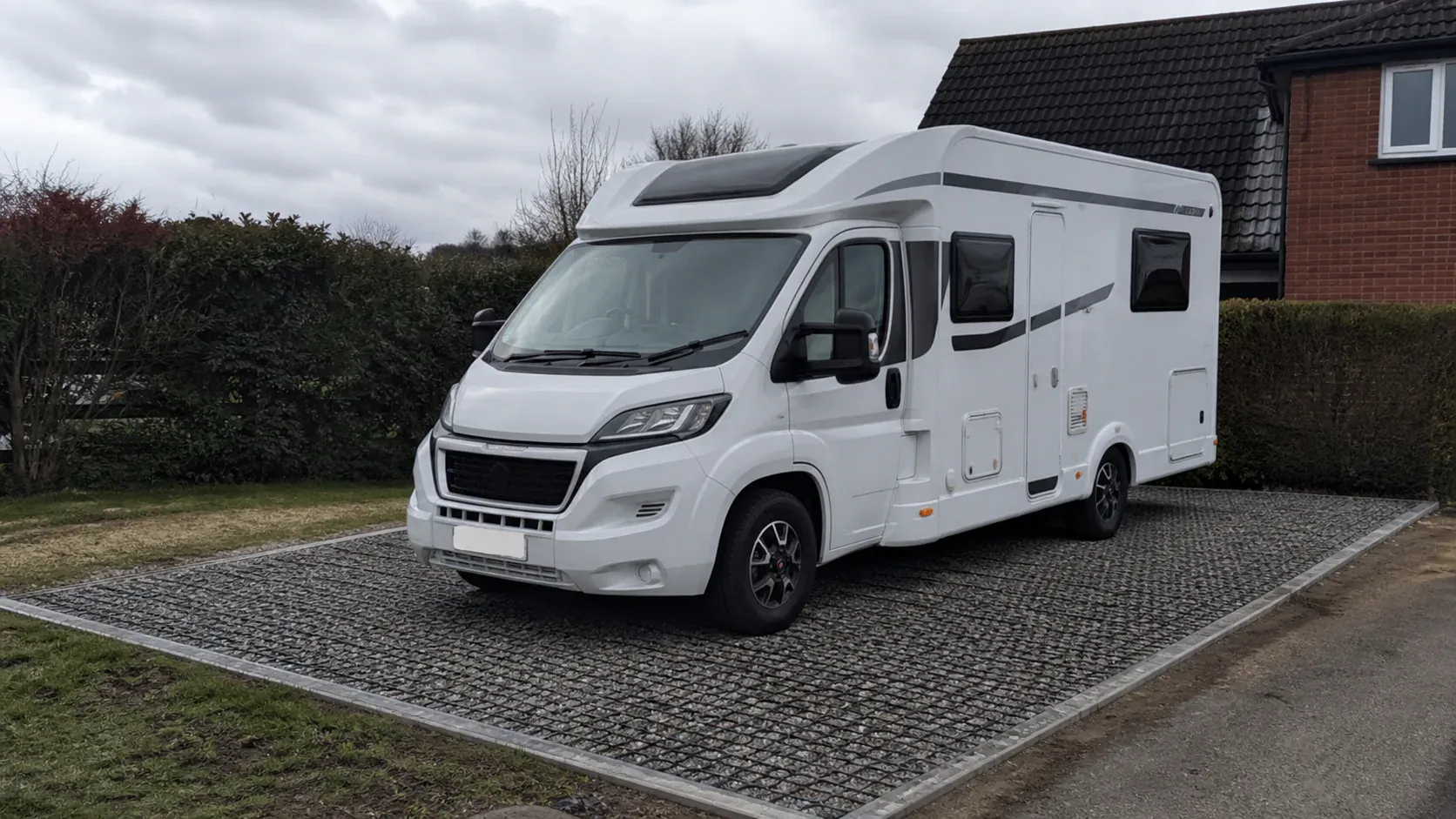
In this article
Parking a motorhome at home can be wonderfully convenient. You can load it without a separate trip to storage and set off when you are ready. The base needs more thought than simply widening a path, though: a motorhome brings substantial axle loads, a long body and a manoeuvre that may be quite different from your car’s.
For many sites, a correctly designed permeable paved or reinforced-gravel hardstanding is a good starting comparison. Concrete can be a practical choice for a durable permanent surface where drainage is properly managed. The best answer depends on the actual vehicle, ground and route into the space.
Our preference for ground screws applies to compatible supported structures. Motorhome parking is a vehicle-surface job, so we compare appropriate hardstanding systems through our motorhome parking-base service rather than suggesting ordinary screws and decking beneath the tyres.
Design for the vehicle you own
The total weight is useful, but the way that weight reaches the ground matters too. Axle loading, wheel positions and the time the vehicle spends parked in one spot all influence the foundation question. The vehicle’s own information is more useful than a guess based on its appearance.
Think about its normal parked condition. Water, equipment and belongings can change what the base needs to carry. You do not need to calculate a pavement design yourself; share the vehicle details so the appropriate construction can be assessed.
The physical envelope is just as important. Mirrors, the rear body, lockers and door opening need room beyond the tyre tracks. A photograph of an empty rectangular space can make a pitch look generous until the vehicle is actually in it.
If a different motorhome is likely in the next few years, mention that. We can discuss whether the layout should allow a reasonable degree of flexibility. It is usually easier to consider that while setting the edges than after a new wall or drain has fixed the available space.
Compare the surfaces and what lies beneath them
| Surface | Main benefit | Main limitation | Good reason to choose it |
|---|---|---|---|
| Vehicle-rated permeable paving | Defined finish with a designed water path | Needs the correct full construction and maintenance | A practical extension to a residential drive |
| Reinforced gravel grid | Retains gravel and can create a permeable surface | Grid rating alone does not prove the completed base | A less formal parking area with suitable preparation |
| Prepared loose gravel | Can be adaptable and relatively unobtrusive | Migration, rutting and tight turns can be inconvenient | Straightforward access with an appropriate construction |
| Concrete hardstanding | Durable continuous support and straightforward manoeuvring | Runoff, curing and permanence need attention | Regular use and a justified permanent surface |
| Designed wheel tracks | Can reduce full-area hard surfacing | Limited tolerance for changed wheel paths | A predictable straight parking arrangement |
Vehicle-rated paving: often a good all-round option
Paved bases can create a parking area that feels like a considered part of the property. You can coordinate it with paths and existing driveway edges while providing a stable surface for access to the motorhome.
The qualification is important: ordinary patio paving is not automatically suitable. The paving product, bedding, sub-base and edge restraints need to be selected for the actual vehicle and site. A familiar driveway product should still be checked against its intended loading conditions.
Marshalls’ driveway technical information sets out product-use limits, edge-restraint requirements and runoff considerations. Its guidance is a useful reminder that choosing a paving style is only one part of choosing a complete construction.
Permeable paving can be especially attractive where rainfall needs managing within the site. Water passes through the designed surface arrangement into an appropriate build-up below. Ordinary blocks laid with standard materials do not become a permeable system simply because small gaps are visible.
The maintenance commitment is manageable but real. The surface and joints need care in accordance with the chosen system so their intended function is preserved. If an area settles, investigate the cause rather than repeatedly topping it up around the same wheel position.
Reinforced gravel grids: more than a plastic top layer
Gravel stabilisation grids can help retain aggregate and provide a firmer-feeling surface than loose stone alone. They can suit a garden-adjacent parking area where a softer visual appearance is preferred to a broad paved or concrete surface.
The grid still depends on suitable ground preparation. The complete system includes its foundation layers, filling material, edges and drainage. A headline load rating for the grid is not a guarantee that it will work when placed over whatever soil happens to be present.
Nidagravel’s installation guidance describes preparing the ground and sub-base as part of its system. That distinction matters when comparing prices: a grid-only supply price is not the cost of a completed motorhome hardstanding.
Think about steering as well as standing. Repeated tight turns can put different demands on a surface from a straight approach. The entry and turning areas may need particular attention rather than giving every part of the pitch the same assumed use.
Grids are also not maintenance-free. Aggregate can need attention and the surface must remain appropriate for the system. They may nevertheless provide a practical balance of appearance, drainage and usability when the vehicle and ground suit the design.
Loose gravel: useful in the right layout
A properly constructed gravel hardstanding can be a sensible option where the approach is straightforward and the site suits a permeable finish. It can be relatively adaptable if the parking layout changes, and it often sits comfortably beside planting.
The disadvantages become clearer during everyday use. Loose stones can move into paths or the road, wheels may disturb the surface when turning, and small trolley wheels or mobility aids can find some gravel finishes awkward. The best choice is about the whole routine around the vehicle.
A deep layer of decorative gravel should not be used to disguise weak ground preparation. The structural build-up beneath the finish is what limits rutting and settlement. Persistent low spots under an axle call for attention to the cause, not simply another layer of stone.
Consider a combination if it genuinely helps: an appropriate parking surface and a firmer pedestrian strip alongside the habitation door, for example. The transition needs to be level and stable enough for everyday use without creating an awkward lip at the point you step out.
For a narrow drive with frequent steering corrections, a different finish may be more convenient. There is no need to force gravel into a layout that makes ownership harder just because it initially appears less expensive.
Concrete: practical for a permanent parking base
A concrete hardstanding provides a continuous surface that can be convenient for regular manoeuvring, loading and walking around the vehicle. It may be appropriate where a robust permanent base is wanted and the drainage arrangement is suitable.
The slab should be designed for the motorhome and ground. Generic garden-base advice cannot supply the necessary specification. Loading, preparation, joints, edges and the interface with any existing drive all need to work as a complete construction.
Concrete involves excavation, handling materials and waiting before vehicle use. Access can affect the work significantly, particularly where the parking area is behind a property or reached through a narrow opening. The quotation should make that preparation and handling clear.
Its greater permanence can be an advantage or a drawback. A defined parking pad may serve for years, but changes to services or layout can require cutting or breaking out. If you expect future alterations, consider them before the surface is finished.
Runoff is a central part of the decision. Ordinary impermeable concrete does not manage rain simply by being level and strong. The finished falls and drainage destination must be planned, with the appropriate approvals and site constraints considered.
Wheel tracks can save material, but reduce flexibility
Two designed tracks may suit a predictable straight approach and parking position. They can reduce the area of continuous hard surfacing while leaving another finish between them.
The drawback is that the tyres do not always follow exactly the same path. Steering into a confined drive, correcting the final position or changing vehicles can place loads outside the tracks. A layout designed only around the final parked wheel positions may fail to support the approach.
People also need somewhere dependable to walk. The habitation door, lockers and any rear storage area should not open over muddy ground simply because the tyres have a firm strip beneath them. Consider the practical use of the whole space.
If tracks are proposed, ask how their edges and the adjacent surface will perform. They need a deliberate design, not leftover paving laid in approximate lines. The potential material saving is useful only if the resulting base still does the job comfortably.
Check rear overhang and entry transitions
A motorhome’s rear body can extend a long way behind its rear axle. That affects clearance when entering a sloping drive or passing near a boundary. A surface that carries the wheels may still leave the vehicle vulnerable to an awkward transition.
The route through the entrance deserves attention before the parking pad is built. Gate posts, walls and the turn from the road can constrain the manoeuvre. A generous final bay does not compensate for an entrance the vehicle cannot use comfortably.
Discuss finished gradients and transitions with the actual vehicle in mind. Do not assume the parking area should be perfectly flat in every direction; water still needs managing. Equally, creating an unnecessary steep change simply to shed water can make access unpleasant.
A new or changed dropped kerb is a separate matter from constructing the hardstanding. Check the relevant highway and property requirements before committing to an access arrangement. This avoids building an attractive parking space around an assumption that has not been confirmed.
Drainage is part of the structure
Permeable surfacing needs an appropriate route for water through and beyond its construction. Ground conditions may require a particular drainage arrangement rather than simple infiltration. A surface described as permeable is not proof that the whole site can absorb water without difficulty.
For front gardens in England, government guidance on permeable surfacing explains the relationship between hard surfacing, runoff and planning considerations. Use the relevant details for your property rather than a blanket claim that all driveways need, or avoid, permission.
Existing drainage covers and buried services should be considered before the wheel route is fixed. Cover suitability and access can change when a pedestrian area becomes vehicle parking. The responsible installer should confirm the appropriate arrangement.
Remember where rain will go when the vehicle occupies much of the pitch. The base should function in normal use, with the motorhome parked, rather than only as an empty area immediately after installation.
Plan the small conveniences while the ground is open
If a power supply is intended, have a qualified electrician agree the route and requirements before an appropriate duct is installed. The groundwork can make a later connection easier, but it does not replace electrical design or certification.
Think about the side from which you load the motorhome and where you open lockers. A modest increase in usable space at one point may be more valuable than widening the entire pad. This is why photographs and a description of your routine help us quote intelligently.
Do not assume that a parking quotation includes washing or waste-disposal facilities. Those need a clear, appropriate scope and drainage arrangements. If you want them, raise the intention early so the right specialists can be involved.
For a future shelter, our carport foundation service can assess the separate structural supports. Ground screws may be useful for an approved shelter design even though the parking surface beneath needs a different construction.
Compare complete costs and avoid unnecessary work
Our price guides are useful background, but motorhome parking should be quoted for the vehicle and site. The written scope should identify preparation, disposal, surface construction, edge restraints, drainage and any agreed ducts or alterations.
A low price for the finish alone can be misleading when most of the work is below it. Equally, replacing a sound suitable drive just to change its appearance may involve more material than the practical parking requirement warrants.
For sustainability, consider retaining useful construction, using an appropriate permeable system and limiting new hard surfacing to a sensible footprint. Ground screws are not the default under a traffic surface. The environmentally sensible answer is the complete, durable system that meets the actual use without unnecessary rebuilding.
Frequently asked questions
Is an existing car driveway strong enough for a motorhome?
Possibly, but it should be assessed against the actual motorhome loading and construction. Its surface appearance does not reveal everything about the preparation beneath it. Share the vehicle details and any information about the existing drive.
Can a reinforced gravel grid carry a heavy motorhome?
Some systems may be suitable when their complete construction is specified for the vehicle and ground. The grid’s headline rating alone is insufficient. Sub-base, fill, edges, drainage and manoeuvring all need consideration.
Does the parking pad have to be perfectly level?
It should support practical parking and access while managing water appropriately. The finished gradients and transitions need to suit the vehicle and site. Avoid choosing levels from a generic rule without considering both drainage and clearance.
Can I request a quote before deciding on the surface?
Yes. Start with your vehicle, the proposed parking area and photographs of the approach. We can discuss concrete, paving and gravel-based options and explain which ones are worth taking forward.
Make home parking work for your motorhome
Use our written-quote form to share the vehicle and location. We will discuss the motorhome parking-base options and help you plan a surface that works for arriving, parking, loading and setting off again.
More advice for your project
What Is the Best Base for a Park Home, Static Caravan or Lodge?
Compare concrete rafts, strips, engineered ground screws and chassis supports for park homes, static caravans and lodges, including siting, services and warranties.
What type of base is best for a caravan hardstanding?
Compare gravel, reinforced grids, concrete and vehicle-rated paving for a touring caravan pitch, including jockey-wheel support, manoeuvring and drainage.
What type of base is best for a shepherd hut?
Compare ground screws, concrete pads, paving and hardstandings for shepherd huts, with clear advice on wheels, chassis supports, slopes and practical access.