The JustBases advice journal
What is the best foundation for a rainwater harvesting tank?
Compare above-ground concrete and granular tank bases with underground bedding, backfill and restraint, including access and groundwater considerations.
By JustBases 9 min read
Explore the installation service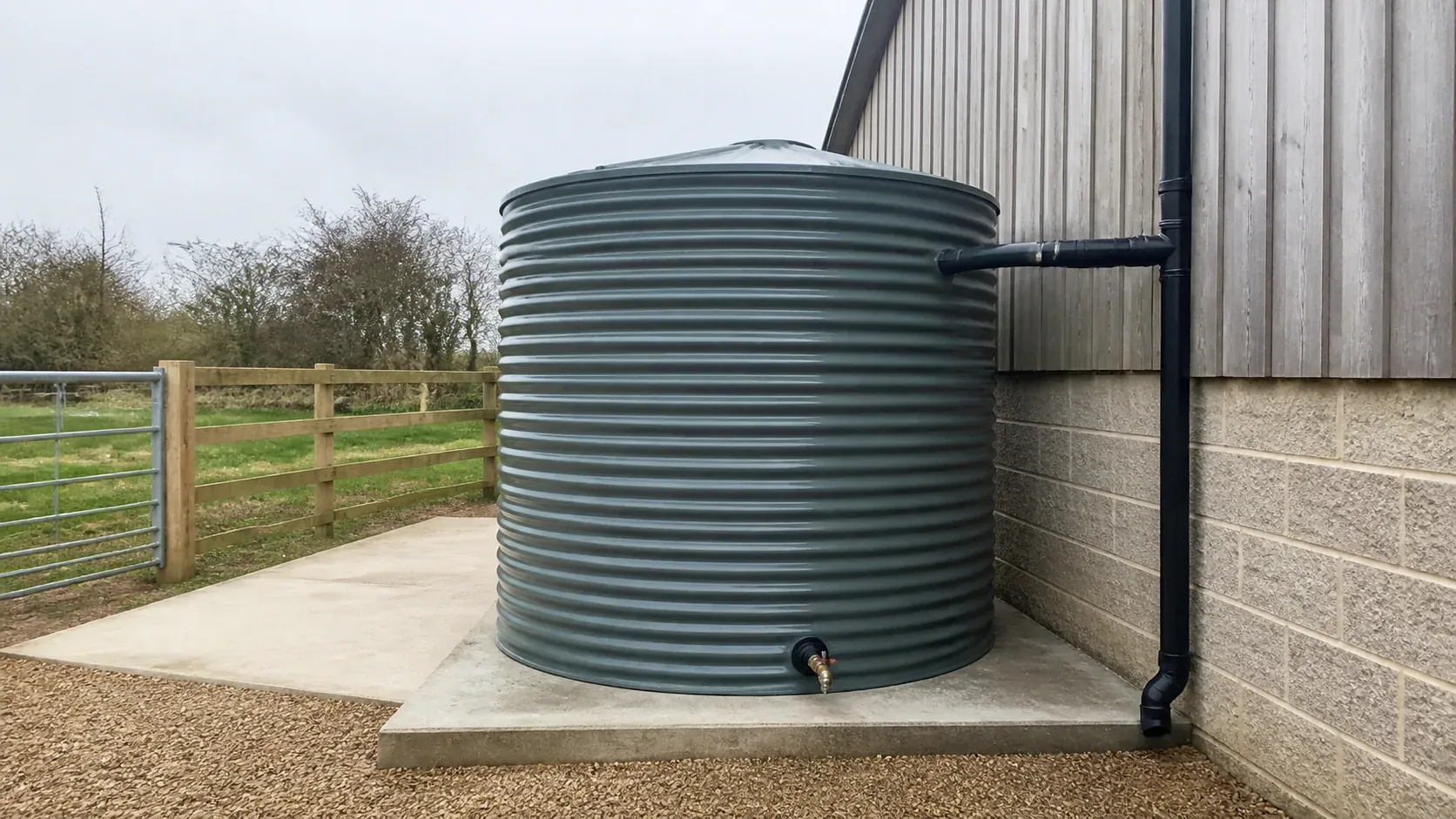
In this article
The best foundation for a rainwater harvesting tank depends first on whether the tank sits above ground or is buried. An above-ground tank may require continuous concrete or an approved granular support. An underground tank needs its manufacturer’s complete bedding and backfill arrangement, with ground conditions, groundwater and surface loading considered together. These are different projects, even when they store the same amount of water.
Ground screws can be useful for compatible surrounding structures or an approved equipment platform, but they do not replace the continuous support or buried installation detail a tank requires. Our rainwater harvester foundation service begins with the selected tank and the site, then builds the agreed support.
Start with the tank, not the hole
It is tempting to prepare a space before choosing the tank. That can create avoidable problems. A tank’s outside size does not reveal its support requirements, installation depth, access arrangement or permissible surrounding loads.
Choose the system with the rainwater specialist, including the intended use, pump arrangement and overflow destination. The foundation then supports that system. A garden-watering tank beside a shed and a buried tank supplying a building may have very different pipe levels and access needs.
GRAF’s Carat installation manual asks for ground suitability, maximum groundwater and expected loads to be considered before installation. It illustrates why a buried tank must be designed as an installation in the ground, rather than treated as an empty container lowered onto a convenient surface.
Do not borrow dimensions from another model’s instructions. Even tanks from one manufacturer can have different permitted conditions. The current manual for the actual product should accompany the groundwork quotation.
The main foundation arrangements
| Arrangement | Benefits | Limitations |
|---|---|---|
| Above-ground concrete slab | Continuous, durable support and a defined level | Concrete and excavation; must suit the tank bearing arrangement |
| Approved granular pad | Can avoid a concrete pour for compatible tanks | Material, compaction, containment and erosion need the supplier’s detail |
| Underground granular bedding and backfill | Suits tank systems designed for that installation | Groundwater, cover and traffic limits remain model-specific |
| Specified concrete bedding or surround | Can address particular approved ground or restraint requirements | Must not be substituted into a tank detail that prohibits it |
| Engineered restraint or ballast system | Addresses a defined uplift condition | Requires design for the tank and maximum groundwater |
Above-ground concrete bases
A concrete base is often a practical support for a permanent above-ground storage tank. It can provide a level bearing surface and a durable edge around which pipework and maintenance access are organised.
The useful question is how the tank transfers its load. Some tanks require support across their underside; others have defined support features. The supplier’s drawing should identify what the base must carry, rather than leaving the contractor to infer it from the tank’s appearance.
Concrete can make inspection and cleaning around the tank easier, but it needs proper ground preparation. The full tank is the relevant loading condition, and a pad should not be built on uncertain fill simply because the empty tank is light.
The disadvantages include material handling and the permanence of the slab. If a large tank may later move, consider that in the site plan. Concrete removal can become a separate project, while the original installation also needs time for the base to be ready before the tank is placed and filled.
Avoid extending the slab merely to create a large surrounding patio. A defined tank base with an appropriate separate access surface may use less material and be easier to adapt.
Granular pads for above-ground tanks
Some above-ground tanks can use a manufacturer-approved granular pad. This can avoid wet concrete work and may make preparation more manageable where access is difficult.
“Granular” does not mean any pile of sand or gravel. The material, preparation, dimensions and containment need to match the tank’s instructions. Sharp particles, uneven support or erosion at the edge may be unsuitable for a particular tank construction.
The finished pad also depends on the ground below it. Placing a neat layer over loose fill does not eliminate settlement. On a cut-and-fill site, the designer needs to understand both sides of the tank footprint rather than assume the surface tells the whole story.
Think about runoff from the start. Water escaping from a downpipe, overflow or adjacent paving should not wash away the support. The plumbing and base details must therefore be coordinated. A granular pad can be a sensible lower-concrete option where the tank supplier accepts the complete arrangement, but not a universal cheap alternative.
Underground bedding and backfill work together
For a buried tank, support comes from a system around the vessel as well as beneath it. Bedding establishes the tank position; the specified backfill and installation sequence help provide the intended surrounding support.
GRAF’s underground installation guide discusses prepared bedding, backfill, water during installation and service routes. Its examples also distinguish ordinary conditions from situations that need a different accepted approach. Use that as a prompt to obtain the model-specific instructions, not as a generic recipe for all buried tanks.
A contractor should not replace the specified material simply because another aggregate is already on site. Nor should “more concrete” automatically be assumed safer. Some tank systems have particular restrictions, and changing the surround changes the installation.
The correct sequence matters too. The tank supplier’s procedure may coordinate filling and backfilling to manage loads during construction. This article is a comparison guide, not a set of excavation or tank-placement instructions. The appointed installer should plan and carry out the operation safely.
Groundwater and the empty-tank condition
A tank normally makes us think about weight pressing down. Underground, water outside the tank can create an upward force, particularly when the tank is empty or partly empty. The design needs to address the relevant conditions, not just the full tank sitting in a dry excavation.
Ask the installer how maximum groundwater has been considered and what the selected tank permits. Depending on the product and site, the accepted detail may involve particular installation limits, restraint, ballast, drainage or a different tank choice.
Do not infer groundwater conditions from one dry afternoon. Seasonal conditions and the behaviour of the surrounding ground matter. If information is uncertain, the project team should identify the appropriate investigation before finalising the installation.
The same care applies to a tank on a slope or near a structure. Soil pressure and nearby loading may affect the design. A larger excavation or an improvised concrete collar should not be used as a substitute for the supplier’s approved response.
Covers, vehicles and future landscaping
A tank in a lawn and a tank beneath a driveway are not equivalent installations. The tank, cover, surrounding construction and load transfer must be accepted for the intended use.
Choose the surface use early. A pedestrian cover should not later become part of a parking bay because the landscaping changes. Equally, a strong-looking access lid does not establish that the tank installation below it can accept vehicles.
Keep construction traffic in the plan. The final area may be a lawn, but machinery could cross it while other work is completed. The installer should define any temporary restrictions and protection needed until the site is finished.
For maintenance, consider where someone will stand to inspect filters or remove a pump. Do not hide the access beneath permanent decking or a fixed planter. A discreet installation can still have a clear and practical service route.
Ground screws and the environmental question
Ground screw foundations can reduce concrete and excavation for suitable framed structures, which is why we prefer them where the design allows. A water tank requires a more specific assessment.
A screw-supported frame would need to support the actual tank exactly as its manufacturer requires, with the full load and stability addressed. It should not be assumed suitable for an above-ground tank that expects continuous ground support. For a buried tank, screws are not a replacement for its bedding and surrounding installation.
There can still be useful applications nearby. An approved pump shelter or lightweight service structure might use a timber-frame base supported on screws while the tank uses its own specified foundation. Those structures should remain compatible with tank access and pipework.
A responsible environmental comparison considers the whole rainwater project: tank manufacture, foundation material, excavation, transport, pumping and eventual maintenance. Where a tank accepts a sound granular installation, avoiding unnecessary concrete may be worthwhile. Where concrete or restraint is required, omitting it is not a sustainability improvement.
Pipes, overflow and levels
The tank’s foundation level affects incoming pipes, overflow and the final access height. These should be coordinated before excavation or pouring, particularly when gravity pipe routes are involved.
Ask the system designer to confirm the inlet and overflow arrangement and the destination of excess water. A well-supported tank that cannot connect at the required level will still need expensive alterations.
Service ducts should be planned with the pump and controls. Their route must remain usable after backfilling, and access should not depend on dismantling unrelated structures. Recording concealed routes is useful for future repairs.
For above-ground tanks, remember that pipework should suit the installation’s potential movement and maintenance needs. The rainwater specialist should provide the connection detail rather than allowing the tank to act as a support for loosely planned external pipes.
A quotation that covers the actual installation
Compare quotes for the same tank, ground assumptions and surface use. Separate a simple above-ground slab from a buried installation that includes excavation, support, backfill and reinstatement. They cannot be compared sensibly by footprint alone.
Ask what is included for groundwater management, lifting, spoil, access covers, ducts and pipe groundwork. Confirm who supplies and installs the tank, pump and controls, and who tests the completed system.
You can enquire before all these decisions are final. Tell us whether the tank will be above or below ground, what it will supply and where it is proposed. A photo and the product link are useful starting points. Request a written foundation quotation and we can help coordinate the support detail with your rainwater installer.
Frequently asked questions
Does every rainwater tank need concrete?
No. Some above-ground and underground tanks accept particular granular support arrangements. Others require concrete or additional restraint in specified conditions. Follow the selected tank’s current instructions and the site design.
Can I place a large tank on ordinary paving?
Only if the tank manufacturer and installer approve the complete support arrangement. A paved surface suitable for walking is not automatically suitable for a full tank and its bearing requirements.
Can an underground tank float?
Groundwater can create uplift, particularly when the tank is empty. The installation designer must consider maximum groundwater and the product’s permitted conditions, including any required restraint or ballast.
Can JustBases start with a basic enquiry?
Yes. You do not need a completed design to speak to us. We can discuss the location and intended tank, then identify what the supplier needs to confirm before the foundation work is finally priced.
More advice for your project
What is the best base for a heating oil tank?
Compare concrete and properly constructed paved oil-tank bases, with advice on continuous support, replacement access and avoiding unsuitable frames.
What is the best base for an air source heat pump?
Compare concrete, paving and approved ground-screw frames for heat pumps, with practical advice on vibration, airflow, defrost water and installation.
What is the best base for an outdoor air conditioning unit?
Compare concrete pads, prepared slabs, brackets and approved screw-supported frames for air conditioning condensers, including noise and access.