The JustBases advice journal
What is the best foundation for a septic tank?
Compare septic-tank bedding, concrete bases and surrounds, with practical advice on groundwater, covers, access and choosing the correct system detail.
By JustBases 9 min read
Explore the installation service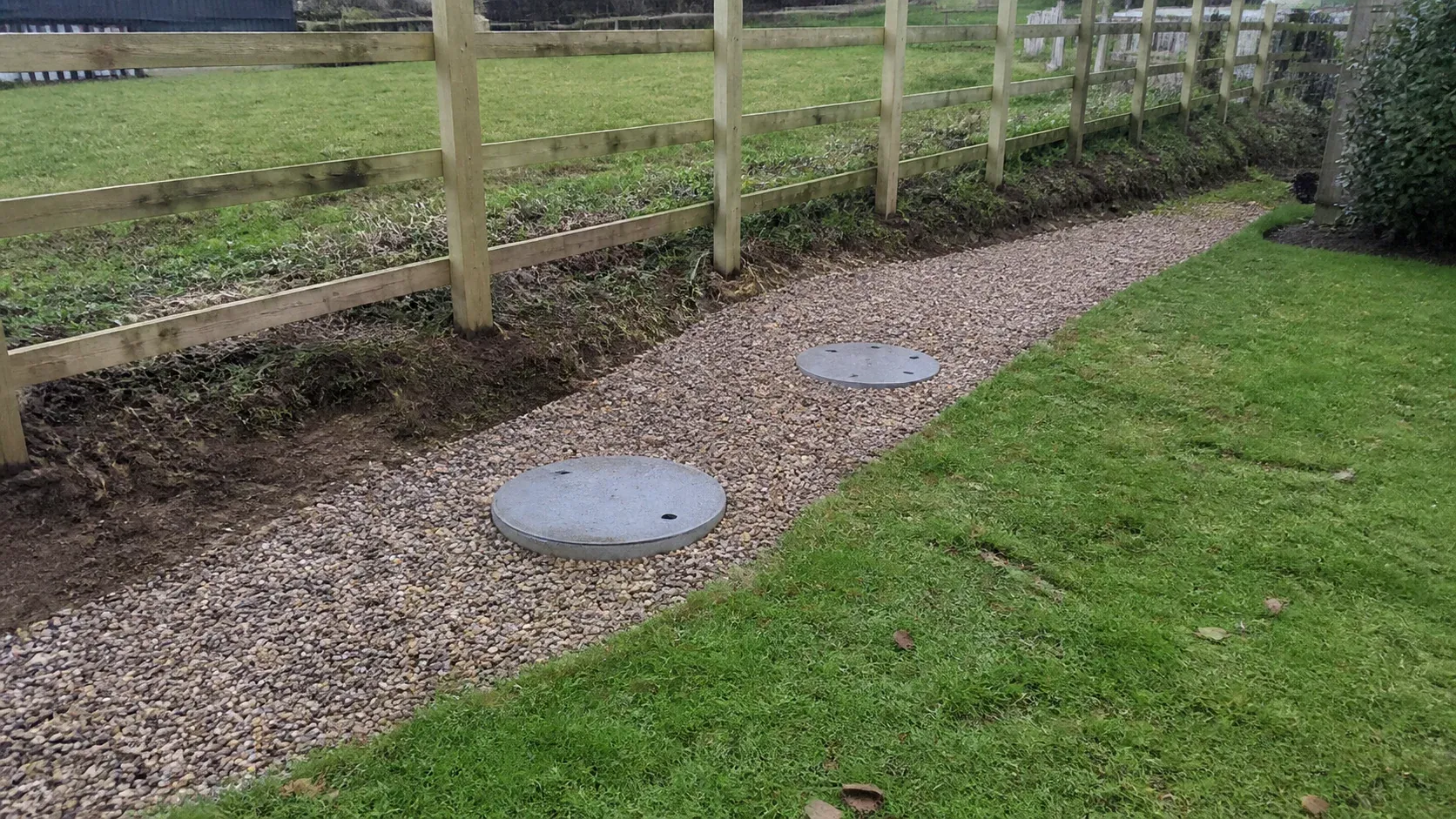
In this article
The best foundation for a septic tank is the bedding, support and surrounding installation specified for that exact tank and site. Depending on the product and conditions, this may involve an approved granular bed, concrete base, concrete surround or designed restraint. It is not a choice between a few interchangeable garden-base materials, and ground screws do not replace the support system a buried tank requires.
Start by confirming what system is being installed. People sometimes use “septic tank” to mean a sewage treatment plant or a cesspool, but these are different products with different operating and installation requirements. Our septic tank foundation service works from the selected manufacturer’s detail and the drainage designer’s agreed layout.
Foundation design and drainage design are separate decisions
A tank can be perfectly supported and still be part of an unsuitable wastewater proposal. The treatment system, discharge route and regulatory position need to be established by the appropriate drainage specialist before permanent groundwork fixes the layout.
GOV.UK’s septic-tank and treatment-plant guidance explains that the applicable requirements depend on matters including the discharge destination and whether the discharge is new or existing. It also distinguishes cesspools and points to separate arrangements elsewhere in the UK. For a project in England, use the current guidance and obtain site-specific advice rather than assuming a foundation quotation covers discharge compliance.
The customer does not need to resolve all of that alone. A useful first enquiry can simply explain the property, proposed system and whether this is replacement or new work. The key is to involve the right specialist before construction, not to arrive with a complete technical dossier before asking for help.
What the tank foundation must achieve
The support has to keep the tank in its intended position and work with the surrounding ground. Below-ground installations can encounter loads from the tank contents, soil, surface use and groundwater.
Those loads do not always act in the same direction. A full tank presses down; groundwater outside an empty tank can create uplift. Backfill can also affect the tank walls during and after installation. The manufacturer’s complete arrangement addresses those conditions together.
This is why generic advice such as “put every tank on concrete” is unreliable. Concrete may be essential in one approved detail and inappropriate as an improvised substitute in another. The tank model, installation conditions and construction sequence govern the choice.
The main support arrangements compared
| Arrangement | Potential benefits | Important limitations |
|---|---|---|
| Specified granular bedding and backfill | Avoids unnecessary concrete where the tank is designed for it | Material and permitted site conditions are product-specific |
| Concrete base | Defined support and a possible part of a restraint design | Must suit the tank underside and installation sequence |
| Concrete surround | Can provide the support or restraint required by particular products | Placement must follow the supplier’s detail; more is not automatically better |
| Precast concrete tank on prepared support | Combines tank structure with a defined manufactured system | Heavy delivery and lifting; joints and foundation preparation matter |
| Engineered ballast or restraint | Addresses an identified uplift condition | Requires a designed connection to the tank, not improvised straps |
Granular bedding: useful where the manufacturer allows it
An approved granular installation can be an efficient way to support a compatible tank in suitable conditions. It may reduce concrete use and wet work, while providing the surrounding support intended by the product designer.
The material must be the specified material. “Gravel” covers a wide range of products, and the presence of sharp particles, unsuitable fines or voids can matter. The ground beneath the bedding also needs to provide the required support.
Do not assume that material already excavated from the hole is acceptable backfill. Nor should a contractor substitute whatever aggregate is left from a driveway project. Obtain the installation manual and price the stated arrangement.
For comparison, GRAF’s underground water-tank manual shows how a buried tank’s ground, groundwater and loading conditions are considered together. It is not a septic-tank specification; it illustrates why the exact wastewater product needs its own instructions.
A granular option is therefore a conditional design choice, not a universal budget shortcut. If the site falls outside the tank’s permitted conditions, the supplier must approve a different approach or product.
Concrete bases and surrounds
A concrete foundation may form part of the required installation, providing a defined base or surrounding support. Where specified, it should be built exactly as the approved detail intends.
The useful distinction is between a concrete base beneath the tank and concrete placed around it. They perform different roles, and the installation sequence may need to control the loads imposed on the vessel during construction.
It is not sensible to decide on a surround after the tank has been delivered because the hole appears wet. The designer should assess the ground conditions and the manufacturer should confirm the accepted arrangement before placement.
Concrete also affects cost and programme. It requires access, material handling and a coordinated sequence with tank installation. A quotation should identify who places the tank, who controls the installation process and how the foundation work is inspected.
Avoid universal dimensions from online discussions. A tank’s shape, construction and site conditions can change the requirements substantially. The correct thickness, reinforcement or restraint detail belongs in the supplier or engineer’s design, not in a generic advice article.
Precast concrete tanks are another complete system
A precast concrete tank can be an alternative to a plastic or composite vessel, but compare complete installations rather than tank material alone. The foundation beneath it still needs preparation, and delivery may require substantial lifting access.
The benefits may include a robust manufactured structure and a defined installation system. The limitations include handling weight, site access, joints and the need to coordinate the excavation with the lifting operation.
A narrow garden route or overhead obstruction may make this option less practical, even where the tank itself appears competitively priced. Conversely, an accessible site with a well-planned lift may suit it well.
Ask the drainage specialist to compare the whole system: tank, support, connections, covers, access and long-term servicing. The foundation contractor should then price the chosen arrangement without assuming one tank material is always the best fit.
Groundwater is a design condition, not a surprise to ignore
An empty buried tank surrounded by water can experience uplift. The installation designer needs to consider the maximum relevant groundwater condition and any restraint the manufacturer requires.
The right response may depend on the tank, site and installation limits. Do not improvise a hold-down strap, add random concrete or assume that the tank’s contents will always keep it in place. Maintenance and emptying are normal parts of use, so the empty condition matters.
Ask how groundwater information was established and what assumptions the quotation includes. If conditions are uncertain, the project team should identify the necessary investigation or contingency before work begins.
Excavation planning belongs with competent contractors. Deep holes, unstable sides and water create construction hazards that cannot be resolved by a general blog guide. The practical role of the customer is to appoint the right team and ensure the agreed installation detail is available.
Covers and surface loading
Decide what will happen above and around the tank. A lawn, pedestrian path and vehicle area can require different accepted arrangements. The cover rating alone does not establish the capacity of the complete tank installation.
If future landscaping may change, discuss it now. A tank installed in a garden should not later be placed under a new parking area without assessment. Similarly, temporary construction traffic should not cross it unless the installation has been designed or protected for that use.
The finished access height should coordinate with the final ground level. Burying a cover beneath landscaping or leaving an awkward projection can create maintenance difficulties. The drainage installer should confirm the required access arrangement before backfilling and reinstatement.
Keep enough working space for inspection and emptying. A discreet tank position is useful only if the service contractor can still reach and operate around it.
Pipe levels can determine the whole layout
The tank’s position and depth are closely tied to incoming and outgoing pipe levels. A foundation built at the wrong level can force changes elsewhere in the drainage system.
The drainage designer should confirm the layout before the excavation is set out. That includes connections, any pumping requirement and the intended discharge arrangement. The base contractor should work from those agreed levels rather than choosing a convenient depth on site.
Connections also need to tolerate the installation as designed. External pipework should not impose unintended loads on the tank, and penetrations should follow the manufacturer’s detail. Record the routes before they are covered so future work does not rely on memory.
For a replacement, assess how the existing system will be isolated and how the property will be served during the work. That sequence can influence the location and programme as much as the foundation itself.
Sustainability without compromising the tank
We favour ground screw foundations where suitable framed structures can use less concrete and less excavation. A buried septic tank is not that type of application. Its bedding, surrounding support and any uplift restraint cannot be replaced by an ordinary screw frame.
There are still responsible material choices. Use the specified granular option where it is accepted, avoid unnecessary concrete, coordinate excavation and deliveries, and select a system suited to the site so remedial work is less likely.
Do not reuse a questionable old tank foundation merely to avoid new material. Equally, do not demolish sound infrastructure without assessment. The drainage designer should identify what can safely remain and what needs replacement.
The environmental purpose of the wastewater system also depends on correct operation and maintenance. A foundation that preserves access and reliable connections supports that purpose more effectively than an unsupported claim about one construction material.
Getting a useful written price
Ask the quote to identify the tank model, drawing revision, ground assumptions and intended surface use. It should state the support and backfill included, excavation and spoil handling, lifting responsibilities, groundwater provisions and reinstatement.
Separate foundation construction from drainage design, tank supply, specialist installation and commissioning. Clear responsibility avoids gaps where one contractor assumes another is checking pipe levels or supplying restraint components.
You can contact us with basic project information while the drainage specialist develops the design. Request a septic-tank foundation quotation and share any product link, site photos or existing layout you have. We can then establish the groundwork scope around the approved system.
Frequently asked questions
Does every septic tank need a concrete surround?
No. It depends on the tank and installation conditions. Some systems permit specified granular arrangements; others require concrete or restraint. The current product manual and site design should decide.
Can ground screws support a buried septic tank?
They are not a substitute for its required bedding and surrounding installation. Any specialist restraint system must be designed for the tank; ordinary garden-building screws should not be offered as an alternative foundation.
Is a sewage treatment plant the same as a septic tank?
No. Confirm the actual system before obtaining a foundation price. Product installation details and the applicable discharge requirements must correspond to what is being installed.
Can the tank go beneath a driveway?
Only where the tank, cover and complete surrounding construction are approved for the intended vehicle loading. A strong lid alone does not establish that the installation below it is suitable.
More advice for your project
What is the best base for a heating oil tank?
Compare concrete and properly constructed paved oil-tank bases, with advice on continuous support, replacement access and avoiding unsuitable frames.
What is the best base for an air source heat pump?
Compare concrete, paving and approved ground-screw frames for heat pumps, with practical advice on vibration, airflow, defrost water and installation.
What is the best base for an outdoor air conditioning unit?
Compare concrete pads, prepared slabs, brackets and approved screw-supported frames for air conditioning condensers, including noise and access.